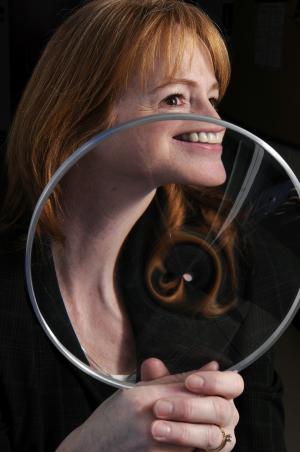



Scientists are harnessing the cosmos as a scientific “instrument” in their quest to determine the makeup of the universe.   Evalyn Gates calls from the University of Chicago calls it “Einstein’s telescope” but she actually means the phenomenon of gravitational lensing, which acts as a sort of natural telescope.

In general relativity, mass can warp space and create gravitational fields that bend light - confirmed in  by Arthur Eddington during a solar eclipse, when he saw that the light from stars that passed close to the sun was slightly bent, making them appear out of position.
During the next decade, some cosmologists say a delicate measurement of primordial light could reveal evidence for the cosmic inflation hypothesis, which proposes that a random, microscopic density fluctuation in the fabric of space gave birth to the universe in a hot big bang approximately 13.7 billion years ago - it also predicts the existence of an infinite number of universes.   The hypothesis was first proposed by Alan Guth of the Massachusetts Institute of Technology in 1979 but cosmologists currently have no way of testing this prediction.
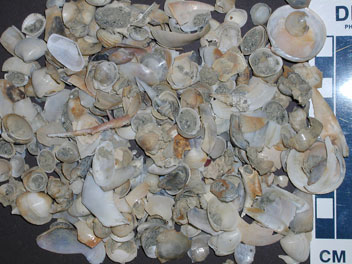
Paleontologists can still hear the echo of the death knell that drove the dinosaurs and many other organisms to extinction following an asteroid collision at the end of the Cretaceous Period 65 million years ago.

"The evolutionary legacy of the end-Cretaceous extinction is very much with us. In fact, it can be seen in virtually every marine community, every lagoon, every continental shelf in the world," said University of Chicago paleontologist David Jablonski. It is, he said, "sort of an echo of the big bang for evolutionary biology."

We hear a lot about 'going green' these days and it seems even the Universe can't endure one more moment of Al Gore putting his hands together, as if in prayer, and guilting us into investing in carbon trading companies, one of which he happens to own stock in.

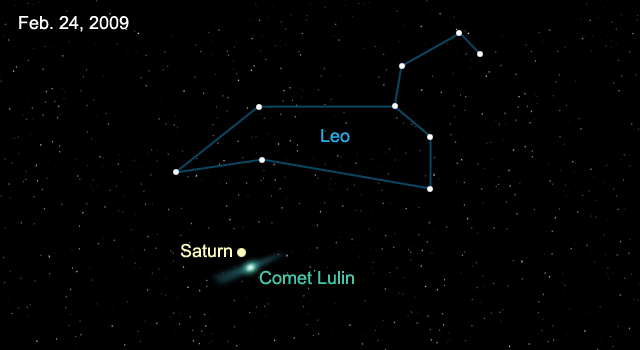
As a peace offering, the cosmos is offering comet Lulin, which is making an appearance in the nighttime sky this month - and it's green.  Literally. Don Yeomans of JPL, manager for NASA's Near-Earth Object Program Office, answers a few questions about this odd comet.

comet lulin

Sky chart showing comet Lulin on Feb. 24, 2009. Image credit: NASA/JPL

A new study says that kids who are allowed to watch R-rated movies are much more likely to believe it's easy to get a cigarette than those who aren't allowed to watch such films. 

The researchers found that parental permission to watch R-rated movies was one of the strongest predictors of the perception that cigarettes are available, about as strong as having friends that smoked. If allowed to watch R-rated films, nonsmokers were almost twice as likely, and smokers were almost three times as likely to say it would be easy for them to get cigarettes. 
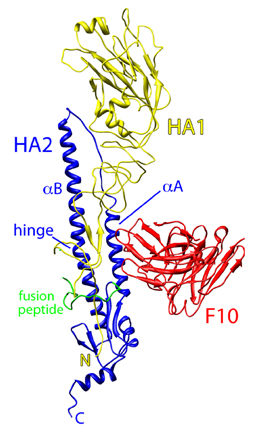
Scientists have identified a small family of lab-made proteins that neutralize a broad range of influenza A viruses, including the H5N1 avian virus, the 1918 pandemic influenza virus and seasonal H1N1 flu viruses.

These human monoclonal antibodies, identical infection-fighting proteins derived from the same cell lineage, also were found to protect mice from illness caused by H5N1 and other influenza A viruses. Because large quantities of monoclonal antibodies can be made relatively quickly, after more testing, these influenza-specific monoclonal antibodies potentially could be used in combination with antiviral drugs to prevent or treat the flu during an influenza outbreak or pandemic.

Show Me The Science Month Day 19


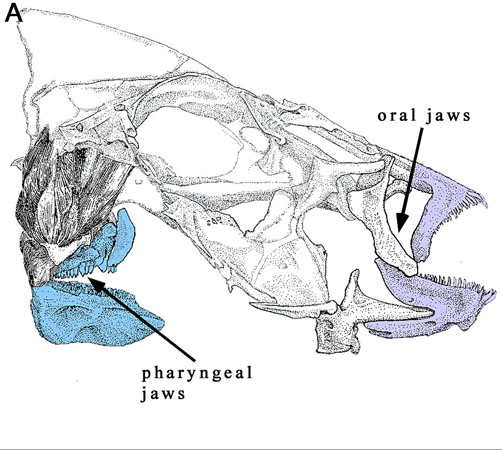
Some fish have two sets of teeth: oral teeth, set towards the front of the mouth (like ours), and so-called pharyngeal teeth, set far back in in the throat in a strange, second set of jaws. Based on what we learn from the fossils of ancient jawless fish, it appears that teeth first appeared on these deep pharyngeal jaws. So how did most vertebrates come to have the more common set of oral teeth? A group of scientists based in Georgia and Tennessee used paleontology and modern genetics to show that tweaks to an ancient gene regulatory network enabled the evolution of  oral cavity teeth possessed by most vertebrates.

pharyngeal jaw pharngula evolution teeth

Figure 1 from Fraser, et al.

Someone on this site recently posed the following thought experiment questioning the postulate of special relativity that no object can travel faster than the speed of light - c.  Imagine a one dimensional problem in which two travelers, move close to the speed of light, but in opposite directions - one moving close the speed of light in the positive direction and the other traveler moving close to the speed of light in the negative direction.  

Wouldn't these observers perceive the relative velocity of the respective other as exceeding the speed of light (i.e., approx. 2c)? 


Special relativity posits the following:
Last night, I watched on BBC Television Natural World, 2008-2009 - 14. A Farm for the Future in which

Wildlife film maker Rebecca Hosking investigates how to transform her family’s farm in Devon into a low energy farm for the future, and discovers that nature holds the key.


Show Me The Science Month Day 19

Merriam-Webster's dictionary says the word 'evolution' originated in 1622 and derives from the Latin evolutio, "unrolling, from", as in a parchment, and this is actually the perfect way to think of both Darwin and Evolution in their context.

