Neandertals were the closest relatives of currently living humans. They lived in Europe and parts of Asia until they became extinct about 30,000 years ago. For more than a hundred years, paleontologists and anthropologists have been striving to uncover their evolutionary relationship to modern humans.
A multi-institutional team of researchers has reported the sequences for all of the 99 known strains of cold virus, nature's most ubiquitous human pathogen. The feat exposes, in precise detail, all of the molecular features of the many variations of the virus responsible for the common cold, the inescapable ailment that makes us all sneeze, cough and sniffle with regularity.
Conducted by teams at the University of Maryland School of Medicine, the University of Wisconsin-Madison and the J. Craig Venter Institute, the work to sequence and analyze the cold virus genomes lays a foundation for understanding the virus, its evolution and three-dimensional structure and, most importantly, for exposing vulnerabilities that could lead to the first effective cold remedies.
Within the next few years it may be possible to go to
Walmart, pick up a gallon of milk, and then stop by and have your genome sequenced while you wait. Sound unbelievable? Recent developments in the sequencing of your genome may make this a reality in the near future.
A company called
Complete Genomics has recently announced that they intend to market the $5000 complete genome sequencing package. $5000 is not cheap, but it is definitely cheaper than some of the earlier efforts at genome sequencing.
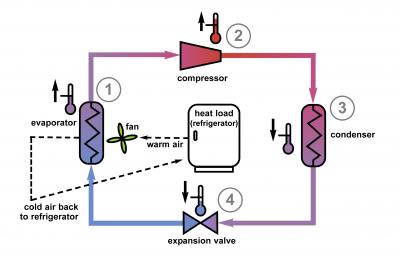
When people think of a refrigerator, magnetism isn't necessarily the first thought that comes to their minds. We've all become accustomed to the loud humming noise of the compressor and blowing fan that keeps our food nicely chilled, and anybody with even a cursory knowledge of thermodynamics knows basically how their refrigerator keeps the temperature down. A new development in materials science, however, may render our current refrigeration design obsolete and lead to far more efficient designs.
Parents and advocates who believe vaccines cause autism were dealt a double blow this week. On the scientific front, a discredited 1998 study that launched the vaccine-autism debate onto the forefront made headlines, and on the legal front, a special U.S. court ruled that vaccines are not to blame for the disease.
This is the year of Darwin (yes, yes, it’s also the year of astronomy, I know), and especially this week -- around the date of Chuck’s birth -- we are seeing a spike of events, radio and tv pieces, and printed articles. (Expect a second peak in November, for the anniversary of the publication of
Origin of Species.)
A well known professor of analog circuit design and theory once said "all models are wrong". Analog design is particularly rewarding and challenging, I believe, for this very reason. Those words have echoed in my mind during many junctures in my journeys to learn something about the physical world. Whether you are a theorist, phenomenologist, experimentalist or some combination of these, this fact is inescapable.
I am fascinated by how concepts of everyday life leak into all scientific thought, whether it be an elementary concept in engineering or within the confines of some rarefied physical theory. And this is a topic I hope to write much about.
The Valentine's Day lovefest on this site - who says scientists aren't warm and fuzzy? - is spectacular. You can learn about the chemistry of love with
Valentine's Day science for women, easy solutions for the
languishing lothario (personal favorites at the moment - "Roses are red, violets are blue. You and me we will stick like clay," and "I wanna be your Viking cleaner breathing in your dust.
Scientists at the University of North Carolina at Chapel Hill say they have helped develop a new genomic test that can help clinicians predict which breast cancer patients are most likely to survive the disease and which treatments may be most effective in increasing those chances of survival.
By specifically measuring the activity level of a small subset of the 20,000 plus genes that may be “turned on” or “turned off” within each tumor, this genomic test can give patients a more accurate picture of how their disease might progress.