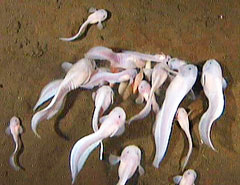










Scientists filming in one of the world’s deepest ocean trenches have found groups of highly sociable snailfish swarming over their bait, nearly five miles (7700 metres) beneath the surface of the Pacific Ocean. This is the first time cameras have been sent to this depth.

‘We got some absolutely amazing footage from 7700 metres. More fish than we or anyone in the world would ever have thought possible at these depths,’ says project leader Dr Alan Jamieson of the University of Aberdeen’s Oceanlab, on board the Japanese research ship the Hakuho-Maru.

‘It’s incredible. These videos vastly exceed all our expectations from this research. We thought the deepest fishes would be motionless, solitary, fragile individuals eking out an existence in a food-sparse environment,’ says Professor Monty Priede, director of Oceanlab.

Smell plays an important role in our lives: It influences the way in which we choose fruit and vegetables, perfume, and even a partner. And yet, smell is not just what we smell with our noses, it's also what we taste, explains Prof. Alexander Vainstein, who is heading the team at the Robert H. Smith Faculty of Agriculture, Food and Environment at the Hebrew University of Jerusalem. "Aroma is of major importance for defining the taste of food."

Scent in flowers and plants is used to attract pollinating insects like bees and beetles that pass on the pollen and help in the reproduction and creation of fruit. The intensity of the scent that the flower emanates is influenced by the time of day, depending on weather, age of the flower and the species.

Now Vainstein and others have found a way to genetically enhance the scent of flowers and implant a scent in those that don't have one.

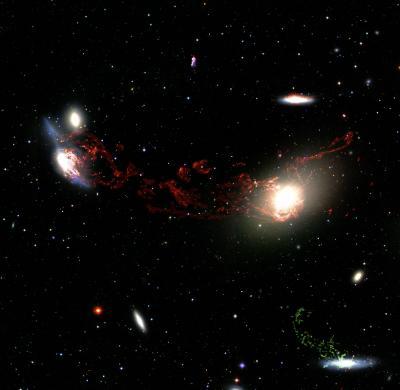
Astronomers studying new images of a nearby galaxy cluster have found evidence that high-speed collisions between large elliptical galaxies may prevent new stars from forming, according to a paper in the November 2008 Astrophysical Journal Letters.

Led by Jeffrey Kenney, professor and chair of astronomy at Yale, the team saw a spectacular complex of warm gas filaments 400,000 light-years-long connecting the elliptical galaxy M86 and the spiral galaxy NGC 4438 in the Virgo galaxy cluster, providing striking evidence for a previously unsuspected high-speed collision between the galaxies. The view was constructed using the wide-field Mosaic imager on the National Science Foundation telescope at Kitt Peak National Observatory near Tucson, Arizona.

Moderate consumption of red wine may decrease the risk of lung cancer in men, according to a report in the October issue of Cancer Epidemiology, Biomarkers & Prevention.

Chun Chao, Ph.D., a research scientist at Kaiser Permanente Department of Research and Evaluation in Pasadena, California, analyzed data collected through the California Men's Health Study, which linked clinical data from California's health system with self-reported data from 84,170 men aged 45 to 69 years. Researchers obtained demographics and lifestyle data from surveys computed between 2000 and 2003, and identified 210 cases of lung cancer.

The Royal Swedish Academy of Sciences has decided to award the Nobel Prize in Physics for 2008 with one half to Yoichiro Nambu of the Enrico Fermi Institute, University of Chicago, IL, USA "for the discovery of the mechanism of spontaneous broken symmetry in subatomic physics"

and the other half jointly to;

Makoto Kobayashi, High Energy Accelerator Research Organization (KEK), Tsukuba, Japan and Toshihide Maskawa,Yukawa Institute for Theoretical Physics (YITP), Kyoto University, Japan, "for the discovery of the origin of the broken symmetry which predicts the existence of at least three families of quarks in nature".

If you’re thinking about which hybrid vehicle to purchase, now that gas prices have dictated that you replace your Hummer, consider a vehicle that will not only eliminate high spending at the gas pump, but also your time spent in traffic. Wouldn’t you rather fly above the endless traffic jams in your very own ethanol-fueled flying car? I know I would.

Science fiction, right? Guess again. Welcome to Moller Int., a small company nestled in the unassuming city of Davis, CA, where they are making this science fantasy into cold hard reality via the M400 Skycar, a 'volantor' sky vehicle. Volantor refers to the capability of a vertical takeoff and landing as well as its quick and agile flight.

Dr. Paul Moller, company founder, Chairman of the Board and also the company’s President and Chief Executive Officer has, needless to say, invested his entire being into his vision. With a masters degree in Engineering and a Ph.D. in Aerodynamics, Moller’s dream, since his first helicopter designs at the age of 15, has been to create viable flight vehicles for the general public. His realization of that dream became the Skycar.


Your next wireless network could use light instead of radio waves. Researchers funded by a National Science Foundation grant expect to piggyback data communications capabilities on low-power light emitting diodes, or LEDs, to create "Smart Lighting" that would be faster and more secure than current network technology.

This initiative, known as the Smart Lighting Engineering Research Center (http://smartlighting.bu.edu), is part of an $18.5 million, multi-year NSF program awarded to Boston University, Rensselaer Polytechnic Institute and the University of New Mexico to develop the optical communication technology that would make an LED light the equivalent of a WiFi access point. This innovative alternative may one day replace most of today's lighting devices.

When astronauts land on the Moon again they may be able to get a critical commodity there – water.

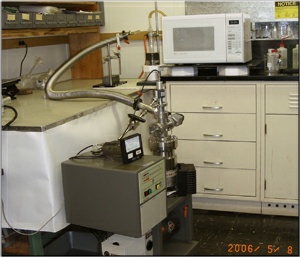
Bill Kaukler, an Associate Research Professor in the Center for Materials Research at The University of Alabama in Huntsville, has spent the past three years investigating the use of microwaves to replenish water on space missions or as a rocket fuel supply.

“A lot of people think that water doesn’t exist on the Moon,” said Kaukler. “It’s true that not all parts of the Moon have water. Where the Apollo missions landed, there isn’t much water because it is exposed to the sun half of the time. However, in the polar regions, exploratory satellites have found huge amounts of hydrogen, which is evidence that water exists.”

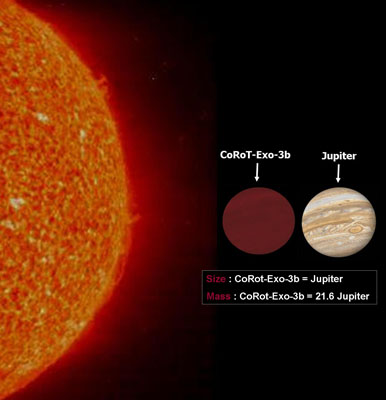
COROT has discovered a massive planet-sized object orbiting its parent star closely, unlike anything ever spotted before. It is so exotic, that scientists are unsure as to whether this oddity is actually a planet or a failed star.

The object, named COROT-exo-3b, is about the size of Jupiter, but packs more than 20 times the mass. It takes only 4 days and 6 hours to orbit its parent star, which is slightly larger than the Sun.

As a planet, COROT-exo-3b would be the most massive and the densest found to date - more than twice as dense as lead. Studying it will help them better understand how to categorise such objects. The mystery is how such a massive object formed so close to its parent.

New research suggests that the identification and examination of key cell signaling events required for initiation and progression of cancer might be best accomplished at the single cell level. The research in Cancer Cell may lead to better diagnosis and treatment of some complex cancers.

Recent advances in flow cytometry, a technique that allows detailed examination of individual cells, have enabled simultaneous measurement of cell type and signaling pathways. Lead study authors Dr. Garry P. Nolan from the Stanford University School of Medicine and Dr. Mignon L. Loh from the UCSF Children's Hospital and the Helen Diller Family Comprehensive Cancer Center were interested in determining whether examination of cellular signaling abnormalities caused by genetic mutations associated with cancer could provide a precise correlation between aberrant signaling events and disease physiology.


