




You may not be aware of it - they might not be aware of it, but the people in your work environment might be slowing you down.

New research by University of Calgary, Faculty of Kinesiology researcher Dr. Tim Welsh says that regardless of their intentions, having an individual working on a different task - within your field of vision - could be enough to slow down your performance.

“Imagine a situation like a complex assembly line,” said Welsh If you are doing a particular task and the person across from you is doing a different task, you’ll be slowed down regardless of their performance.”

There are several human characteristics considered to be genetically predetermined and evolutionarily innate, such as immune system strength, physical adaptations and even sex differences. These qualities drive the nature versus nurture debate and ask of our species, who is more successful and why?

Psychologists Agneta Herlitz and Jenny Rehnman in Stockholm, Sweden asked an even more complicated question of human predisposition: Does one’s sex influence his or her ability to remember every day events? Their surprising findings did in fact determine significant sex differences in episodic memory, a type of long-term memory based on personal experiences, favoring women.

The possibility of generating hydrogen from sea water using sunlight energy is now one step closer, say scientists at Atmos Technologies. They claim to have successfully developed a completely new, environmentally friendly technique for the production of photo voltaic diodes at a lower cost and with a substantially lower carbon footprint than that created by conventional methods.

They say the hydrogen produced using their technology can be generated economically and efficiently and utilized either in fuel cells or in conventional engines as a replacement for petrol. Current techniques cost more in energy to generate the hydrogen than what is given out when the hydrogen is used.

Tiny particles of pure silica coated with an active material could be used to remove toxic chemicals, bacteria, viruses, and other hazardous materials from water much more effectively and at lower cost than conventional water purification methods, according to researchers writing in the International Journal of Nanotechnology.

Peter Majewski and Chiu Ping Chan of the Ian Wark Research Institute, at the University of South Australia, explain that the availability of drinking quality water is fast becoming a major socio-economic issue across the globe, especially in the developing world. However, water purification technology is often complicated, requires sophisticated equipment and is expensive to run and maintain. Moreover, it usually requires a final costly disinfection stage. The Australian team suggests that nanotechnology could provide a simple answer to the problem.

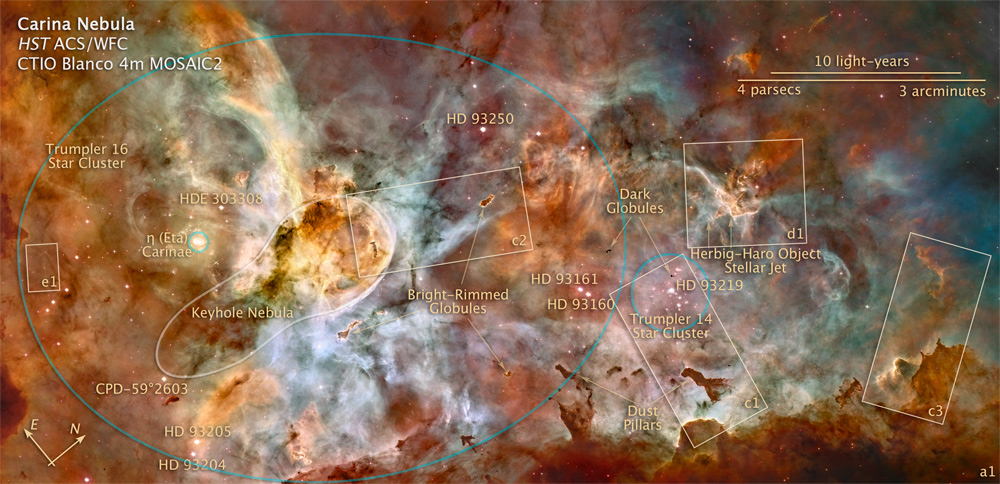
ESA’s Integral has made the first unambiguous discovery of high-energy X-rays coming from a rare massive star at our cosmic doorstep, Eta Carinae. It is one of the most violent places in the galaxy, producing vast winds of electrically-charged particles colliding at speeds of thousands of kilometres per second.

The only astronomical object that emits gamma-rays and is observable by the naked eye, Eta Carinae is monstrously large, so large that astronomers call it a hypergiant. It contains between 100–150 times the mass of the Sun and glows more brightly than four million Suns put together. Astronomers know that it is not a single star, but a binary, with a second massive star orbiting the first.

When the public considers competing arguments about a new technology’s potential risks and benefits, people will tend to agree with the expert whose values are closest to their own, no matter what position the expert takes. The same will hold true for nanotechnology, a key study has found.

The study results appear in a report issued today by the Project on Emerging Nanotechnologies (PEN). The study was based on experiments involving some 1,600 American adults and was carried out by the Cultural Cognition Project at Yale Law School — an interdisciplinary team of researchers from Yale University, the University of Washington, The George Washington University, Cornell University, and Decision Research in Eugene, Oregon.

Eu que pensava que fontes osteológicas eram apenas os museus ou as jazidas por

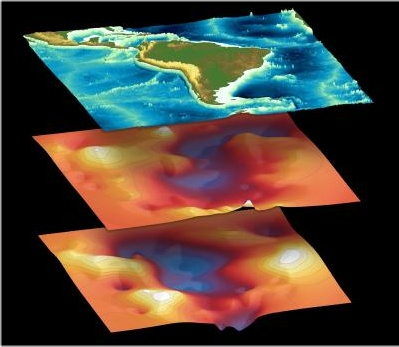
Volcanoes are notoriously hard to study. All the action takes place deep inside, at enormous temperatures. So geophysicists make models, using what they know to develop theories about what they don’t know.

Research led by Gregory P. Waite, an assistant professor of geophysics at Michigan Technological University, has produced a new seismic model for figuring out what’s going on inside Mount St. Helens, North America’s most active volcano. Waite hopes his research into the causes of the earthquakes that accompany the eruption of a volcano will help scientists better assess the hazard of a violent explosion at Mount St. Helens and similar volcanoes.

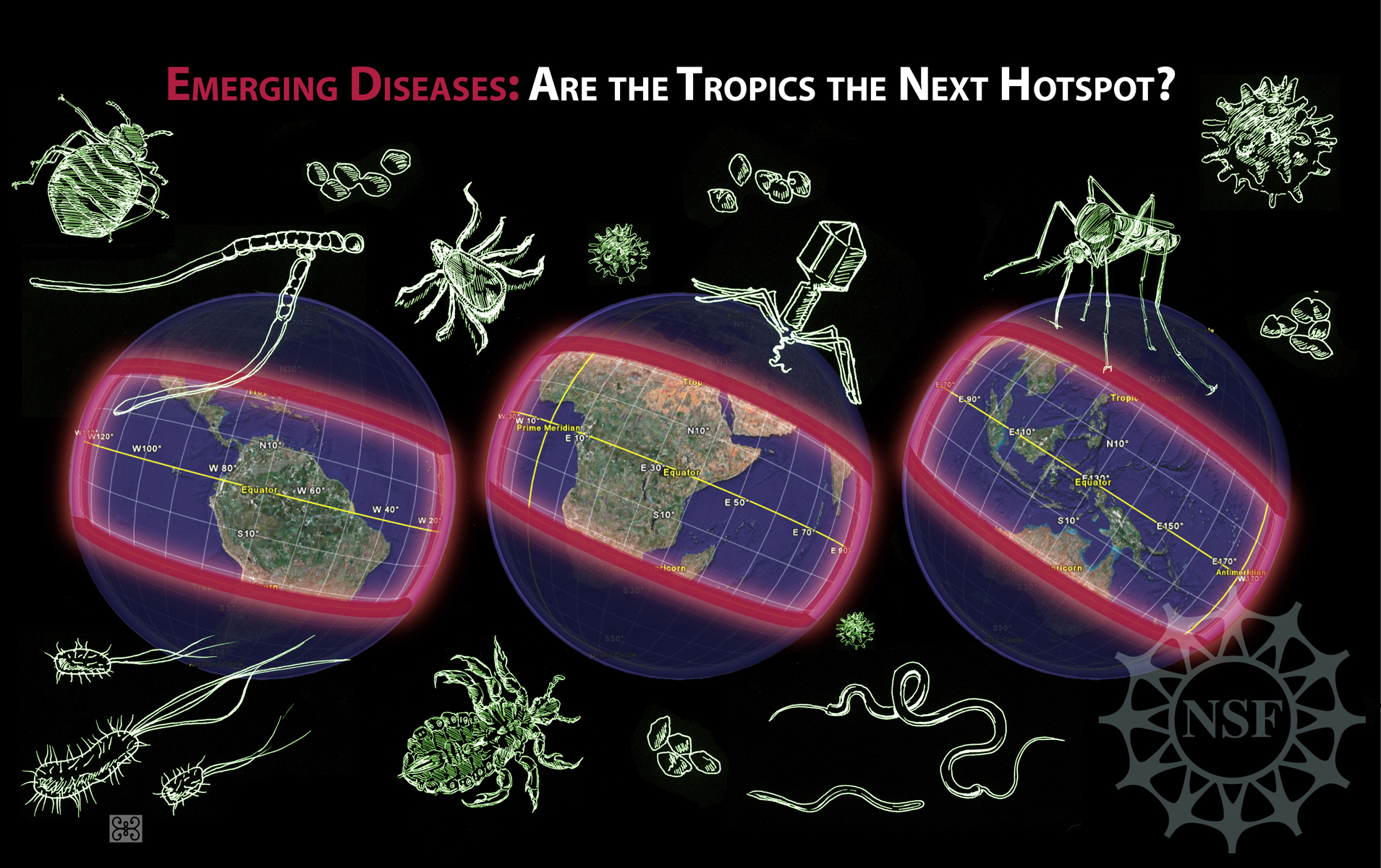
Scientists from four well-known institutions say the next major disease like HIV/AIDS or SARS could occur in any of a number of developing countries concentrated along the equator. They encourage increased surveillance to prevent the spread of a potential outbreak.

Using global databases and sophisticated computer models to analyze patterns of emerging diseases, the researchers -- from the Consortium for Conservation Medicine (CCM) at Wildlife Trust, N.Y., the Institute of Zoology, London, U.K., Columbia University, N.Y., and the University of Georgia, Athens, Ga.

When European naturalists first visited the New World Tropics they saw vast forests that seemed untouched by humans. While indigenous people often lived in these forests, their populations were small. This led to a perception of tropical forests as primeval, “virgin” forests. In the last few decades, this perception has changed - large areas now covered by mature forests have a history of cultivation. In many cases, “primeval” forests are less than 500 years old.


