






A team of researchers, led by surgeons at the Kimmel Cancer Center at Jefferson in Philadelphia, has found further evidence supporting the ability of a protein to predict how well a patient with advanced pancreatic cancer will do after surgery, chemotherapy and radiation. The levels of the protein CA 19-9 in the blood can be used to determine the need for further therapy, they say.

Adam Berger, M.D., assistant professor of surgery at Jefferson Medical College of Thomas Jefferson University, and his co-workers examined CA 19-9 levels and the survival of 385 patients with advanced pancreatic cancer who were treated with surgery and subsequent chemotherapy and radiation.

Just a few years ago, the average computer user’s documents, applications and even photos seemed to rattle around a 120 GB disk drive. Today’s multimedia-intensive user can exhaust that capacity in no time and engineers expect to max out conventional magnetic storage techniques by about 2010.

At that point, they’ll be looking for nanotechnology to step up.

A magnetic storage surface – the disk of a hard-disk drive -- consists of tiny sectors of magneti-cally-aligned particles. When the read-write head of a disk drive passes over a sector, it flips the magnetic field to the opposite direction – encoding a zero or a one. When it reads, it senses the magnetic field for the whole sector.

Why does putting our feelings into words — talking with a therapist or friend, writing in a journal — help us to feel better? A new brain imaging study by UCLA psychologists reveals why verbalizing our feelings makes our sadness, anger and pain less intense.

From the viewpoint of biology, learning and education can be defined as the processes of forming neuronal connections in response to external environmental stimuli, and of controlling or adding appropriate stimuli, respectively.

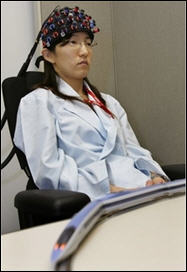
Computers can't do that but researchers in Japan have shown how they can control electronic devices simply by reading brain activity.

The "brain-machine" developed by Hitachi Inc. recently analyzed changes in the Akiko Obata's blood flow and translated those into electric signals which linked to a mapping device that controlled a toy train.


Akiko Obata wears the brain machine and controls a model train in Hatoyama, Japan

Nanobiotechnology holds a lot of promise and people have often speculated how it will impact the world of medicine. Unfortunately promising nanostructured systems so far have turned out to be extremely toxic to humans.

Now a group of researchers at the University of Michigan Nanotechnology Institute for Medicine and Biological Sciences have devised a multifunctional nanoparticle platform comprising nanoparticles synthesized within dendrimers equipped with targeting molecules and dyes. These dendrimer nanoparticle systems are able to seek out and specifically bind to cancer cells.

Buckyballs, or fullerenes, are nanoparticles containing 60 carbon atoms.

Bacteria called Dehalococcoides Ethenogenes, discovered in Ithaca sewage sludge in 1997 by James Gossett, Cornell professor of civil and environmental engineering, are now in wide use to detoxify some carcinogenic chemicals but they could be used for a lot more.

These bacteria remove chlorine atoms from molecules and leave less-toxic compounds behind in toxic waste like perchloroethylene (PCE) and trichloroethylene (TCE).

But D. ethenogenes strains work well at some sites and not so well at others, and nobody knows why.


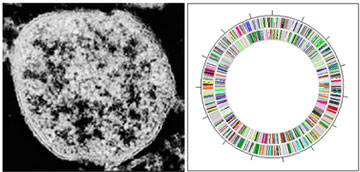
The bacterium Dehalococcoides ethogenes can extract chlorine from chemicals to help clean up toxic wastes. Its genome (charted at right) consists of 1,640 genes.

A diet rich in omega-3 polyunsaturated fatty acids found in certain fish or fish oil, nuts, seeds, and vegetable oils may help lower prostate cancer risk in individuals with a genetic predisposition to cancer.

While many genetic mutations are known to predispose to cancer, it has remained unclear whether dietary fat can modulate the risk of developing cancer in genetically predisposed individuals. Some studies suggest that a diet rich in omega-3 polyunsaturated fatty acids reduces cancer incidence.

Haptics means “of or relating to the sense of touch”. Haptics Technolofy refers to the technology that connects the user to a computerized system via the sense of touch by applying forces, vibrations and/or motions to the user.

Perhaps people do not realize it, but haptic technology is already in our lives. Vibrating phones, gaming controllers and force-feedback control knobs in cars, like BMW’s iDrive, are examples of this technology. These days, you can turn your phone ring tone off, put it in your purse and still feel that someone is calling you when you get a vibration. On the other hand, the Nintendo Wii video game console has been a new revolution for game lovers. The controller, called Wii, provides vibrations (i.e.

Scientists at the Alaska Stable Isotope Facility can tell you whether marijuana came from Mexico or the Matanuska Valley. Soon they'll even be able to tell you whether it was grown indoors or out.

A few more years and enough samples and they hope to have something even more precise: an elemental fingerprint that could tell police where and under what conditions a sample of marijuana was grown.

"There are scientists already doing this for drugs like heroin and cocaine," said Matthew Wooller, Alaska Stable Isotope Facility director. "The potential is there for being able to do this for marijuana as well."

