









If you want children ages 4 to 8 to tell the truth, it's best not to threaten to punish them if they lie.

An experiment involving 372 children, led by Prof. Victoria Talwar of McGill's Dept. of Educational and Counselling Psychology, left each child alone in a room for 1 minute with a toy behind them on a table, having told the child not to peek during their absence. 

While they were out of the room, a hidden video camera filmed what went on.

When the researchers returned, they asked the child, a simple question: "When I was gone, did you turn around and peak at the toy?"

What the researchers discovered was that:

Researchers from the U.S. Department of Energy's Lawrence Berkeley National Lab have accelerated subatomic particles to the highest energies ever recorded from a compact accelerator -  a laser-plasma accelerator, which is a new class of particle accelerators that can fit on a table.

The team used a specialized petawatt laser and a charged-particle gas called plasma to get the particles up to speed - electrons in this case - inside a nine-centimeter long tube of plasma. The speed corresponded to an energy of 4.25 giga-electron volts. The acceleration over such a short distance corresponds to an energy gradient 1000 times greater than traditional particle accelerators and marks a world record energy for laser-plasma accelerators.  


You're a vegetarian? But your subconscious ordered the Meat Lover's! BrokenSphere, CC BY-SA

By John M. Henderson,
University of South Carolina


The jellyfish highway.

By Stefano Piraino,
University of Salento and Bella Galil,
Israel Oceanographic and Limnological Research

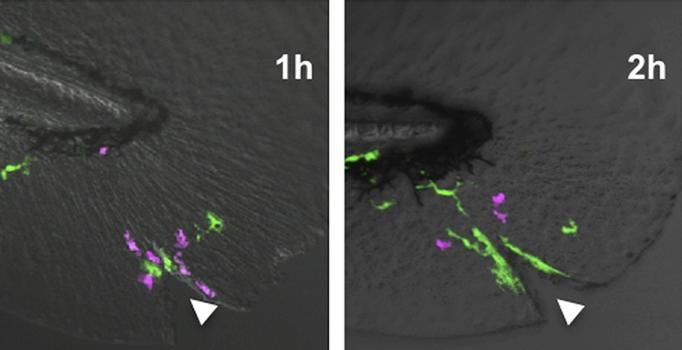
Macrophages sweep up cellular debris and pathogens in order to thwart infection - sometimes even before the white blood cells, which are designed for that task. 

Neutrophils, white blood cells, are "first responders" that are attracted to wounds by signaling molecules called reactive oxygen species (ROS) that activate a protein kinase. When neutrophils finish their work, inflammation is partly resolved through apoptosis, or cell suicide, and then macrophages arrive to clean up the infection.

But neutrophils can also elect to leave wounded tissue in a process known as reverse migration. Whether macrophages promote this mode of inflammation resolution is unclear. 

There are not a lot of new stories to be found by the humanities in ancient parchments, but millions of documents stored in archives could trace agricultural development across the centuries, thanks to increasingly progressive genetic sequencing techniques.

Thanks to sequencing, vital information can be derived from the DNA of the parchment on which they are written.

Women over the age of 70 with certain early-stage breast cancers don't get much benefit from radiation therapy, according to studies, but they still get it.  The reason is because doctors were able to make decisions that overruled the published evidence and every patient wanted to take no chances.

Now, with government increasingly controlling health care in the United States, the search is one for ways to lessen such "defensive medicine" and cut costs. The problem is that it will be difficult to tell doctors and patients they won't get what was previously considered standard care under a free market system now that more treatments are determined by government panels.

Psychology lacks the methodological rigor of science, but bold claims are popular in corporate media and so they become paper of consumer belief. One recent popular claim is that being bilingual is
a cognitive advantage.

The claims are so popular that you will have a hard time getting published in psychology journals if you debunk them. 

Writing in Psychological Science, scholars suggest that publication bias in favor of positive results of the
bilingual-advantage
 hypothesis are skewing the overall literature on bilingualism and cognitive function. Whenever publication bias exists, it is good for creating the belief in a consensus or getting people to take action, but it is bad for public acceptance of science.

What made the wealthy elites in San Fransisco and Seattle who deny the benefits of child vaccines suddenly clamor for government action to create more vaccines? Two cases of Ebola in the United States.

Though 12,000 people died of heart disease in that same time, and their states were leading the nation in preventable debilitating childhood diseases, it got little media, and therefore consumer, attention. There is a reason why. In the modern environment of surveillance medicine and the focus on risk factors for disease, the lines between health and illness have become blurry and even skewed, according to sociological surveys.

