



Before the European colonial era, the people who lived on the land now called California used fire to control growth and make sure they had food, fuel, tools, and objects for ritual. 


Revolutions are messy business, they require participation by a type of personality that is not very savory; militant, bombastic, a little crazy. 

Much artificial-intelligence research addresses the problem of making predictions based on large data sets. An obvious example is the recommendation engines at retail sites like Amazon and Netflix.

But some types of data are harder to collect than online click histories —information about geological formations thousands of feet underground, for instance. And in other applications — such as trying to predict the path of a storm — there may just not be enough time to crunch all the available data.

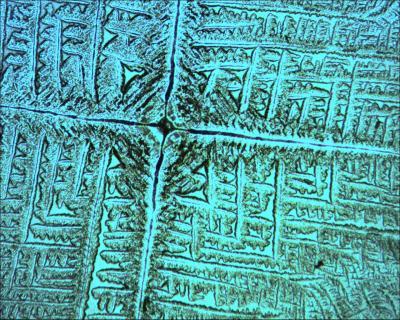
Researchers have detected a previously unknown interaction between microorganisms and salt. When Escherichia coli cells are introduced into a droplet of salt water and left to dry, bacteria manipulate the sodium chloride crystallisation to create biomineralogical biosaline 3D morphologically complex formations, where they hibernate.

Afterwards, by rehydrating the material, bacteria are revived. The discovery was made by chance with a home microscope but made the cover of Astrobiology because it may be a way to find signs of life on other planets.

This is just a short post to report about a useful paper I found by preparing for a talk I will be giving next week at the 3rd International Conference on New Frontiers in Physics, in the pleasant setting of the Orthodox Academy of Crete, near Kolympari.

My talk will be titled "Extraordinary Claims: the 0.000029% Solution", making reference to the 5-sigma "discovery threshold" that has become a well-known standard for reporting the observation of new effects or particles in high-energy physics and astrophysics.

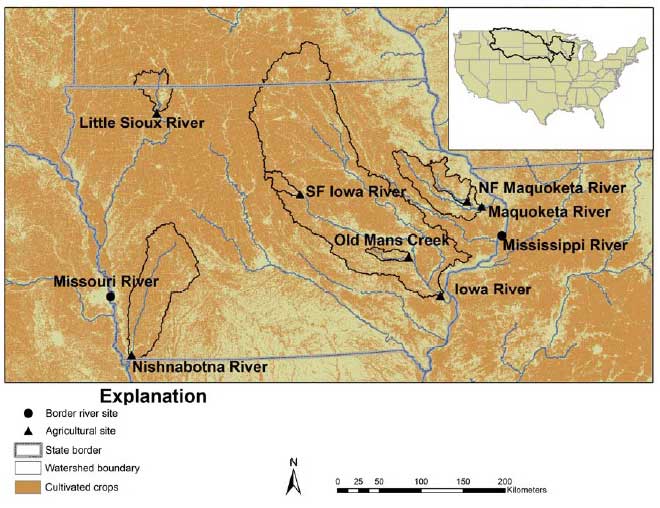
Insecticides that behave like nicotine, known as neonicotinoids, became popular in the late 1990s as replacements for more toxic products. They have been effective but like all products there is concern about ongoing environmental effects. The U.S. Environmental Protection Agency has classified all neonicotinoids as safe for humans.

Concert promoters and sports teams have long insisted that scalping - private ticket sales outside a venue - hurts their revenue and forces fans to pay exorbitant prices for tickets.

Not so, according to a new analysis which concludes that resale markets can add value to tickets sold by concert venues and Ticketmaster. Suppose you are interested in a Bruno Mars and Pharrell Williams concert that is three months away. You're not 100 percent sure you'll be able to make it because you  have to travel, so you don't buy tickets at all.

I’ve often wondered about the Scopes trial, and wanted to read a good account of it.  I was recommended the account by Edward J. Larson in When Science and Christianity Meet, edited by DC Lindberg and RL Numbers (ISBN 0226482162).  .  It’s a very informative book, and wide-ranging too: out of 12 chapters, only one on Galileo and one on Darwin.

In 312, Roman Emperor Constantine was told in a dream to paint a cross on his army’s shields.[1] Based on that dream, he commanded his generals to slap crosses on pretty much everything. If it went into battle, it had a cross on it.

And lo, when his army faced the rebel army that was twice the size of his, his soldier guys smote them other soldier guys real bad and got all pre-medieval on their butts; and Constantine did declare, “Hot Damascus, it worked!” (Obviously, I am paraphrasing; I don’t speak Latin.) So, Constantine remained emperor of Rome and a Christian, sort of.

A new National Academy of Sciences (NAS) assessment examining the causes of the 2011 Fukushima Daiichi nuclear accident affirms the culture of safety adhered to by the U.S. nuclear industry.

Core findings from the NAS study, “Lessons Learned from the Fukushima Nuclear Accident for Improving the Safety of U.S. Nuclear Plants,” validate the actions that the nuclear industry has initiated in recent years to be ready to manage plants if extreme natural events occur that may exceed a plant’s design basis.

