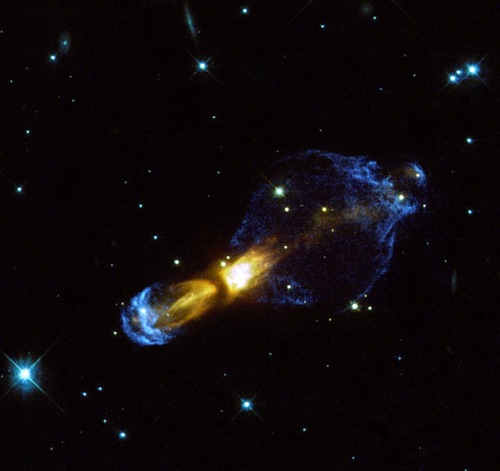






Large stars go supernova but smaller stars sometimes end up as planetary nebulae – colorful, glowing clouds of dust and gas.

These nebulae have been observed to often emit powerful, bipolar jets of gas and dust. But how do spherical stars evolve to produce highly aspherical planetary nebulae?

A hypothesis published in the Monthly Notices of the Royal Astronomical Society by a University of Rochester undergraduate student and a professor states that only "strongly interacting" binary stars – or a star and a massive planet – can feasibly give rise to these powerful jets.

In 1832, the HMS Beagle arrived at Bahia Blanca, Argentina and Charles Darwin disembarked. On his way to Buenos Aires, Darwin collected several fossils of large mammals along with many other living organisms, including several insects.

February 12 is Darwin's birthday scientists and scientists have named after him a long lost but new to science beetle genus and species from his collection.

Since most people don't want to engage in the only weight loss plan guaranteed to work - consuming fewer calories than they burn - options are limited in America's battle of the bulge and are likely to stay limited.

The Federal Drug Administration has approved few drugs for long-term weight loss and some are no longer marketed because of safety issues.

What shapes a man’s life?

To begin: Mom, dad, little Jenny Harrison in the 3rd grade, adolescence, acne, heartache, and the jockstrap.

And then there comes the real trauma, age 60 or so: loss of gluteofemoral adipose tissue.

As in:

Sagging of the butt

Collapse of the “gluteo-pecs”

and even...

Disappearance of the “back package.”

You know what I’m talking about. It’s that age-related reworking of your once-marvelous physique, when we replace pecs with moobs, 6-pac abs with a two-liter jug and slim leg Levy’s for old time beltless-wear.

Here is how I found out about it:

Tailor: “What is going on back here? Looks like...diapers. Pampers!”

Me: “What do you mean?”
Research and Development (R&D) has become something of a dirty word throughout a giant swath of the Science, Technology, Engineering and Math (STEM) community. Academia is where it's at, the saying goes, and basic research, learning for the sake of learning with no defined public benefit, is what scientists are told they must do if they want to be real scientists.

Technology will be fine, it is assumed. Like gifted students who find their school programs cut, the belief is that American technology will be find a way to be dominant. 

The precautionary principle says when it comes to health, you err on the side of caution, and a well-publicized effort to get annual screening for breast cancer paid off - but it hasn't lowered mortality rates in women aged 40-59. An annual physical examination does just fine, according to a 25-year study.

We may have too much plastic in the environment but creatures that lack a Mother Jones to tell them how awful things are adapt and overcome; two urban bee species have been caught making nests out of plastic waste.

Although lots of research has shown adverse impacts of the material on species and the ecosystem, few scientists have documented insects 'making lemonade out of lemons' and adapting to a plastic-rich environment. It's an important discovery because it shows bees' resourcefulness and flexibility in adapting to a human-dominated world, says lead author Scott MacIvor, a doctoral student at York University. 

It would be almost impossible to find a better example of the difficulties that face the pharmaceutical industry than the campaign against hepatitis C.

Unfortunately, this example is now at the expense of Vertex Pharmaceuticals, a small, but top-notch drug discovery organization that began as a biotech startup in 1989.

When is a smoker not a smoker?

When they live in California and simply choose to self-identify as a non-smoker. Who are we to criticize the self-identify of people in a state where boys can just declare they are female and use a girl's restroom?

Smoking has plummeted in the last few decades- health statistics, rampant sin taxes and billions of dollars in anti-smoking campaigns will do that - but University of California, San Diego School of Medicine scholars wonder about people who say they use cigarettes but didn't consider themselves to be "smokers" in  the 2011 California Longitudinal Smokers Survey.

• Some people might feel happier if they get their hands on some more money.
• Some people might feel happier if they use their hands to pray.

Leading some to the question : is it feasible to equate the two? In other words, is it possible to put a price on prayer?

