As the male túngara frog serenades female frogs from a pond, he creates watery ripples that make him easier to target by rivals and predators such as bats, according to researchers from The University of Texas at Austin, the Smithsonian Tropical Research Institute (STRI), Leiden University and Salisbury University.

A túngara frog will stop calling if it sees a bat overhead, but ripples continue moving for several seconds after the call ceases. In the study, published this week in the journal Science, researchers found evidence that bats use echolocation — a natural form of sonar — to detect these ripples and home in on a frog. The discovery sheds light on an ongoing evolutionary arms race between frogs and bats.

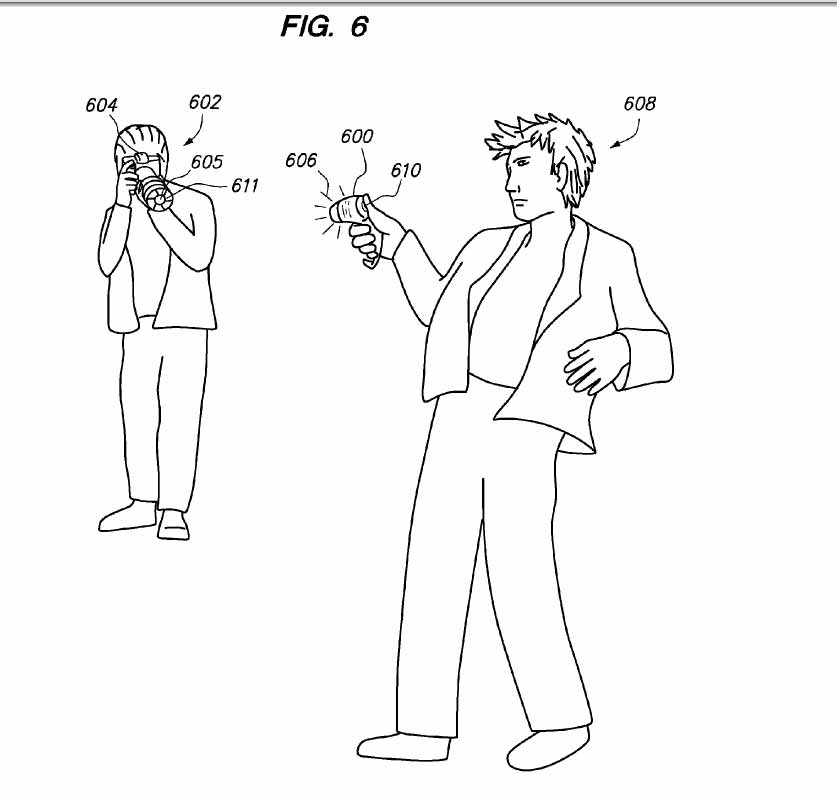
“Photography has been around for many years. A problem associated with photography is oftentimes many people do not want to have their picture taken. For example, many celebrities do not want their picture taken or pictures of their companion’s [sic?] or relative’s [sic?] taken because they feel it is an invasion of their privacy.”

What to do? A new solution is described in this April 2012 US patent – Inhibiting unwanted photography and video recording

The linchpin location of the "Star Wars" franchise was the planet Tatooine, home to both Luke Skywalker and Obi-Wan Kenobi. It, along with its twin suns, appeared in every movie of the franchise except "The Empire Strikes Back".

How would such a planet, orbiting two stars, form? There are few environments more extreme than a binary star system, if you are forming a planet. 

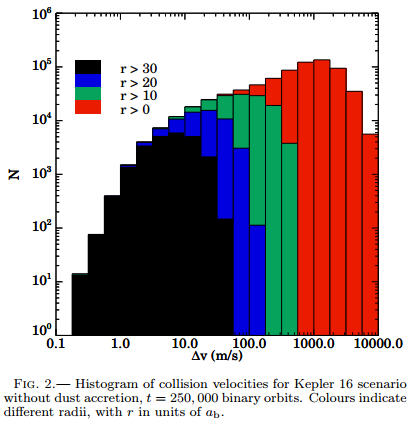
Kepler-34(AB)b has some answers, according to a new study. Like Tatooine, Kepler-34(AB)b is a circumbinary planet, its orbit encompasses two stars. Since powerful gravitational perturbations from two stars lead to destructive collisions that grind down planetary material, the existence of such planets can be difficult to explain.

Alchemy, which most people have at least heard of, along the lines of 'the quest to turn lead into gold', is getting rehabilitated. In one paper, anyway.

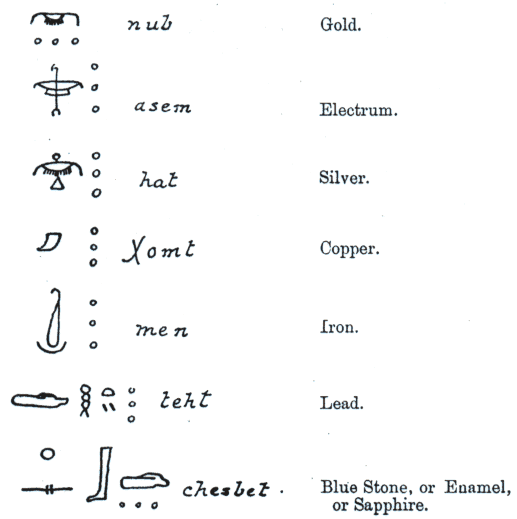
Alchemy, like chemistry, had 'chem' at its core. Chem derives from Khem ('black land'), which was the name for what we call Egypt, due to the dark alluvial soil provided by the flooding Nile each year. Egypt was well known to Greeks and Romans but it wasn't until the 8th century that Arab Muslims, having conquered it in the previous century, re-introduced the science from their new state to Europe, a state which they called Al-Khem. This science believed that metals were composed of sulfur and mercury. Gold was the perfect metal and a Philosopher's Stone could transmute baser metals into it.

A new study conservatively estimates that one in five women with ovarian cancer has inherited genetic mutations that increase the risk of the disease, according to research at Washington University School of Medicine in St. Louis.

Most women in the study would have been unaware of a genetic predisposition to ovarian cancer because they didn't have strong family histories that suggested it.

Silicon-based electronics has certain limits, in the physical sense of the word: this type of circuit can never become "nano" because of the physical laws governing the flow of electrons. This imposes a halt to the process of miniaturization of electronic devices. One of the possible solutions is to use molecules as circuits, but their poor conduction capabilities make them unlikely candidates. There is, however, a possible way around this, which was investigated in a recent paper published in Proceedings of the National Academy of Sciences (PNAS) by an international research team that includes Ryan Requist, Erio Tosatti and Michele Fabrizio of the International School for Advanced Studies (SISSA) in Trieste.

Humans are able to smell sickness in someone whose immune system is highly active within just a few hours of exposure to a toxin, according to new research published in Psychological Science, a journal of the Association for Psychological Science.

According to researcher Mats Olsson of Karolinska Institutet in Sweden, there is anecdotal and scientific evidence suggesting that diseases have particular smells. People with diabetes, for example, are sometimes reported to have breath that smells like rotten apples or acetone.

Being able to detect these smells would represent a critical adaptation that would allow us to avoid potentially dangerous illnesses. Olsson wondered whether such an adaptation might exist already at an early stage of the disease.

In two studies in the January 24 issue of Science, researchers at Albert Einstein College of Medicine of Yeshiva University used advanced imaging techniques to provide a window into how the brain makes memories. These insights into the molecular basis of memory were made possible by a technological tour de force never before achieved in animals: a mouse model developed at Einstein in which molecules crucial to making memories were given fluorescent "tags" so they could be observed traveling in real time in living brain cells.

Male túngara frogs call from puddles to attract females. The production of the call incidentally creates ripples that spread across the water. Researchers at the Smithsonian Tropical Research Institute in Panama revealed that these ripples are used by other male frogs to assess the level of competition in the puddle. Unfortunately for the frogs, their main predator, the frog-eating bat, senses the ripples too, making the frogs easier targets.

I received yesterday a copy of the brand-new book by Ilya Narsky and Frank Porter, "Statistical Analysis Techniques in Particle Physics" (Wiley-vch 2014), and I would like to offer here my impressions and thoughts on the material.

