




There are examples of positive political campaigns - Ronald Reagan appealed to what America could be, for example - but even that message of hope had an undercurrent of fear, namely that if things did not change, America would stay morassed in 1970s stagflation.

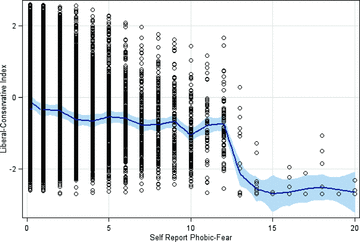
Fear is still used in political campaigns to steer public opinion, but a political scientist claims not everyone is equally predisposed to be influenced by that strategy. Who is most genetically predisposed to be swayed by fear?  Well, it is a humanities study done by someone with no science training, so take a guess.  Answer farther done if you can't connect the cultural dots.

Mothers get all the blame these days but a new paper led suggests that the father's diet before conception may play an equally important role in the health of their offspring. It also raises concerns about the long-term effects of current Western diets and of food insecurity.

A new review outlines the health effects of silica, and calls for action to reduce illness and death from silica exposure at work.

The home team holds the advantage over visitors, at least in the plant world, but a handful of genetic adaptations could even the playing field, according to a new paper.

Genetic tradeoffs, in part, explain the rich diversity of species on earth. If all plants could perform well in all climates, the world would have similar flora from the poles to the Equator. Trade-offs, however, such as protection from freezing temperatures in exchange for growing larger, must be made by plants, limiting the regions where they can flourish.

Shaving foam and baby diapers might not be the first key components to spring to mind if you were tasked with developing a gargantuan Non Lethal Weapon (NLW) for use against enemy warships.
But spring they did, however, to the mind of Lieutenant Commander Daniel L. Whitehurst of the United States Navy –  for he describes just such a weapon in a 2009 research report originating from the Air Command And Staff College, Air University, Maxwell Air Force Base, Alabama. (“The Intellectual and Leadership Center of the Air Force.”)

That weapon is ‘The Slimeball’

No, this is not an article about top models. Rather, the subject of discussion are models that predict the existence of heavy partners of the top quark.
Blood clots may be a good thing - at least in protecting the body from the deadly effects of bacteria by absorbing bacterial toxins, according to a new paper in PLoS ONE.

Even with modern antibiotics, septic shock from bacterial infections afflicts about 300,000 people a year in the U.S., with a mortality rate of 30 to 50 percent. Septic shock is caused by Gram-negative bacteria, which release a toxin called lipopolysaccharide or endotoxin. In small amounts, lipopolysaccharide triggers inflammation. When infections with these bacteria get out of hand, lipopolysaccharide courses through the bloodstream, causing catastrophic damage to organs and tissues.

Some papers say that meditation can have beneficial health effects, and that makes sense, but a new paper claiming evidence of specific molecular changes in the body following a period of mindfulness meditation is likely the first of its kind.

The scholars investigated the effects of a day of intensive mindfulness practice in a group of experienced meditators, compared to a group of untrained control subjects who engaged in quiet non-meditative activities. After eight hours of mindfulness practice, the meditators showed a range of genetic and molecular differences, including altered levels of gene-regulating machinery and reduced levels of pro-inflammatory genes, which in turn correlated with faster physical recovery from a stressful situation. 


Peer-reviewed articles are taking off on Twitter - whether or not people have read them is another story.

But someone read them during peer review so more exposure is good even if, in the case of legacy journals, people can only read the abstract.


