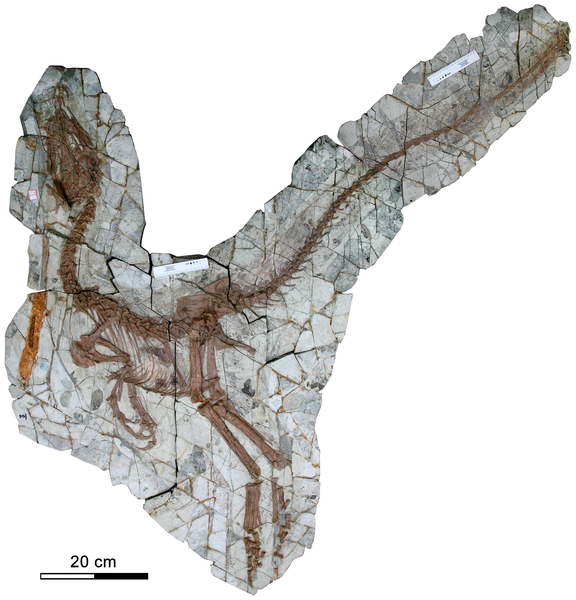
Analysis of the abdominal contents of two dinosaur fossil specimens reveals new information about their hunting and eating behavior, according to a new report. They may have been stealth hunters.
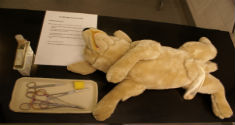
Danish veterinarians are a little squeamish about working on dead animals - instead of encouraging them to find other careers, the Faculty of Life Sciences at the University of Copenhagen is encouraging them to work on stuffed animals to lessen their anxiety.
The stuffed animal operating room laboratory allows students to train basic surgical skills on toys which resemble animals, featuring organs, veins and arteries. Measurements of students' heart rate, questionnaires and interviews show that after attending the 'teddy laboratory', students are less fearful about the possibility of surgery on living animals.
Politicians make a lot of promises when they are trying to get elected. So many they probably can't keep track of them of them. That's understandable. Believing candidates is one of the 'sweet little lies' we tell ourselves.(1)
Whey protein has been primarily used by weightlifters but more recently gotten popular with other groups who need food supplements because of their diets. Whey protein is the protein contained in whey, the watery portion of milk that separates from curds when making cheese. The other protein from milk is casein protein.
So it sounds a little strange that True Nutrition is recalling its Whey Protein because its label does not disclose that milk is the source of the whey, when it is by definition derived from milk. The concern is people who are allergic to milk might have a reaction and the recall is voluntary. Obviously, people will not have to return it if they are not allergic to milk.
I am white. I am liberal. I went to a good college, but some might argue that I didn't get a good education. Certainly I like to study science to this day. Let me tell a medical story I went through which might be germane to a blog by Hank, "
Celiac: The Trendy Disease For Rich White People".
I have always been liberal about eating, as in I eat anything. I was skeptical about all food allergies. I also have insulin dependent diabetes. That is a disease that can kill you any day, but I am approaching my thirtieth year.
Modern culture is always trying to find new ways to catch bad guys more scientifically but as psychology has fallen in credibility, so has one of its more successful methods; profiling.
It isn't a new trend; after the terrorist attacks of September 11, 2001, there was outcry because the terrorists had not been arrested in advance. One bureaucrat came forward and was identified as a whistleblower because she had tried to raise alarm but that renewed the debate - she used 'racial' profiling about people from the Mid-East and had narrowed in on the right people.
Are you white and a little resentful that black people get their own cool disease, sickle cell anemia? There is good news for you. Celiac disease is all the latest rage and you can be any color at all and claim it.
How do you know if you are gluten intolerant? Elaborate assays? DNA? At least a blood sample? Nope, you just have to give up wheat and say you feel better and you are allowed to claim you have it. And proponents have even scarier numbers - they claim 97 percent of the people who have Celiac disease don't know they have it, so their ranks are really much bigger.
Standards of Transparency in Science?
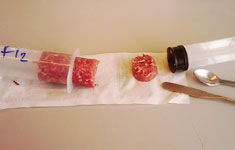
Helpful bacteria that processors add to acidify the sausage and make it safe for consumption are weakened by antibiotic residues in uncured pepperoni or salami meat, according to a new small-scale lab study in mBio.
Researchers studying the effects antibiotic residues in fermented sausages found that antibiotic concentrations within limits set by US and European Union (EU) regulators are high enough to slow fermentation, a process that acidifies the sausages and should destroy foodborne pathogens like Salmonella or E. coli.
For more than 180 years, the origin of Cerataspis monstrosa - monster larva - has been a mystery as deep as the ocean waters it comes from.
Researchers have been trying track down the larva that has shown up in the guts of other fish over time but found no adult counterpart. Until now.
George Washington University Biology Professor Keith Crandall cracked the code to the elusive crustacean's DNA this summer. It turns out this monster larva and the deep-water aristeid shrimp known as Plesiopenaeus armatus are one and the same: larvae and adult forms of the same species.