




During the Middle Palaeolithic, between 127,000 and 40,000 years ago, humans that lived along the banks of the river Manzanares (now Madrid, Spain) ate pachyderm meat and bone marrow, according to a study that found percussion and cut marks on elephant remains in the site of Preresa.

So if you want to try a fad paleolithic diet, get a cheap spear and see how you do bringing one of those babies down first.

I may have mentioned before that squid fishermen of the Falkland Islands go after two very different species: Illex argentinus, the shortfin squid, an open-ocean animal that migrates between Falkland and Argentinian waters, and Loligo gahi, the Patagonian squid, which is present in both Falkland and Argentinian waters but doesn't move much between the two.

Is it a shrub?  No one really knows. A fossilized specimen, a roughly elliptical shape with multiple lobes, totaling almost seven feet in length, was unveiled today at the North-Central Section 46th Annual Meeting of the Geological Society of America, in Dayton, Ohio.

Around 450 million years ago, shallow seas covered the Cincinnati region and harbored one very large and now very mysterious organism. Despite its size, no one has ever found a fossil of this "monster" until its discovery by an citizen paleontologist, Ron Fine of Dayton, last year. 

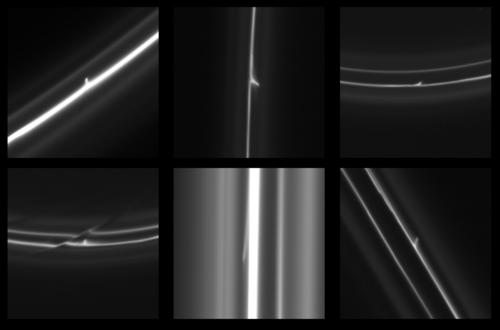
Half-mile-sized objects have been seen punching through parts of Saturn's F ring, leaving glittering trails behind them.  These mini-jets' trails in the rings fill in a missing link in our understanding of the curious behavior of the F ring. 

Scientists have known that relatively large objects like the moon Prometheus, 92 miles across, can create channels, ripples and snowballs in the F ring but what happened to these snowballs after they were created was unclear. 

Commonly prescribed anti-depressants appear to be doing patients more harm than good, say researchers who have published a paper examining the impact of the medications on the entire body.

Prostate cancer is a type of cancer that starts in the prostate gland and usually occurs in older men. Recent data shows that about 1 in 36 men will die of prostate cancer. Estimated new cases and deaths from this disease condition in the US in 2012 alone are 241,740 and 28,170, respectively. Current treatment options for patients include surgery, radiation therapy, hormone therapy, chemotherapy, and immune therapy. Unfortunately, these are associated with considerable complications and/or severe side effects.

When people talk about an “all of the above” approach to energy they’re usually referring to the sources we know – gas, hydro, nuclear, solar and wind. But a steady stream of emerging alternatives promises to take advantage of natural processes to produce zero-carbon electricity for untold millions. The latest entrant in this sounds-too-good-to-be-true energy sweepstakes: pressure-retarded osmosis, a kind of reverse water desalination that kicks off energy instead of consuming it.

I tried to figure out the precession of the perihelion of Mercury calculation out three or four times from my collection technical books on gravity.  There was never enough detail for me to follow their work.  The authors can rightly figure that anyone reading this part of their textbook is exceptionally good at physics compared to the general populace and will be able to fill in any missing details.

For those part-timers who wish to move beyond the "Brief History of Time" level of physics, this is an obvious thing to try and figure out.  Because gravity does not work instantaneously, there is a wee bit more wobble in the orbit of Mercury.  This blog hopes to provide all the detail needed.
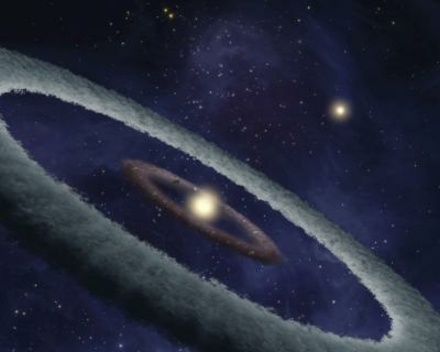
Here's an astronomy puzzles: Rather than occupying orbits at regular distances from a star, giant gas planets, like Jupiter and Saturn in our solar system, appear to prefer to occupy certain regions in mature solar systems while staying clear of others, which results in “planet pileups” and “planet deserts."

Researchers identified high-energy radiation from baby sun-like stars as the likely force that carves gaps in protoplanetary disks, the clouds of gas and dust that swirl around young stars and provide the raw materials for planets. The gaps then act as barricades, corralling planets into certain orbits. 
If you are freezing eggs or ovarian tissue to delay childbearing for social reasons, society should reply 'thanks, but no thanks', according to a recent analysis.


