



How much actual on-task work do you do on a typically work day? The myth is everyone produces 8 hours of useful, targetted work in an 8.5 hour work day (with unpaid lunch). Staying in the office extra hours, likewise, produces more useful work. I suggest you should measure this for yourself. Here's how to find out-- but you may want to hold off telling your boss quite yet.

As a freelancer, I have no salary or set work hours. I bill only for time spent on task. I use an electronic timer-- a stopwatch, really-- to track my time. Starting on a task? Timer on. Pause to check personal email or Facebook? Timer off. Back to task? Timer on.

Talking about relativity one should not forget Galileo's great contributions to - or perhaps in fact foundations of - physics. But more fun are Galileos researches on falling bodies and motion of projectiles, all mainly carried out by either real or Gedanken-experiments, the historians are not quite sure there.

But these Galileo experiments have been realized later and are both on YouTube and in Italian museums. 

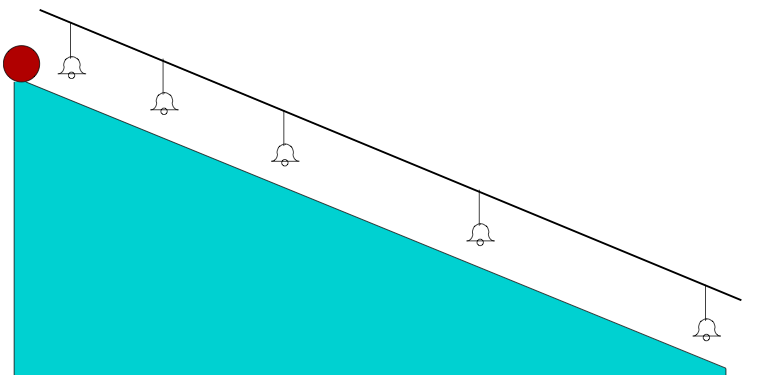
Here is a schematic picture, the rolling ball will produce regular bell sounds.

In case you don't know it, the Navy is not the 1970s "Village People" branch of the military.  These guys do some cool stuff and are making even cooler toys to do it with.

Want to find future tech for megawatt-class laser beams in next-generation weapon systems?  The Navy.   Want to go completely science fiction and find work on a railgun with a projectile that rides an electromagnetic current to its target?  The Navy.
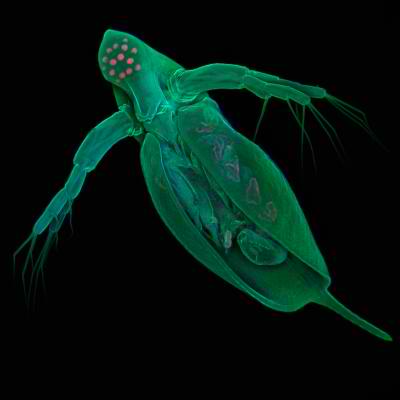
Humans have about 23,000 genes and we are at the top of the food chain but the animal with the most genes is the near-microscopic freshwater crustacean Daphnia pulex, or water flea, clocking in around 31,000.

Daphnia is the first crustacean to have its genome sequenced.   The findings are part of a comprehensive report by members of the Daphnia Genomics Consortium, an international network of scientists led by the Center for Genomics and Bioinformatics (CGB) at Indiana University Bloomington and the U.S. Department of Energy's Joint Genome Institute.
Coffee can be quite good for you, as any number of studies have shown.   But you still have to take some personal responsibility for moderation because companies like Starbuck's are not going to do it for you.    They're not in the personal responsibility business, they are in the drink business, so when they roll out a new size - the "Trenta" - this spring, all 31 ounces of it, they want you to buy it in any form you want.
There are exceptions, of course - some athletes will never be ethical no matter how much coaching they receive and not all coaches are ethical, but overall coaching helps athletes become more than better athletes.   

New survey data from Concordia University says coaches exert moral influence over athletes and how athletes respond.

Biofuels were all the rage in the 1990s, with Vice-President Al Gore declaring them the Holy Grail of fossil fuel replacement.    Unfortunately, no quality science agreed with that assessment yet they have been passed into law anyway by anti-science politicians who saw a way to please part of the voter base.
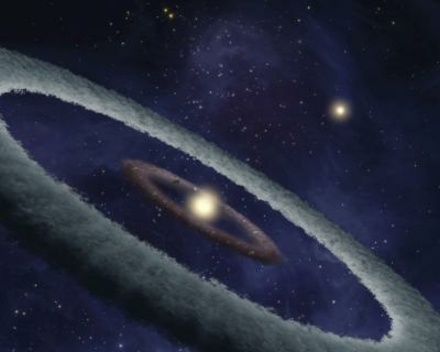
New papers in arXiv show that the Kepler space telescope continues to fulfill its mission of searching for exoplanets, especially those in the 'habitable' zone, a region where liquid water could exist on a planet's surface, around stars.
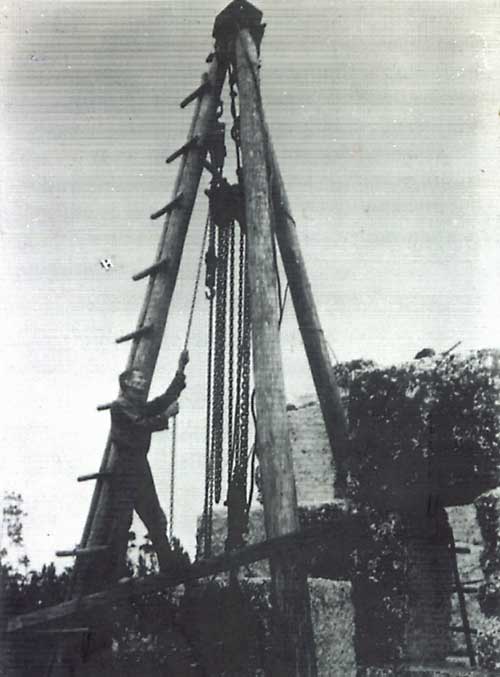
Despite the various claims surrounding the idea of alien visitation in the past, one of the primary arguments has been the creation of immense structures in the past that have been argued as being impossible to create without sophisticated modern technologies.  More to the point, the argument even suggests that it would take quite advanced technologies (even beyond our abilities today), to produce such construction projects.

Invariably the size of the blocks is mentioned (on the order of several tons to several hundred tons), as well as the issue of moving them, positioning them, and of course the precision involved in their placement.
A recent paper in the arxiv describes the observation, in 7 TeV proton-proton collisions produced by the LHC collider in the core of the LHCb detector, of a new decay mode of the particle called "B-sub-s", a meson which is a bound state of a anti-bottom-quark and an s quark.

