

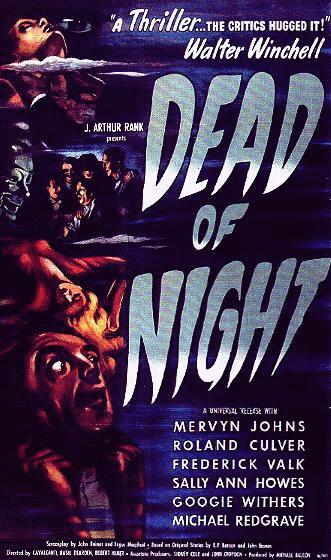
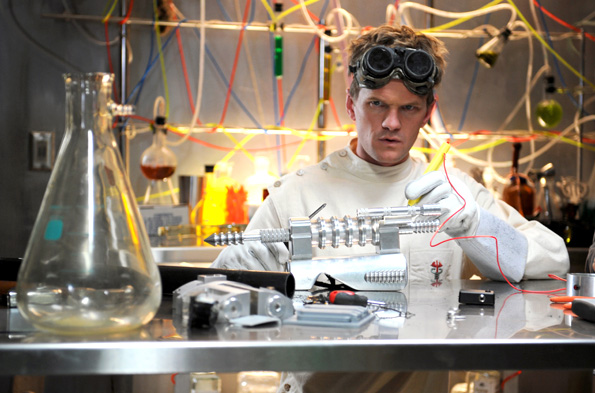



1950s horror movies were primarily irradiated monsters but they also contained a bit of a cultural slam - the heroes were often scientists but they were battling other scientists who were often not even evil, just in love with their data.    Science was the problem because it did not concern itself with ethics, was the mentality - it was even more confusing than that good Jedi versus bad Jedi stuff (really, since the 'Dark Side' had more power and was much easier and mostly meant taking orders from some old guy and not much actual evil, why wouldn't anyone choose the so-called Dark Side?) but it lent itself to philosophical discussions.

Dracula orchids tempt flies by masquerading as mushrooms. Goblin spiders lurk unseen in the world's leaf litter. The natural world is often just as haunting as the macabre costumes worn on city streets, as highlighted by two studies published this year by curators in the Division of Invertebrate Zoology at the American Museum of Natural History, David Grimaldi and Norman Platnick.

Biogeochemists say new evidence linking glacial events during the "Snowball Earth" period to the rise of early animals. 

The controversial Snowball Earth hypothesis, which originated in 1964 due to the discovery of glacial deposits near the equator, posits that on several occasions the Earth was covered from pole to pole by a thick sheet of ice lasting for millions of years.   These glaciations, far more severe than the usual Ice Ages, occurred from 750 to 580 million years ago, and in their aftermath, the oceans were rich in phosphorus, a nutrient that controls the abundance of life in the oceans, according to new research.
After watching "Five Million Years To Earth", a terrific mix of science, horror and anthropology, it's no crime to associate British horror cinema with Hammer Films, even though that was not one of the bloody Dracula films which earned them their fame.
This week I agree to give an invited talk at the AGU, soldered some more of my satellite, advised a student, gave several short lectures, and edited some papers.  All of these are things professors get paid for-- except the editing.  Yet, ironically, the editing was my only paying work.

I am a reverse professor.  I do many of the career tasks an academic does, but I only get paid for the private sector component.  And that's the part that a 'true academic' would do for free.

In practice, this means I have traded any form of job stability for complete academic freedom.  I can research anything I wish, write about any topic from any stance, and speak freely.  I have 'virtual tenure', only with no paycheck.

Here we have two words, one in Arabic and one in Hebrew, which scholars of those languages will have no difficulty in recognizing as descending from the same ancient Semitic source. In Arabic the word means “error” in the sense of “error message” from a computer. The Arabic version is pronounced “khata” (with an emphatic “t”), and the Hebrew is quite similar.

I’m sticking with the Arabic for now, because this is the jumping-off point for an interesting bit of medieval mathematical history.
In one description, an observer falls freely through empty space, in another one, she hits a surface smack on, yet both descriptions are completely equivalent. This example for a duality in modern physics was explained the last time in this series. There we saw that a black hole can also be described by a string theoretical membrane at the event horizon. The observer cannot escape the black hole because she literally gets stuck to the black hole’s event horizon, glued to it via strings.
ResearchBlogging.orgIn 1983, two scientists, one from California and one from Denmark, co-authored a research paper titled "Can odontocetes debilitate prey with sound?" Odontocete is a fancy term for toothed whales (the group that includes sperm whales, orcas, and dolphins) and so the question could be written thus: Can toothed whales stun their prey with loud noises?
I had the following article in the ICMPC 11 proceedings.

ABSTRACT

An often cited conclusion that musical chills are mediated by endogenous opioids (endorphins) is based on an experiment that showed the opioid antagonist naloxone reduced the chills rate of music in some subjects. However, we find some experimental problems with its methods, results and conclusion. Dr. Goldstein's experiment with musical chills and naloxone used 10 subjects, all music chill responders, and found that 3 had significant chill reduction related to naloxone. He did not provide the result showing if the other 7 had any reduction at all, and the assumption would be that they had no reduction in chills.

One of my son’s favorite before-bed books is a Bert and Ernie number called “Bert’s Hall of Great Inventions.” (http://muppet.wikia.com/wiki/Bert%27s_Hall_of_Great_Inventions) On each page poor Bert exalts in another human invention, only to be answered by Ernie that his animal friends came up with it first. The point of the book is very much true of science and human innovation in general, which is that we have and continue to rip-off nature to inspire some of our best work. It seems that we have done it again. At least this time, animals also may benefit.

