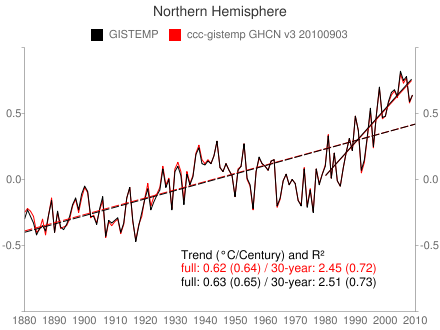
Climate science is in a difficult position. On the one side, climate scientists like James Hansen say that the data behind IPCC media talking points is too easy to misinterpret so people shouldn't have it, but to hard science people, climate science accuracy, in the science data sense, is far too inaccurate for claims that its people make. No one in physics could get away with the accuracy levels climate scientists regard as settled.
A week from now, Tuesday October 5th, the winner(s) of the 2010 Nobel Prize for physics will be announced. Predicting the Nobel laureates in physics is
notoriously difficult. As part of their overall Nobel prize predictions, each year Thomson Reuters
attempts to predict the winners in physics, but despite their habit of listing multiple candidates, so far they never managed to hit any of the annual winner(s).
This year
Thomson Reuters might, for the first time, be lucky.
Pickering is quite a name in the philosophy of science, or science studies, sociology of scientific knowledge (
SSK), or science and technology studies (STS).
He is especially interested in physics and
writes about so called “old” versus “new” science. He means and to this day insists on the difference being soft versus hard scattering in particle collider experiments, the latter being something that happened around the time he started to look into physics more than 30 years ago (oh coincidence).
A new study says sodium nitrate, like you get if you eat plenty of vegetables, reverses features of metabolic syndrome in mice.
Metabolic syndrome is the list of risk factors of metabolic origin that increase likelihood of getting cardiovascular disease and type 2 diabetes.
As obesity has increased, and the number of people with metabolic syndrome right along with it, various attempts have been made to identify a common underlying molecular mechanism for metabolic syndrome. One group has pointed to a defect in endogenous synthesis and bioavailability of nitric oxide (NO) and their new study says one contributing issue in metabolic syndrome is a decrease in the amount of nitric oxide from endothelial NO synthase (eNOS).
We know people have positive social behavior in part because of emotional reactions to real or imagined social harm - we may not like seeing others slighted or we may not want to be perceived as the kind of person who does that sort of thing.
But some are a lot more sensitive than others and a new study says that the neurotransmitter serotonin can directly alter both moral judgment and behavior through increasing our aversion to personally harming others, rather than just controlling violent impulses or helping you sleep.
Ronald Fisher, evolutionary biologist and statistician who
introduced the method of maximum likelihood and the fiducial interval into life sciences, said basically that the more complex a plant or animal is, the more difficulty it should have adapting to changes in the environment.
But there are well-adapted, complex organisms, orchids, humans, you name it, and confusion about 'cost of complexity' offers ammunition to proponents of Creationism, who hold that intricacy could only arise only through the efforts of a divine designer and not natural selection.
Unable to exercise? Some new research may be hope in keeping muscles from atrophy. Researchers from Stanford University have shown how to use light to induce muscle contraction.
But don't cancel your gym membership just yet. The study used bioengineered mice whose nerve-cell surfaces were coated with special light-sensitive proteins.
They used a technology known as optogenetics, which involves the insertion of a specialized gene derived from algae into the genomes of experimental animals. This gene encodes a light-sensitive protein that situates itself on nerve-cell surfaces. Particular wavelengths of light can trigger nerve activity in animals endowed with these proteins, modifying nerve cells' firing patterns at the experimenters' will.
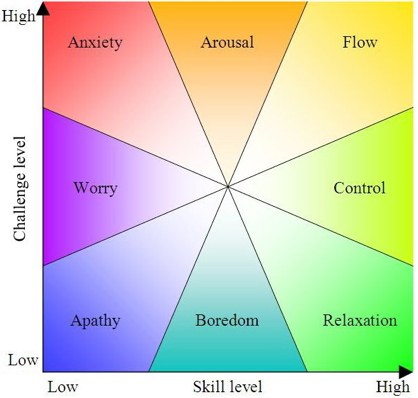
'Flow', or the 'flow state', refers to what you might know as being 'in the zone'. It is that state where you are wrapped up in the activity that you are doing, so much so that you are 'one' with it (in the sense of being fully engaged that is; not a strange zen thing).
The main researcher of flow is the delightfully unpronounceable Mihaly Csikszentmihalyi (Chick-sent-me-high). Generally it is associated with more intrinsic motication for the activity in question, and although you lose sense of yourself and time while you are in flow, you are said to return with a stronger sense of self afterwards.
Conceptualisation of Flow
Did you find
yesterday's personalized horoscope spookily accurate? Isn't it amazing how precisely the websites you visit allow description of who you are?
In fact (as many of you guessed), it's a trick.
The Large Hadron Collider is increasing gradually the number of proton bunches that circulate in the machine. Yesterday's fill saw 104 colliding proton bunches, producing the record instantaneous luminosity of 3.5 x 10^31 collisions per square centimeter per second. This is no surprise, of course: luminosity is essentially the product of the number of particles crossing each other per second divided by the cross section of the beams, so if you increase the particles and manage to keep the beam transverse size constant, luminosity must go up.