Our ideal image of the perfect partner differs greatly from the one we have, according to new research from the University of Sheffield and the University of Montpellier in France.
Why would we choose partners with a different height, weight and body mass index than those we would ideally choose?
It may be that we take what we can get.
The study found that most men and women express different mating preferences for body morphology than the actual morphology of their partners and the discrepancies between real mates and fantasies were often larger for women than for men.
Stem cells help regenerate or repair damaged tissues, primarily by releasing growth factors that encourage existing cells in the human body to function and grow.
There has been an ongoing ethical controversy about human embryonic stem cell research but progress has been made nicely using adult stem cells, such as from marrow donors.
It may be just a coolness factor for kids, but one classroom in Canada is getting a big boost in reading thanks to canine teaching assistants.
University of Alberta researcher Lori Friesen's says one Alberta classroom showed positive success when small children signed up for weekly reading or writing sessions with her and one of her dogs. During that time, they would read children's literature or work on the student's writing.
A thirteen year old girl from Montana was visiting family in the Denver area. The sight of a huge cloud of smog in the sky made the girl think, “Oh my gosh! What are we doing?” This shocking discovery led to an interest in renewable energy.
Today, that young lady is Chandra Macauley and she's a student at Montana State University majoring in chemical engineering. In 2009, she studied abroad in Sweden where she experienced a new perspective on renewable energy that showed her promising results she felt could serve as a model for renewable energy development in the United States. She disagrees with people that say going green isn't economical because an entire country is proving that renewable energy is a viable solution.
It’s been a little more than two years since I finished my master’s in psychology, and I was looking through some of the work I’d done in my social psychology class when I ran across a discussion post on implicit and explicit norms. At the time I was an adjunct instructor in developmental reading and writing; I've just this semester moved to a full-time English instructor position.
The piece remains of interest to me, both because of my role as an instructor and as mom to three on the spectrum. Explicit norms are for obvious reasons easy to grasp; they’re the rules that are clearly stated; implicit norms are much harder, especially for folks who have difficulty with socially-based learning.
You’ve heard that space is curved – that’s gravity. You’ve also been told that you cannot really understand curved space. Sure, you can come to know curvy mathematics by studying general relativity or differential geometry, but you cannot grasp curved space in your bones…for the obvious reason that, in our everyday human-level world, space is flat, and so we have a brain for thinking flat.
Or, at least, that’s what they say.
But there is at least one variety of curvy mathematics that your brain comprehends so completely that you don’t even know you know it. It concerns your visual field, and your innate understanding of the directions from you to all the objects in your environment.
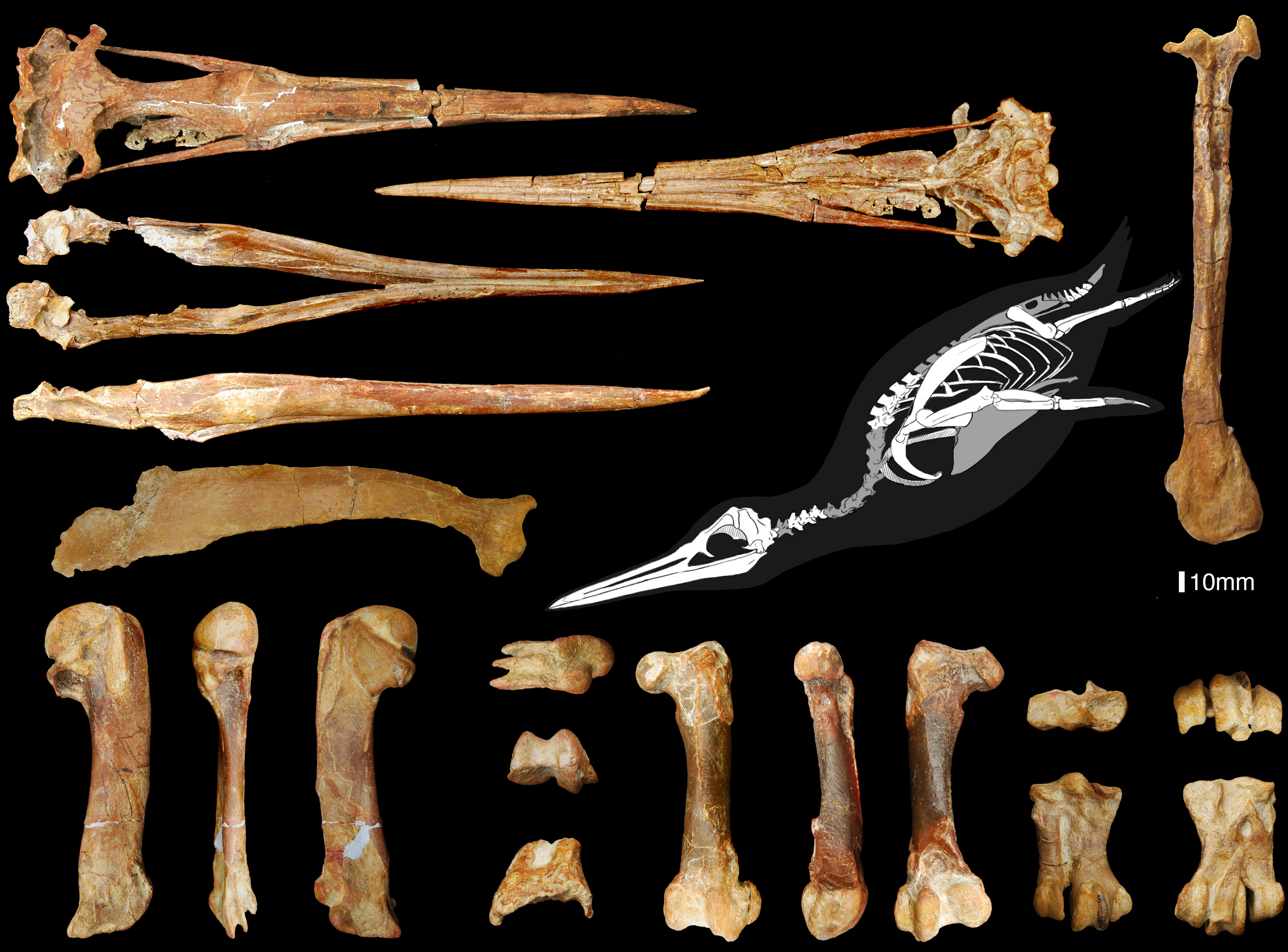
A 36-million-year-old penguin fossil from Peru shows the new giant penguin's feathers were reddish brown and grey, much different from the black tuxedoed look of living penguins - and it had scales.
The new species, Inkayacu paracasensis, or Water King, was nearly five feet tall - twice the size of an Emperor penguin, the largest penguin today. The fossil shows the flipper and feather shapes that make penguins such powerful swimmers evolved early, while the color patterning of living penguins is likely a much more recent innovation.

Georges Charpak, a French physicist and 1992 Nobel Prize winner, died yesterday.
Of Polish origin, Charpak gave crucial contributions to experimental physics, in particular for his invention of the multiwire proportional chamber in 1968.
Back then, the signal of passage of charged particles was recorded by bubble chamber images and images triggered by spark chambers - where the charge deposition would create a discharge in a very high electric field.
Proteins are the heavy lifters of cells, doing numerous tasks, but how the shape of a protein determines function remains one of the most important questions in the physics of biology.
Proteins are not the static, Lego-like objects you might see in an x-ray photograph in a textbook, they are made from long chains of amino acids scrunched into various blobs and a protein is always changing to slightly different structural arrangements due to thermal motion of its atoms. Even a modest-sized protein like myoglobin has an unimaginable number of possible arrangements of its atoms and each of these arrangements slightly changes its function.
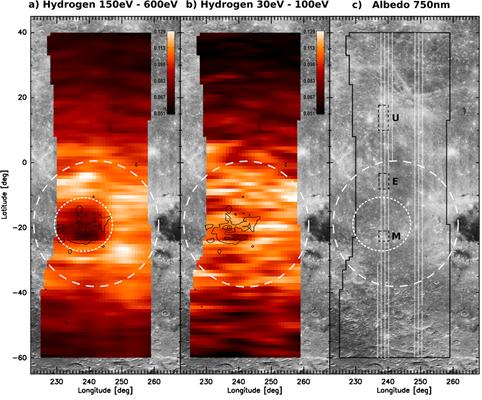
Scientists have discovered a new type of solar wind interaction with airless bodies in our solar system. Magnetized regions called magnetic anomalies, mostly on the far side of the Moon, were found to strongly deflect the solar wind, shielding the Moon’s surface, a discovery which will help us to understand solar wind behavior near the lunar surface and how water may be generated in its upper layer.