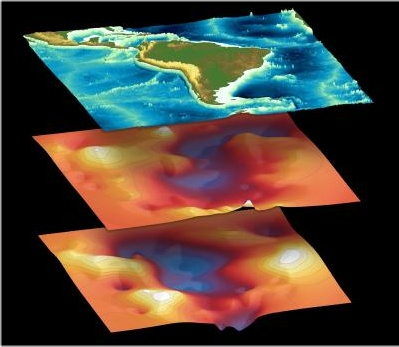
Ice loss in Greenland, which has been increasing during the past decade over its southern region, is now moving up its northwest coast, according to a study published in Geophysical Research Letters.
A comparison of data from NASA's GRACE Satellite and continuous GPS measurements made from long-term sites on bedrock on the edges of the ice sheet revealed the ice loss. The study indicates the ice-loss acceleration began moving up the northwest coast of Greenland starting in late 2005.
Foods spiked with "fructans" from the agave plant, the source of tequlia, may help protect against osteoporosis by boosting the body's absorption of calcium and could have other health benefits, according to research presented today at the ACS National Meeting.
Fructans are non-digestible carbohydrates. They consist of molecules of fructose -- the sugar found in honey, grapes, and ripe fruits -- linked together into chains. Rich natural sources include artichokes, Jerusalem artichokes, garlic and onions, and chicory. Fructans do not occur in tequila, however, because they change into alcohol when agave is used to make tequila.
Geophysicists have developed a new model of the Earth, 20 years in the making, that offers a precise description of the relative movements of 25 interlocking tectonic plates that account for 97 percent of the Earth's surface.
Dubbed MORVEL for "mid-ocean ridge velocities," the new model is detailed in Geophysical Journal International. The work builds on a 1990 study describing tectonic plate velocities. During the past 20 years, researchers have incorporated more and higher-quality data to improve the model's resolution and precision.
Why Cow-Driven Global Warming Is A Load Of Bull
All animals breathe in air and then breathe it out again. This astounding fact, seemingly new to some web users, has nothing whatsoever to do with global warming.
Some people are still seemingly astonished to find that cows breathe out air deficient in oxygen and with a surfeit of CO2. They eagerly report this brand new finding to a breathless crowd of eager supporters of any 'proof' that humans are not responsible for the inexorable rise in global CO2.
Readers of this blog know that I am not fond of Krista Tippett, the fuzzy thinking host of National Public Radio’s “Speaking of Faith” (it really ruins my early Sunday mornings). She and New York Times’ columnist Stanley Fish make for entertaining targets when I feel like venting at irrationality disguised as profundity. And now Tippett has done it again.
A newly constructed climate record from the Triassic-Jurassic boundary explains how the dinosaurs rose to prominence as the Triassic Period ended, says an international team of geologists and paleobiologists writing in PNAS.
Researchers reconstructed the climate from the Triassic-Jurassic boundary by combining fossil evidence of plant and animal extinctions with the carbon signature found in the wax of ancient leaves and wood found in lake sediments intermixed with basalts.
In paintings of the last supper from last Millennium, the sizes of the portions and plates have gradually grown bigger and bigger, according to a forthcoming study in the International Journal of Obesity.
The finding suggests that the phenomenon of serving bigger portions on bigger plates – which pushes people to overeat – has occurred gradually over the millennium.
"We took the 52 most famous paintings of the Last Supper (from the book 'Last Supper,' 2000) and analyzed the size of the entrees, bread and plates, relative to the average size of the average head in the painting," said Brian Wansink, the John S. Dyson Professor of Marketing and of Applied Economics and director of the Cornell Food and Brand Lab.
Research has shown that healthy people can benefit from moderate alcohol consumption.
And a new analysis in the Journal of the American College of Cardiology suggests that patients who have already suffered a heart attack, stroke or another ischemic vascular event can reap these benefits, too.
Researchers analyzed the most important scientific studies performed during the last years. Eight in total in four Countries: United States, Sweden, Japan and Great Britain. Each study took into account patients already affected by an ischemic vascular event.
According to a new study in the Journal of Consumer Research, what we think of a product or brand, or how positively or negatively we assess it, depends on the context in which it is viewed.
The research suggests that marketers have to carefully construct and consider the context to get the desired results.
"Although [consumers] generally think their judgments reflect the true quality of the products, many irrelevant contextual factors from the weather to another product brand can influence consumers' evaluations," the authors write.
The study was based on four experiments that looked at how consumers compare and contrast products and brands and what it takes to get them to positively or negatively evaluate them.
Most people think that money is the solution to their problems. But that may only be true if they acquire enough money to improve their social rank, according to a new study in Psychological Science. The study found that a bigger paycheck was not the solution if it did not make the recipients wealthier than their neighbors, friends and colleagues.
Researchers from Cardiff and Warwick Universities looked at data on earnings and life satisfaction from seven years of the British Household Panel Survey (BHPS), which is a representative longitudinal sample of British households.