




In creating a science site for kids (that would be Kids Science Zone - if you haven't written anything there, feel free to do so) , the majority of comments I have gotten have been likely about the same as I would have gotten if I had opened up this site to a large community of people with advice to give - namely a lot of suggestions from people who don't use it about how awesome it would be if it had X, Y or Z added.
Readers of this blog may begin to think that I have a personal antipathy for New York Times editorialist Stanley Fish. I don’t, really. Don’t even know the guy. And yet, somehow he manages to get criticized in writing by yours truly more often (and certainly more harshly) than Richard I-don’t-know-what’s-wrong-with-Bill-Maher-but-I’ll-endorse-his-award Dawkins.
Where does evolution leave God? This question has been debated for over a century, and it likely isn't going anywhere any time soon. Some may feel, myself included, that the glut of fighting among the camps should just be put to rest, like the new song on the radio that is played every five minutes. One is about science, one is about religion. Over and done.

Occasionally I'll come across an article that still sparks my interest (like the many on Scientific Blogging, of course). One such article was an essay featured in the Wall Street Journal, in the vein of point/counter-point, but neither writer knew what the other was going to say.1
I recently attended the International Developmental Biological Congress in sunny Edinburgh, Scotland. Here is my diary.

Day One

Saturday, 8:15 AM: Arrive Edinburgh hotel, early. Wait for room in hotel bar.   Soccer, a hateful game, blares at 8:30 in the morning. Bourbon appropriate?

 Saturday, 5:15 PM: Take walking tour of city. Discover no one in Scotland speaks English.

Day Two

Sunday, 1:00 PM: Pick up press credentials.  Easy because no other sane journalists here.
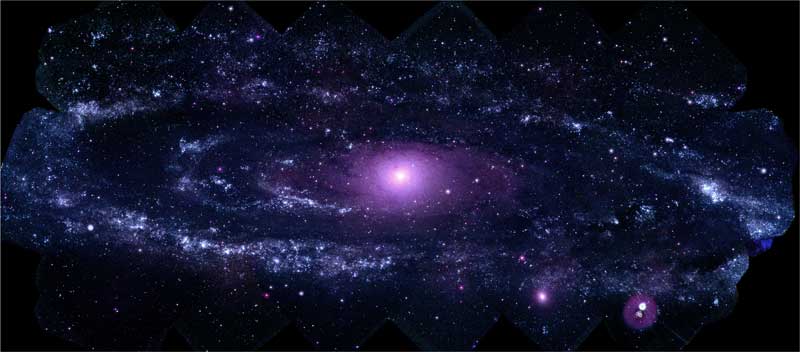
NASA's Swift satellite has acquired a new high-resolution view of a neighboring spiral galaxy; M31 in the constellation Andromeda, the largest and closest spiral galaxy to our own.

M31, also known as the Andromeda Galaxy, is more than 220,000 light-years across and lies 2.5 million light-years away. On a clear, dark night, the galaxy is faintly visible as a misty patch to the naked eye.

Between May 25 and July 26, 2008, Swift's Ultraviolet/Optical Telescope (UVOT) acquired 330 images of M31 at wavelengths of 192.8, 224.6, and 260 nanometers. The images represent a total exposure time of 24 hours. 
In a recent LiveScience article the following statement was made:
"And while metacognition can involve self-awareness, the "I" part of the equation isn't a necessary ingredient, Smith said. Scientists are not sure if other animals possess self-awareness."
Peter Lawrence in PLoS Biology writes about the story of K.:
A new gene called AP2gamma has been discovered to be crucial for the neural development of the visual cortex in a discovery that can have implications for the therapeutics of neural regeneration as well as provide new clues about how the brain evolved into higher sophistication in mammals. The article will come out in the journal Nature Neuroscience1 on the 14th of September.
What do engineer Burt Rutan, hotel magnate Robert Bigelow, and game programmer John Carmack have in common? Answer: they've built the first private earth-to-space rocket, space station, and lunar lander in the current new space race.

Most people are familiar with Scaled Composite's X-Prize $10 million victory with SpaceShipOne, the first private reusable multi-flight manned spacecraft to succeed. But note 'first'-- they were not the only competitor. Just the first tick on the space race radar.
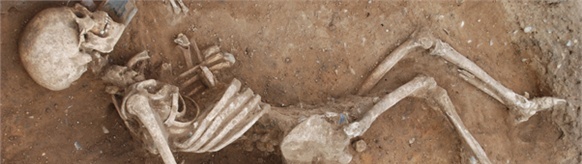
The buried town of Venta Icenorum at Caistor St Edmund in Norfolk is one of the most important, though least understood, Roman sites in Britain.

Caistor lies in the former territory of the Iceni, the tribe of Boudica Celts who famously rebelled against Roman rule in AD 60/61.

The survey revealed numerous circular features that apparently predate the Roman town.  These are probably of prehistoric date, and suggest that Caistor was the site of a large settlement before the Roman town was built. This had always been suspected because of numerous chance finds of late Iron Age coins and metalwork, but until the survey was carried out there had never been any evidence of buildings.

