Premier League clubs who have long-term managers are more successful than those who change their managers on a frequent basis, say business school researchers.
Because there's nothing sports clubs want more than advice from academics who examine past trends and draw conclusions based on the fact that elite clubs fire people less.
The lowly appendix used to get no respect and was simply regarded as a useless evolutionary artifact but two years ago researchers at Duke University Medical Center proposed that it actually serves a critical function as a safe haven where good bacteria could hang out until they were needed to repopulate the gut, like after a nasty case of diarrhea.
Now a group writing in the Journal of Evolutionary Biology claim something even more aggressive; that Charles Darwin was wrong and the appendix is a whole lot more than an evolutionary remnant. Not only does it appear in nature much more frequently than previously acknowledged, but it has been around much longer than anyone had suspected.
Annoyed that your child schleps home 35 lbs. of books and settles in for 3 hours of homework per night? Dreaming of an ancient time when teachers teached during the day?
Nope. Contrary to common belief, parents are okay with the homework load, according to a new study from University of Nebraska-Lincoln researchers.
Students are spending considerable time doing homework but parents are generally supportive of homework practices, their study says. They're also involved in homework, usually in minimal but supportive ways, said Ken Kiewra, UNL professor of educational psychology and an expert on learning strategies, homework and study methods.
Researchers at Virginia Tech believe they have solved the controversy over how the oldest complex life forms, which lived more than 540 million years ago, ate. Osmosis, they say.
The researchers studied two groups of modular Ediacara organisms, the fern-shaped rangeomorphs and the air mattress-shaped erniettomorphs. These macroscopic organisms, typically several inches in size, absorbed nutrients through their outer membrane, much like modern microscopic bacteria. The rangeomorphs had a repeatedly branching system like fern leaves and the erniettomorphs had a folded surface like an inflated air mattress to make tubular modules.
Science fact or urban legend? If you get lost, you will walk in circles, just like you have seen in too many movies and TV shows to count.
Fact, say researchers from the Multisensory Perception and Action Group at the Max Planck Institute for Biological Cybernetics in Tübingen writing in Current Biology, though there was no scientific evidence to back that up until now.
And those circular paths are rarely systematic, the researchers say. The same person may sometimes veer to the left, then again to the right, before ending up back where they started from, which rules out one potential explanation for the phenomenon, namely that circle-walking stems from some systematic bias to turn in one direction, such as differences in leg length or strength.
As I start my 5th semester here at Auburn University, I will again be teaching introductory labs. I would not say I have a passion for teaching, but it is my deepest desire for the students I teach to learn something about their planet and maybe even consider Geology as a career. However, with the hundreds of students that have passed through my classroom, Only a small handful have been enthusiastic about it. Even a smaller number have switched to major (or minor) in it.
Today, I was met by a science-debunker (laugh a little, you know you want to.) He didn't know that I work in the field of biotechnology, or that I am a scientist. I am often met with the, "you're too pretty to have a high IQ," mentality, so I tend to take the route of listening to the blather before I correct them. It makes their judgment of my level of intelligence seem so much more embarrassing. Cruel? Perhaps a little.
He had heard through friends that I am an atheist (according to him, this is synonymous with devil worship, and he wished only to save me from an eternity in hell.) We proceeded to have a half-religious-half-philosophical conversation discussing the bible, stoicism and how misguided I am, but that's a story for another entry.
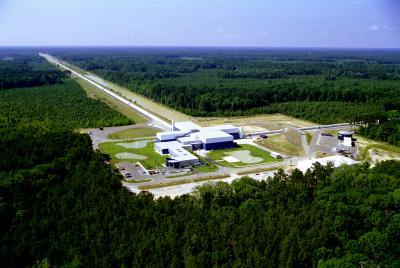
The Big Bang is believed to have created a flood of gravitational waves that still fill the universe with information about its existence immediately after the Big Bang. These waves would be observed as the "stochastic background," analogous to a superposition of many waves of different sizes and directions on the surface of a pond. The amplitude of this background is directly related to the parameters that govern the behavior of the universe during the first minute after the Big Bang.
Our teeth can withstand an enormous amount of pressure over a period of decades but tooth enamel is only about as strong as glass.
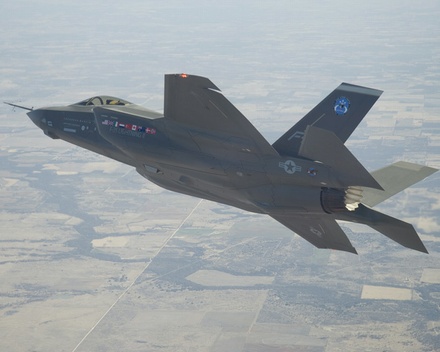
The mystery of teeth may become a solution to future aircraft design concerns, according to a a new study by Prof. Herzl Chai of Tel Aviv University's School of Mechanical Engineering and colleagues at the National Institute of Standards and Technology and George Washington University.
The automotive and aviation industries already use sophisticated materials to prevent break-up on impact. For example, airplane bodies are made from composite materials ― layers of glass or carbon fibers — held together by a brittle matrix.
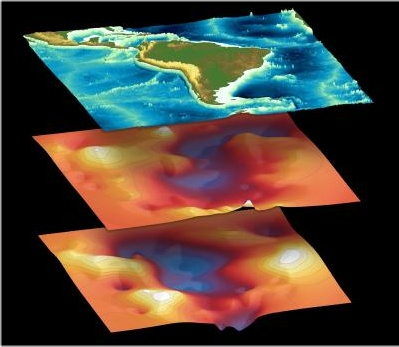
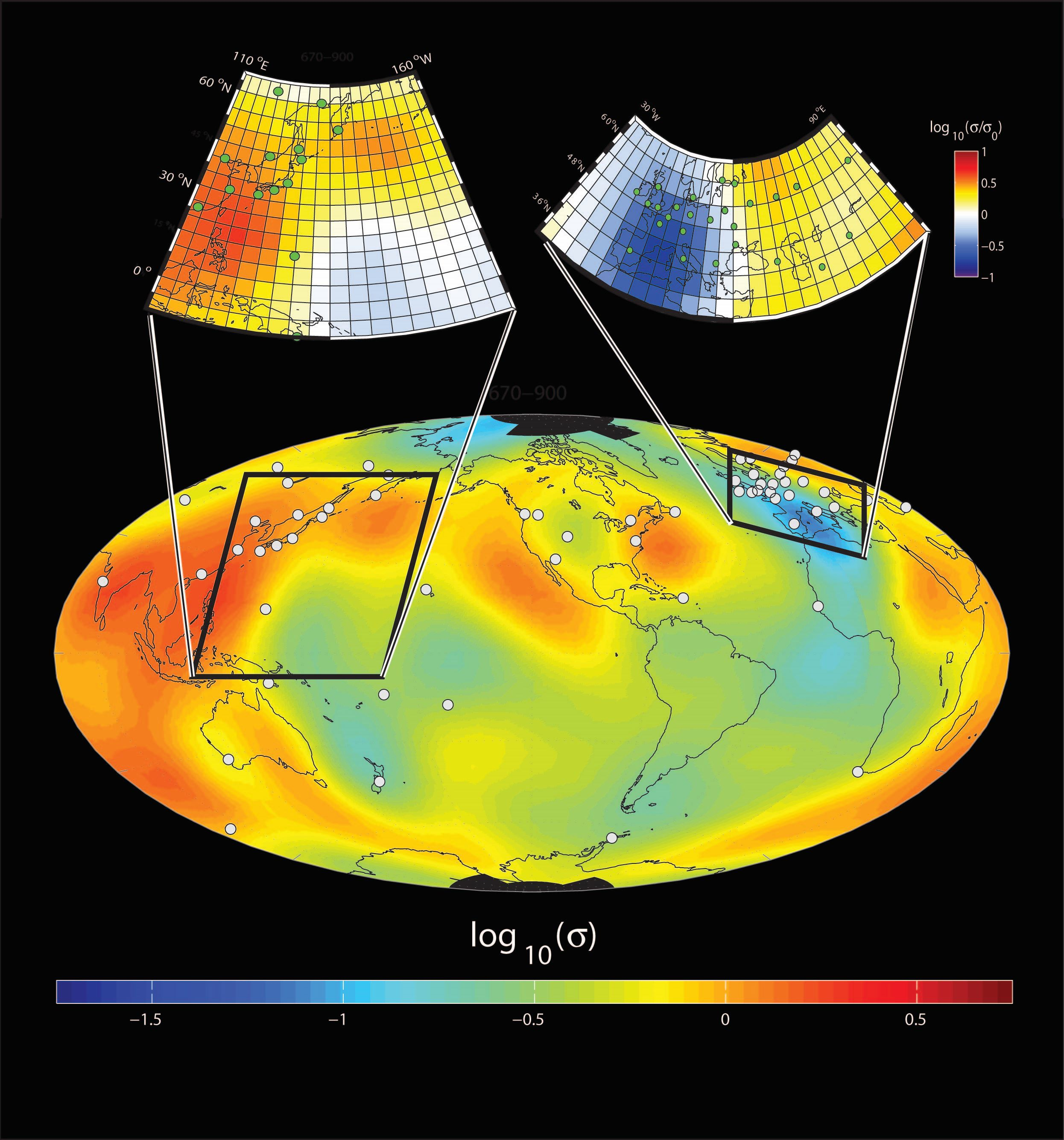
A team of scientists from Oregon State University has created the first global three-dimensional map of electrical conductivity in the Earth's mantle and their model suggests that that enhanced conductivity in certain areas of the mantle may signal the presence of water.
What is most notable, the scientists say, is those areas of high conductivity coincide with subduction zones – where tectonic plates are being subducted beneath the Earth's crust. Subducting plates are comparatively colder than surrounding mantle materials and thus should be less conductive. The answer, the researchers suggest, may be that conductivity in those areas is enhanced by water drawn downward during the subduction process.
Results of their study are being published this week in Nature.