



Craig Venter says that in a few months, his team will have created the first genuine artificial life form. As you may recall, Venter's team did the first whole genome transplant a few years back, which involved taking the genome of one species of bacteria and putting it into the genome-free cell of another closely related species. The new hybrid species was able to reboot with the new genome. According to The Times:

Artificial life will be created within four months, a controversial scientist has predicted. Craig Venter, who led a private project to sequence the human genome, told The Times that his team had cleared a critical hurdle to creating man-made organisms in a laboratory.
An international team has sequenced the genome of Schistosoma mansoni, a parasite that infects 200 million people in 76 countries through freshwater snails.

The US is not one of the affected countries because we don't have the snails that carry the Schistosoma mansoni parasite, though Americans at risk include those traveling in the Peace Corps, on business or for church missions.   The new research is the largest genome sequencing of a parasite to date. 
A sense of pleasure generated by the brain’s hedonic neural systems is fundamental to daily life and it's been essential for evolution and the survival of humans and most animals, say Morten Kringelbach and Kent Berridge, editors of a new book to be published by Oxford University Press in October 2009 called Pleasures of the Brain.

Here's a little exercise in scientific thinking. What's wrong the approach to science described in the following passage? (This passage, about applying network analysis to counterterrorism, is taken from the complex systems special feature in the July 24th issue of Science.)
New research led by Michael Symonds, Professor of Developmental Physiology in the School of Clincal Sciences at The University of Nottingham, says Brown adipose tissue (BAT), the brown fat found in abundance in hibernating animals and newborn babies, could be the key to new ways of preventing obesity.

Studies have previously shown that BAT activity in adults is reduced with obesity, so logically  promoting BAT function could prevent or reduce obesity in some people. 

Symonds now says that daylight is a major factor in controlling BAT activity.  “Our research has suggested a previously unknown mechanism for controlling BAT function in humans and this could potentially lead to new treatments for the prevention or reversal of obesity.”
Would you like to make your own black hole before the LHC supposedly dooms us all (though it has to stop breaking first before it can unleash  physics-induced Eschaton)?
 
Dartmouth researchers say they may be able to do it.

Writing in Physical Review Letters, they propose a new way of creating reproduction black holes in the laboratory on a much-tinier scale than their science-fiction staples. 

The new method, if it works, would create tiny quantum-sized black hole and allow researchers to better understand what physicist Stephen Hawking proposed more than 35 years ago; that black holes are not totally void of activity, they emit photons, what is now called Hawking radiation. 

Biomass refers to all the matter that can be obtained from photosynthesis. Most vegetable species use solar energy to create sugars from carbon dioxide and water. They store this energy in the form of glucose or starch molecules, oleaginous, cellulose, and lignocellulose .Biomass appears to be an attractive feedstock for three main reasons.

First, it is a renewable resource that could be sustain ably developed in the future. Second, it appears to have formidably positive environmental properties, notably the recycling of carbon in the biological processes, resulting in no net releases of carbon dioxide and a very low sulphur content.

My kids asked me if there was enough water in the universe to quench the Sun.  I voted yes, but of course science isn't about voting, but about verifiable facts.  So now the explanation.

The Sun has a mass of around a third of a million Earths.  Stealing a figure from MadSci.org, the mass of water on the Earth is 1/4400 the total mass.  We'll say we need enough water to completely douse every atom in that fusion-burning puppy we call Sol, so we'll need... 4400 * 0.3 * a million Earths. 

This works out neatly to just over a billion Earths, to get enough water to douse the Sun.

I just spent an extended weekend in Montréal (Picasa album with some highlight photos), and one thing I noted is the parking payment system — New York is adopting a similar system.

In some places, they still have the old parking meters (well, for some value of “old”; they’re digital), and I used one of those — you put coins in, and the time on the display increases up to the maximum.

On the big list of environmental challenges we face, you might worry about volcanic ash or industrial soot or farting cows ... some people are even concerned by an obscure greenhouse gas named carbon dioxide.    But you probably aren't concerned about the global impact of those rare rocket launches.

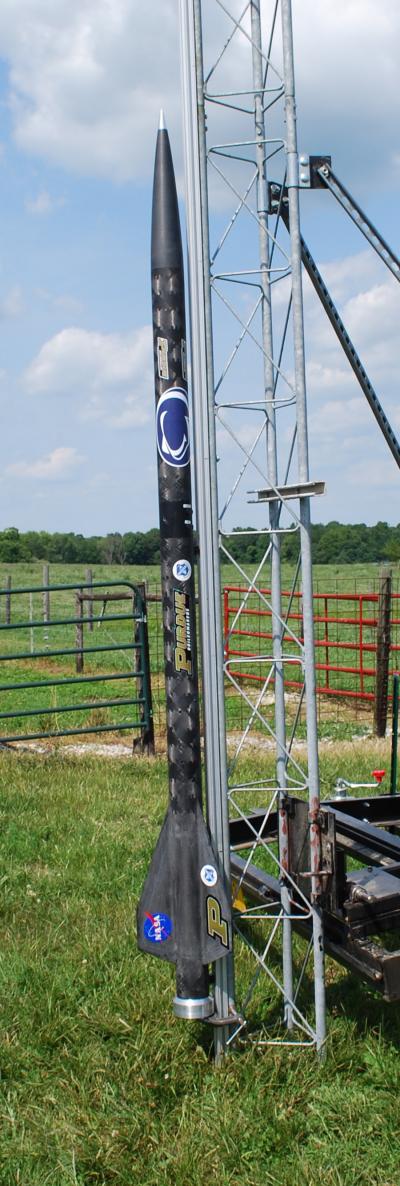
Going green is big, though, so efforts to make green rocket propellant are getting funding.   Thus, NASA and the Air Force Office of Scientific Research are pleased  to accounce they have successfully launched a small rocket using an environmentally-friendly, safe propellant comprised of aluminum powder and water ice, called ALICE.


