




The human papillomavirus (HPV) vaccine is a contentious debate.   A large pharmaceutical company with budget to spend can't usually find a friend in science but even with vague benefit it's difficult to argue against protecting children or opening debate about the value of all vaccines by being critical of one.
The Commonwealth Fund,  a private foundation devoted to health care reform, has issued a report saying that President Obama's proposed health care plan would help more than 13 million uninsured young adults ages 19-29 gain coverage.
Now that people have finally realized ethanol is a government-run, unscientific boondoggle, efforts are under way to make legitimate biofuels efficient enough for mass usage.

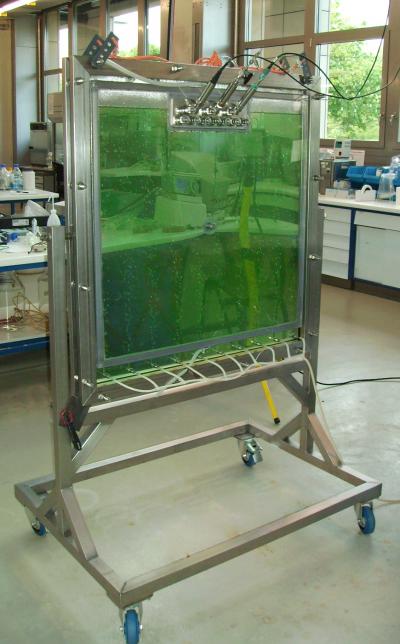
Microalgae are monocellular, plant-like organisms that use photosynthesis and convert carbon dioxide (CO2) into biomass. From this biomass, both potential resources and active substances as well as fuels like biodiesel may be produced. While growing, algae take up the amount of CO2 that is later released again when they are used for energy production. Hence, energy from algae could potentially be produced in a CO2-neutral manner contrary to fossil fuels or current biofuels.
As kids, we all liked to imagine scenes where big dinosaurs squared off against each other for gigantic battles - if you're young, imagination is like a Transformers movie, but without $100 million for special effects.  

Those battles rarely happened, if at all, goes a new hypothesis.    Dinosaurs became chickens in evolution (well, maybe) but they were already chickens at heart, say paleontologists at Ludwig-Maximilians-Universität (LMU) in Munich.
Usain Bolt, sprinter from Jamaica, currently holds the world record in the 100 meter sprint with a time of 9.69 seconds.  Whenever new records are set, people ask 'what is the limit on human performance?'

So how fast can a human run?  

Two econometricians from Tilburg University in the Netherlands, Professor of Statistics John Einmahl and former student Sander Smeets, say have calculated the ultimate records for the 100-meter sprint. The good news; there is still room for improvement in both the men's and women's times in the near future.
Uncompressed hydrogen will require a tank the size of a bus to take your car 300 miles but compressed hydrogen can be ... explosive ... unless the materials for storage get a lot better.

Engineers in the Department of Energy's Pacific Northwest National Laboratory have a different idea entirely:  they want to pack hydrogen into a larger molecule.

There are obstacles.   A gas flows easily out of a tank but getting hydrogen out of a molecule requires a catalyst. New details about one such catalyst in the Journal of the American Chemical Society may be a step toward better hydrogen energy applications such as fuel cells.
As you might imagine, I get a lot of press releases.  As I have said here before, I like getting them because it's difficult for me to know all the good things happening out there, especially if an organization lacks the budget to hire an expensive PR firm.  A little proactive work helps get your message out.
Hitler's gift to astronomy? What?

Believe it or not, Hitler wanted to give Mussolini and Rome a planetarium*. Rome was among the first in the world to build a planetarium. Italy (and Mussolini) had already taken a planetarium as part of the 'compensation' for the damage Germany did to Italy in WW1 and opened the first Roman planetarium already in 1928.

It is the most peculiar story, so much so that I feel compelled to tell, however little, what I know about this hidden treasure of planetarium history...

Until recently, I had only known of Thomas Carlyle as a writer, mightily significant in the 19th century, but somehow superannuated by the time I heard of him.  However, recently I learnt that he is responsible for that famous English mis-definition:


A straight line is the shortest distance between two points.

which he gave us while translating the Eléments de géométrie of Legendre.  The great French mathematician actually wrote

"La ligne droit est le plus court chemin d'un point à un autre."

There's this little company you may have heard of called GE.   Yeah, it's the one Edison started and I don't know where you come down in the whole Westinghouse/Edison fight but one of those guys screwed Tesla and one did not, so I am inclined to like Westinghouse more than Edison even though GE stock obviously did much better.

Hey, I can stick with my principles and still make some money.

But GE has earned my respect, not because of Jack Welch (though he earned my respect, mostly by making the stock a gold mine and despite being a part of that annoying Six Sigma crap that has been foisted off on MBAs since the 1990s) but because they made smart grids seem kind of cool.

What are smart grids?


