Researchers have carried out the largest study of differences between human and chimpanzee genomes, identifying regions that have been duplicated or lost during evolution of the two lineages. The study, published in Genome Research, is the first to compare many human and chimpanzee genomes in the same fashion.
The team show that particular types of genes - such as those involved in the inflammatory response and in control of cell proliferation - are more commonly involved in gain or loss. They also provide new evidence for a gene that has been associated with susceptibility to infection by HIV.
Three million Americans suffer from stuttering. It afflicts 5% of all children and most eventually overcome it but childhood suffering from stuttering can be traumatic, producing educational, social, and occupational disadvantages. Bruce Willis, Marilyn Monroe and Carly Simon all suffered from stuttering as children and it can affect children of all ages but boys are three times more likely to stutter than girls.
A 19th-century historian traveling in southern Ohio later wrote about his first glimpse of Union Village, a Shaker community located near Harrison, Ohio: "When I caught sight of the first house, my opinion was confirmed that I was on the lands of the Shakers, for the …style of architecture, solid appearance and want of decorative art was before me.
A new study in the Journal of Marriage and Family found that serial cohabiters are less likely than single-instance cohabiting unions to result in marriage and, if serial cohabiters do marry, divorce rates are very high.
Daniel T. Lichter of Cornell University and Zhenchao of Ohio State University used data from the National Longitudinal Survey of Youth to track the experiences of serial cohabiters, or women who have cohabited with more than one partner.
Shrinkage is a good thing when you want it to happen. Energy consumption in buildings is a great candidate for shrinkage. Do you have a building in mind?
Two reports (1-2) were published recently to show how to achieve 50% energy savings over the American Society of Heating, Refrigerating, and Air Conditioning Engineers (ASHRAE) Standard 90.1-2004 in medium-sized retail buildings and grocery stores. They represent the first technical support documents for commercial retail buildings under the U.S. Department of Energy's (DOE) Net-Zero Energy Commercial Building Initiative.
In all cases studied, these design measures were recommended to achieve a 50% reduction in energy consumption:
Fenfluramine, the appetite suppressant drug banned in the US in 1997 due to fears over its links to heart conditions, has been shown to have serious long-term effects. In a report published today in BMC Medicine, researchers have shown that people who stopped using fenfluramine eleven years ago had damaged heart valves up to seven years later.
Which species is more diverse, humans or chimps? Most of us would be tempted to answer 'humans'. Unless you're a primatologist or you work at a zoo, you would likely have trouble telling one chimp apart from another, not to mention distinguishing between West African and Central African chimpanzees. By contrast, we can easily spot differences among humans - if asked to guess whether someone was from China, Pakistan, or Kenya, few of us would have any trouble getting the answer correct.
By the measure of genes though, humans are amazingly uniform. Humans are genetically less diverse than chimps, and both chimps and humans are much less diverse than a common species of fruit fly. Given our species' long history of racial conflict, our genetic uniformity may come as a surprise. Not too long ago people in polite company would debate whether different human races really all belonged to one species. Our DNA tells us that our genetic differences don't even come close to matching the variety found within a single, apparently monotonous fruit fly species.
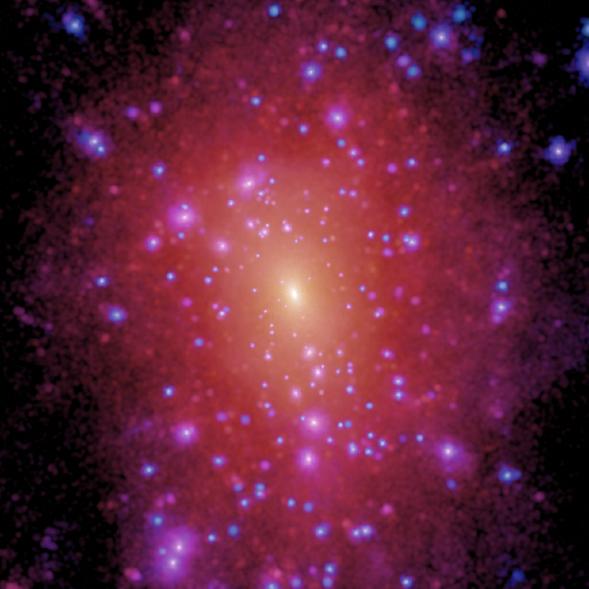
Dark matter is believed to account for 85 per cent of the Universe’s mass but has never been detected. Scientists inferred its existence from gravitational effects of objects in space more than 75 years ago and it has become quite prominent in physics, for something that's never been seen or verified.
The international Virgo Consortium say they can change that and have used a massive computer simulation showing the evolution of a galaxy like the Milky Way to “see” gamma-rays given off by dark matter. They say their findings, published in Nature, could help NASA’s Fermi Telescope in its search for the dark matter and open a new chapter in our understanding of the Universe.
MIT engineers have outfitted cells with tiny “backpacks” that could allow them to deliver chemotherapy agents, diagnose tumors or become building blocks for tissue engineering. Michael Rubner, director of MIT’s Center for Materials Science and Engineering and senior author of a paper on the work that appeared online in Nano Letters on Nov. 5, said he believes this is the first time anyone has attached such a synthetic patch to a cell.
The polymer backpacks allow researchers to use cells to ferry tiny cargoes and manipulate their movements using magnetic fields. Since each patch covers only a small portion of the cell surface, it does not interfere with the cell’s normal functions or prevent it from interacting with the external environment.
A new study published in the journal of
Minerva Cardioangiologica says that
Pycnogenol, pine bark extract from the French maritime pine tree, reduces jetlag in passengers by nearly 50 percent. The two-part study, consisting of a brain CT scan and a scoring system, showed Pycnogenol lowered symptoms of jetlag such as fatigue, headaches, insomnia and brain edema (swelling) in both healthy individuals and hypertensive patients. Passengers also experienced minimal lower leg edema, a common condition associated with long flights.