









Diversity is praised as good for business and for promoting creativity but when organizational theorist Viktorija Kalonaityte studied diversity work at a Swedish adult education school, the school wanted to make everyone as “Swedish” as possible.

That means protecting women from 'honor killings' and teaching in Swedish.

In Sweden, diversity is largely about integration policy and the public sector rather than just being corporate policy in places lke America. Viktorija Kalonaityte recently defended her doctoral dissertation at the School of Economics, Lund University in Sweden and her thesis addressed identity and diversity work at a municipal school for adults. The school she studied views itself as working actively with diversity in line with a municipal diversity plan but Kalonaityte says that the diversity plan often collides with people’s understandings of what things should be like at a Swedish workplace.

You know you must be doing something right when both the Discovery Institute and the Institute for Creation Research get on your case! These two outlets of religious-centered non-thinking vehemently attacked my recent post on the inanity of choosing Sarah Palin as a Vice Presidential candidate -- which focused on her positions on teaching (she supports “equal time” for Creationism) and censorship (she has attempted to remove “offensive” books from a public library, going so far as threatening a librarian with being fired).

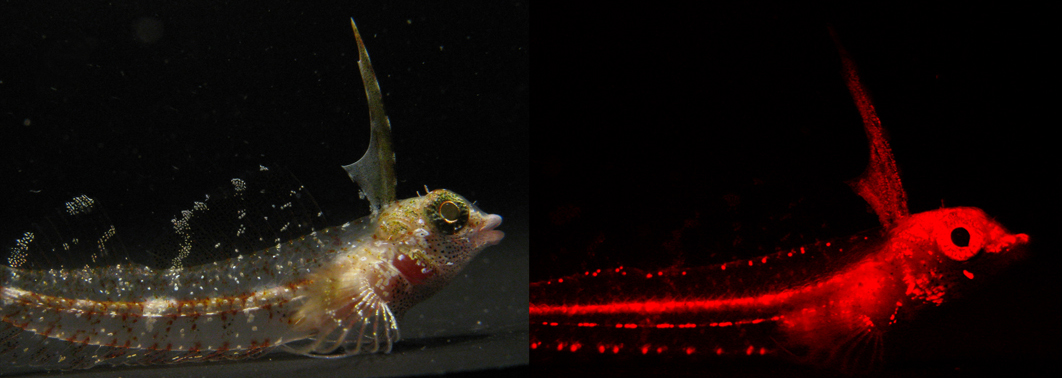
Scientists have discovered that certain fish are capable of glowing red. Research published today in BMC Ecology includes striking images of fish fluorescing vivid red light.

Due to absorption of ‘red’ wavelengths of sunlight by sea-water, objects which look red under normal conditions appear grey or black at depths below 10m. This has contributed to the belief among marine biologists that red colors are of no importance to fish.

Nico Michiels, from the University of Tübingen, Germany, led a team of researchers who captured the striking images in the article which, as he describes, “Shows that red fluorescence is widespread among marine fish. Our findings challenge the notion that red light is of no importance to marine fish, calling for a reassessment of its role in fish visual ecology.”

A long-standing scientific belief holds that stars tend to hang out in the same general part of a galaxy where they originally formed. Some astrophysicists have recently questioned whether that is true, and now new simulations show that, at least in galaxies similar to our own Milky Way, stars such as the sun can migrate great distances.

What's more, if our sun has moved far from where it was formed more than 4 billion years ago, that could change the entire notion that there are parts of galaxies – so-called habitable zones – that are more conducive to supporting life than other areas are.

"Our view of the extent of the habitable zone is based in part on the idea that certain chemical elements necessary for life are available in some parts of a galaxy's disk but not others," said Rok Roškar, a doctoral student in astronomy at the University of Washington. "If stars migrate, then that zone can't be a stationary place."

AUSTIN, Texas—A new species of blind, subterranean, predatory ant discovered in the Amazon rainforest by University of Texas at Austin evolutionary biologist Christian Rabeling is likely a descendant of the very first ants to evolve.

The new ant is named Martialis heureka, which translates roughly to "ant from Mars," because the ant has a combination of characteristics never before recorded. It is adapted for dwelling in the soil, is two to three millimeters long, pale, and has no eyes and large mandibles, which Rabeling and colleagues suspect it uses to capture prey.

Menus and advertising affect our emotions, and if we understand those emotions, we make better food choices, according to a new study in the Journal of Consumer Research.

Authors Blair Kidwell, David M. Hardesty, and Terry L. Childers (all University of Kentucky) examined the "emotional intelligence" of consumers, including obese people. They found that people who made the healthiest choices had high correlations between their emotional intelligence and confidence in their emotional intelligence—what the authors call "emotional calibration."

Dr. Ed Corboy had no idea what was afflicting his 80-year-old mother, Joan Corboy. All he knew for certain was that since being treated for what was a routine diarrheal infection, she seemed to be wasting away and none of her doctors or other health specialists could explain why.

Afraid that his mother was running out of time, Corboy called the Centers for Disease Control in Atlanta for advice. Dr. Clifford McDonald told him the infection his mother probably had was of the NAP1 type of the bacteria Clostridium difficile, a virulent strain of a common intestinal bacteria currently plaguing hospitals that now rivals the superbug Methicillin-resistant staphylococcus aureus (MRSA) as one of the top emerging disease threats to humans.

The inventor of a revolutionary new forensic fingerprinting technique claims criminals who eat processed foods are more likely to be discovered by police through their fingerprint sweat corroding metal.

Dr John Bond, a researcher at the University of Leicester and scientific support officer at Northamptonshire Police, said processed food fans are more likely to leave tell-tale signs at a crime scene.

Speaking before a conference on forensic science at the University of Leicester, Dr Bond said sweaty fingerprint marks made more of a corrosive impression on metal if they had a high salt content.

To activists in cozy offices, the solution to over-hunting is easy; ban it. But unless we put a McDonalds in the forests of Africa, that isn't really an answer. But we need to find one.

A new report from the Center for International Forestry Research (CIFOR), the Secretariat of the Convention on Biological Diversity (CDB) and partners warns that an upsurge in hunting bushmeat—including mammals, birds, reptiles and amphibians — in tropical forests is unsustainable and that it poses serious threats to food security for poor inhabitants of forests in Africa, who rely largely on bushmeat for protein.

The authors of the report call on policymakers in the region to develop policies protecting endangered species, while allowing sustainable hunting of "common" game, since there is no clear substitute available if common wild meat sources were to be depleted.

The next major advance in computer processors will be the move from today's two-dimensional chips to three-dimensional circuits, and the first three-dimensional synchronization circuitry is now running at 1.4 gigahertz at the University of Rochester.

Unlike past attempts at 3-D chips, the Rochester chip is not simply a number of regular processors stacked on top of one another. It was designed and built specifically to optimize all key processing functions vertically, through multiple layers of processors, the same way ordinary chips optimize functions horizontally. The design means tasks such as synchronicity, power distribution, and long-distance signaling are all fully functioning in three dimensions for the first time.

