Researchers at Carnegie Mellon University have devised the first computerized method that can analyze a single photograph and determine where in the world the image likely was taken. It's a feat made possible by searching through millions of GPS-tagged images in the Flickr online photo collection.

The IM2GPS algorithm developed by computer science graduate student James Hays and Alexei A. Efros, assistant professor of computer science and robotics, doesn't attempt to scan a photo for location clues, such as types of clothing, the language on street signs, or specific types of vegetation, as a person might do. Rather, it analyzes the composition of the photo, notes how textures and colors are distributed and records the number and orientation of lines in the photo.

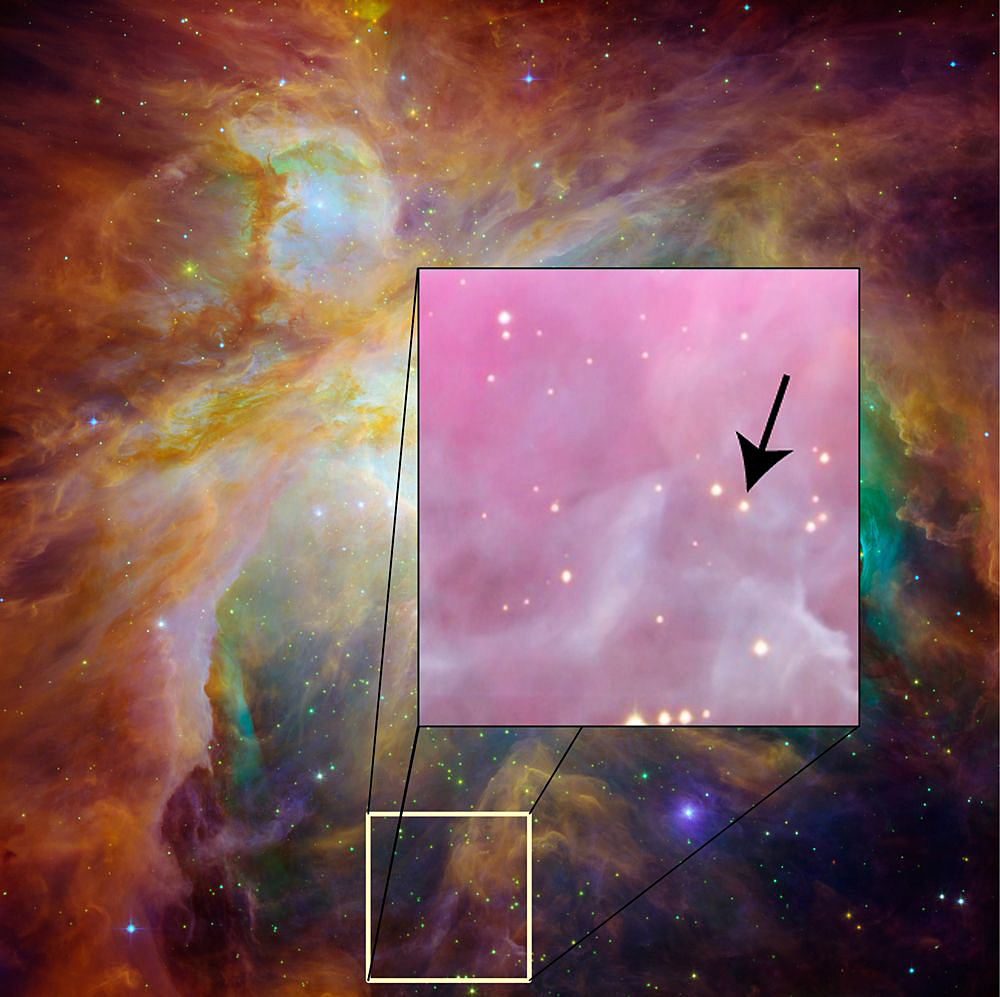
Two stars, each with the same mass and in orbit around each other, are twins that one would expect to be identical. So astronomers were surprised when they discovered that twin stars in the Orion Nebula, a well-known stellar nursery 1,500 light years away, were not identical at all. In fact, these stars exhibited significant differences in brightness, surface temperature and possibly even size.

The study published in the June 19 Nature suggests that one of the stars formed significantly earlier than its twin. Because astrophysicists have assumed that binary stars form simultaneously, the discovery provides an important new challenge for today's star formation theories, forcing theorists to reexamine their models to see if the models can indeed produce binaries with stars that form at different times.

The pageantry of Oprah Winfrey’s talk show, the Coca-Cola empire, Michael Jackson’s turn from the King of Pop into an iconic global recluse: American pop culture – Hollywood cinema, television, pop music – dominates the rest of the world through its hegemonic presence. Does that make everyone a hybridized American, or do these elements find mediation within the other cultures that consume them?

Fabricating the Absolute Fake. America in Contemporary Pop Culture by Jaap Kooijman applies concepts of postmodern theory – Baudrillard’s hyperreality and Eco’s “absolute fake,” among others – to this globally mediated American pop culture in order to examine both the phenomenon itself and its appropriation in the Netherlands, as evidenced by such diverse cultural icons as the Elvis-inspired crooner Lee Towers, the Moroccan-Dutch rapper Ali B, musical tributes to an assassinated politician, and the Dutch reality soap opera scene.

Bacteria survive everywhere. Under the sea, in the air, even in some of the hottest environments on Earth.

How are microbes seemingly so smart? Bacteria don't just react to changes in their surroundings, say Princeton University researchers, they anticipate and prepare for them. The findings, reported in the June 6 issue of Science, challenge the prevailing notion that only organisms with complex nervous systems have this ability.

"What we have found is the first evidence that bacteria can use sensed cues from their environment to infer future events," says Saeed Tavazoie, an associate professor in the department of Molecular Biology, who conducted the study along with graduate student Ilias Tagkopoulos and post-doctoral researcher Yir-Chung Liu.

It's an ingredient found in dandruff shampoos and, if you're a movie buff, you also know it was used to help fight off alien invaders in the film "Evolution."

Scientists at the University of Leicester are now using selenium as a tool in investigating how the oxygen content of the oceans has changed over geologically recent time.

Selenium is an anti-oxidant and an essential trace nutrient in our diet. It belongs to a group of elements whose behavior is controlled by the concentration of oxygen in the environment. Now scientists are using selenium as part of a research project to measure the isotopic ratios of selenium in sediments.

Between 54 percent and 64 percent of hospitals had chaplaincy services between 1980 and 2003, despite changes over the last fifteen years in national accreditation guidelines making the religious and spiritual care of hospitalized patients a right.

This protection seems to have had no effect on the number of hospitals with chaplains and there was no systematic trend over this period.

Interesting results:

Could injecting a gene into a patient with severe heart failure reverse their disabling and life-threatening condition? Physician-scientists are setting out to answer that question in a first-ever clinical trial of gene therapy to treat severe heart failure.

NewYork-Presbyterian Hospital/Columbia University Medical Center is the only center in the New York City area where the therapy is currently available.

Patients enrolled in the multicenter CUPID trial (Calcium Up-Regulation by Percutaneous Administration of Gene Therapy in Cardiac Disease) will undergo a minimally invasive cardiac catheterization procedure that will introduce a specially engineered gene that stimulates production of an enzyme necessary for the heart to pump more efficiently.

The International Council for Industrial and Applied Mathematics (ICIAM), the International Mathematical Union (IMU) and the Institute of Mathematical Statistics (IMS) today released the Citation Statistics report. The report is written from a mathematical perspective and states that while citation-based statistics such as impact factor are often used to assess scientific research they are not the best measures of research quality.

The use of citations in assessing research quality is a topic that is of increasing interest throughout the world's scientific community. The report cautions against the over-reliance on citation statistics such as the impact factor and h-index. These are often promoted because of the belief in their accuracy, objectivity, and simplicity, but these beliefs are unfounded.

Among the report’s key findings:

Male homosexuality is difficult to explain under strictly Darwinian evolutionary models, because carriers of genes predisposing towards male homosexuality would be likely to reproduce less than average, suggesting that alleles influencing homosexuality should progressively disappear from a population.

Partly due to that, homosexuality in males is thought to have both psycho-social factors and genetic components. This is suggested by the high concordance of sexual orientation in identical twins and the fact that homosexuality is more common in males belonging to the maternal line of male homosexuals. These effects have not been shown for female homosexuality, indicating that these two phenomena may have very different origins and dynamics.

An Italian research team, consisting of Andrea Camperio Ciani and Giovanni Zanzotto at the University of Padova and Paolo Cermelli at the University of Torino, found that the evolutionary origin and maintenance of male homosexuality in human populations could be explained by a model based around the idea of sexually antagonistic selection, in which genetic factors spread in the population by giving a reproductive advantage to one sex while disadvantaging the other.

Previous work by Camperio Ciani and collaborators, published in 2004, showed that females in the maternal line of male homosexuals were more fertile than average, giving less weight to the idea that alleles influencing homosexuality should progressively disappear from a population.


Want to get a male mouse excited? A group of steroids found in female mouse urine is all it takes, say researchers at Washington University School of Medicine in St. Louis. They found the compounds activate nerve cells in the male mouse's nose with unprecedented effectiveness.

"These particular steroids, known as glucocorticoids (GCCs), are involved in energy metabolism, stress and immune function," says senior author Timothy E. Holy, Ph.D., assistant professor of neurobiology and anatomy. "They control many important aspects of the mouse's physiology and theoretically could give any mouse that sniffs them a detailed insider's view of the health of the animal they came from."

Holy plans further research to see if activating the nerves in the male mouse's nose leads to particular behavioral responses. He probes the male mouse's reaction to chemical signals from female mice to advance understanding of pattern recognition and learning in the much more complex human brain. In 2005, he found that female mice or their odors cause male mice to sing. He doesn't know yet if the GCC steroids' effects on the male mouse nose help to trigger this behavior.