







Researchers have found that female red squirrels showed high levels of multimale mating and would even mate with males that had similar genetic relatedness, basically mating with their relatives.

Researchers from the University of Alberta, in Edmonton, Alberta, Canada and the University of Sheffield in Sheffield, England, United Kingdom studied a population of red squirrels over a period of three years near Kluane National Park in southwest Yukon.

While males mating with multiple females is quite common in the animal kingdom, females that multi-mate is much harder to explain.

A new discovery by University of Western Ontario scientist Graham Thompson claims to be conclusive evidence that the 'selfish gene', introduced conceptually in 1976 by British biologist Richard Dawkins, isn't just accepted as a natural extension to the works of Charles Darwin, but is now confirmed.

In studying genomes, the word 'selfish' does not refer to the human-describing adjective of self-centered behavior but rather to the blind tendency of genes wanting to continue their existence into the next generation. Ironically, this 'selfish' tendency can appear anything but selfish when the gene does move ahead for selfless and even self-sacrificing reasons.

For instance, in the honey bee colony, a complex social breeding system described as a 'super-organism,' the female worker bees are sterile. The adult queen bee, selected and developed by the worker bees, is left to mate with the male drones.

If you watch popular shows like “Undress the Nation” or Gok Wan’s “How to Look Good Naked” - what, you don't watch them? That's because that guy behind American Idol hasn't brought them here yet, and in these times of strife we need shows about women in underwear - but if you live in England and watch them you may have noticed something a researcher also noticed; when women wear the right underwear, they are more confident about their bodies and about their overall appearance which, to men, is the same thing.


Who knew underwear was so important? Not me. All I know is there is 'dating' underwear - bras and panties match - and then 'dating a long time' underwear. You do the math.


Dr. Ira Sharlip, President of the International Society for Sexual Medicine (ISSM) detailed a new definition of premature ejaculation. He addressed the audience of the American Urological Association during the ‘late breaking science forum’, a session designed by AUA to premier newsworthy developments in clinical urology.

The ISSM convened a panel of world experts who met in Amsterdam in the fall of 2007. Each of the 21 members of the panel was selected through a peer review process for their expertise in ejaculatory physiology, pharmacology and dysfunction. The panelists were tasked with creating a new definition of premature ejaculation (PE) based on currently available clinical evidence. Definitions of PE have previously been based on group consensus and not meeting new standards for evidence-based medicine. These definitions of PE include the Diagnostic and Statistical Manual of Mental Disorders (DSM-IV, 2002) and the AUA definition of (2005).

The knock on publicly traded companies is that they only think short term, quarter to quarter, which reduces or delays investments in risky, long term innovation projects in order to boost the firm’s stock price.

Entrepreneurs always talk about innovation while larger companies hesitate to take chances that could hurt short term profits. But do investments in innovations hurt stock prices?

Not according to Gerard J. Tellis, a professor of marketing at the University of Southern California’s Marshall School of Business, and Ashish Sood, an assistant professor at the of marketing at Emory University’s Goizueta Business School. They have devised a new metric for evaluating the total stock market returns to an innovation project. “We’re assessing whether markets respond negatively to investments in innovation and whether they enforce a shorter orientation,” explains Tellis. “The key questions are: how does the stock market react to announcements about innovation and what is the total return to the innovation project?”

Ice On Mars?

Ice On Mars?

Jun 20 2008 | comment(s)

Dice-size crumbs of bright material have vanished from inside a trench where they were photographed by NASA's Phoenix Mars Lander four days ago, convincing scientists that the material was frozen water that vaporized after digging exposed it.

"It must be ice," said Phoenix Principal Investigator Peter Smith of the University of Arizona, Tucson. "These little clumps completely disappearing over the course of a few days, that is perfect evidence that it's ice. There had been some question whether the bright material was salt. Salt can't do that."

The chunks were left at the bottom of a trench informally called "Dodo-Goldilocks" when Phoenix's Robotic Arm enlarged that trench on June 15, during the 20th Martian day, or sol, since landing. Several were gone when Phoenix looked at the trench early today, on Sol 24.

Researchers have determined that there are hundreds of biological differences between the sexes when it comes to gene expression in the cerebral cortex of humans and other primates. These findings indicate that some of these differences arose a very long time ago and have been preserved through evolution. These conserved differences constitute a signature of sex differences in the brain.

Many more obvious gender differences have been preserved throughout primate evolution; examples include average body size and weight, and genitalia design. This study, believed to be the first of its kind, focuses on gene expression within the cerebral cortex. The cerebral cortex is involved in many of the more complex functions in both humans and other primates, including memory, attentiveness, thought processes and language.

We grow closer and closer to an understanding of the mechanisms underlying addictions, and with that knowledge we also learn about other illnesses. It is not new to think of eating disorders as addictions, but the connection has often been one of analogy, not brain function.

In a piece in Scientific American magazine, an interesting exploration of the underlying mechanisms that may be at play with anorexia nervosa:

Addicted to Starvation: The Neurological Roots of Anorexia

"What is more, cultural cues cannot easily explain why the afflicted, who are shockingly skinny, misperceive themselves as fat.

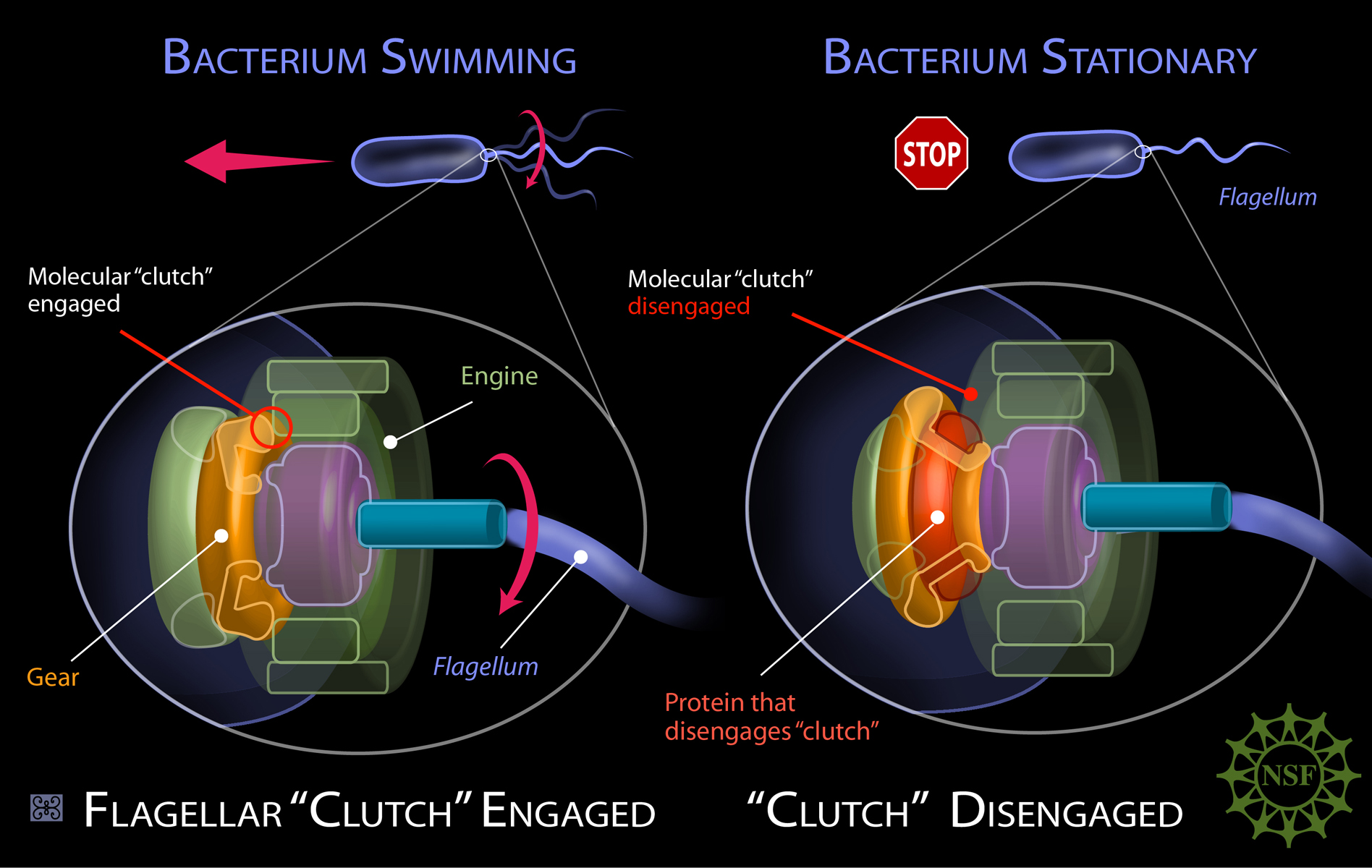
It has been long been known that bacteria swim by rotating their tail-like structure called the flagellum. The rotating motion of the flagellum is powered by a molecular engine located at the base of the flagellum. Just as engaging the clutch of a car connects its gear to its engine and delivers power to its wheels, engaging the molecular clutch of a bacterium connects its gear to its engine and delivers power to its flagellum.

Now, a paper appearing in Science describes, for the first time, how the flagellum's rotations are stopped so that bacteria stop moving.

Here's how the stopping mechanism works: while a bacterium is swimming, it releases a protein (shown in red in the stationary bacterium in the figure) that flows between its gear and engine. The presence of this protein detaches the bacterium's gear from its engine and thereby stops the delivery of power to its flagellum. This process is analogous to disengaging the clutch of a car, which detaches its gear from its engine and thereby stops the delivery of power to its wheels.

Once the delivery of power to bacterium's flagellum stops, the flagellum stops rotating, and the bacterium's swimming ends.

In the current issue of Science, researchers from the European Molecular Biology Laboratory's European Bioinformatics Institute [EMBL-EBI] uncover systematic errors in existing methods that compare genetic sequences of different species to learn about their evolutionary relationships.

They present a new computational tool that avoids these errors and provides accurate insights into the evolution of DNA and protein sequences. The results challenge our understanding of how evolution happens and suggest that sequence turnover is much more common than assumed.

The four letter code that constitutes the DNA of all living things changes over time; for example individual or several letters can be copied incorrectly [substitution], lost [deletion] or gained [insertion]. Such changes can lead to functional and structural changes in genes and proteins and ultimately to the formation of new species. Reconstructing the history of these mutation events reveals the course of evolution.

