





There are many on-going themes in the large discussion of global warming and replacing fossil fuels with renewable, clean energy. One of the dominant ones is that alternative fuels such as solar are much more expensive than fossil fuels. This argument is often put forth by those entrenched in the status quo of the fossil fuel industry. The general argument is that our entire economic world will take a hit if we use solar as it is so much more expensive that oil.

There was a recent news story here at ScientificBlogging saying that it will take another ten years for solar energy to be price-competitive with fossil fuels.

Female fruit flies sometimes choose males who are aggresive, sometimes choose males who do not fight at all, and sometimes choose males for no reason science can explain, write a team of biologists, and the findings help explain the large variation in aggressiveness in most species, including humans.

So females are unpredictable, which means the fittest males don’t always get the girl. This explains why males don't evolve towards super-aggressiveness.

“If aggression makes you more likely to father children, all males should be selected to be very aggressive. Male fruit flies (like humans and other animals) show a lot of genetic variation in aggression, and we wanted to find out why,” explained study leader Brad Foley, a post-doctoral researcher at USC.

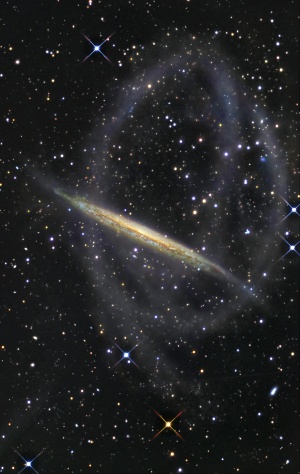
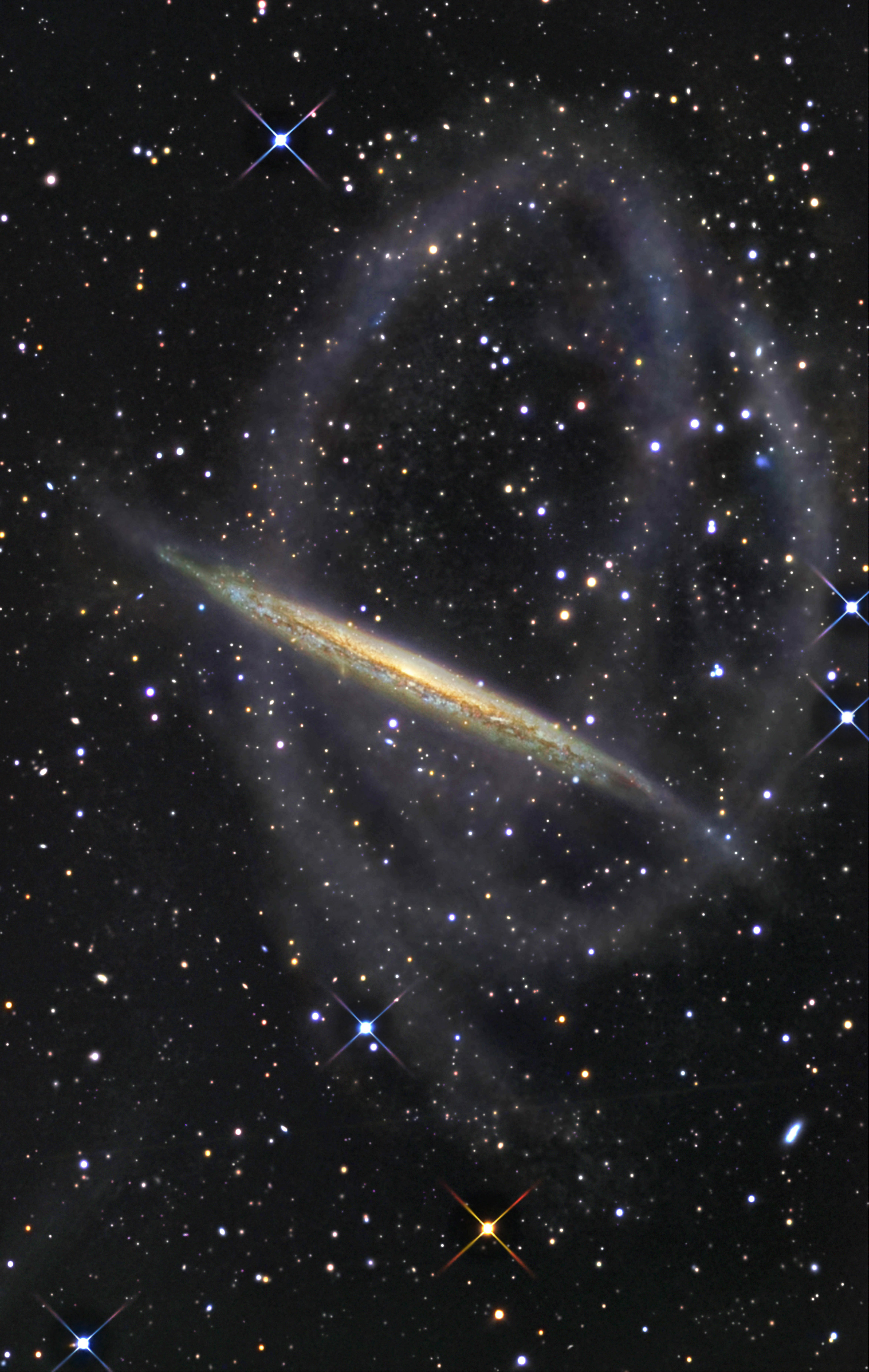
Huge star streams in the outskirts of two nearby spiral galaxies have allowed astronomers to obtain a panoramic overview of ' galactic cannibalism' similar to that involving the Sagittarius dwarf galaxy in the vicinity of the Milky Way.

The detection of these immense stellar fossils confirms the predictions of the cold dark matter model of cosmology, which proposes that present-day grand design spiral galaxies were formed from the merging of less massive stellar systems.

The first of these debris structures surrounds the galaxy NGC 5907, located 40 million light-years from Earth and formed from the destruction of one of its dwarf satellite galaxies at least four billion years ago.

The electric solar wind sail developed at the Finnish Meteorological Institute has moved rapidly from invention towards implementation. Electric sail propulsion might have a large impact on space research and moving in space in general.

The electric solar wind sail developed by Dr. Pekka Janhunen at the Finnish Meteorological Institute might revolutionise travelling in deep space. The electric sail is a Finnish invention which uses the solar wind as its thrust source and therefore needs no fuel or propellant. The solar wind is a continuous plasma stream emanating from the Sun. Changes in the properties of the solar wind cause auroral brightening and magnetic storms, among other things.

A team of researchers from Case Western Reserve University has found that gravitational radiation—widely expected to provide “smoking gun” proof for a theory of the early universe known as “inflation”— can be produced by another mechanism.

According to physics scholars, inflation theory proposes that the universe underwent a period of exponential expansion right after the big bang. A key prediction of inflation theory is the presence of a particular spectrum of “gravitational radiation”-- ripples in the fabric of space-time that are notoriously difficult to detect but believed to exist nonetheless.

“If we see a primordial gravitational wave background, we can no longer say for sure it is due to inflation,” said Lawrence Krauss, the Ambrose Swasey Professor of Physics and Astronomy at Case Western Reserve.

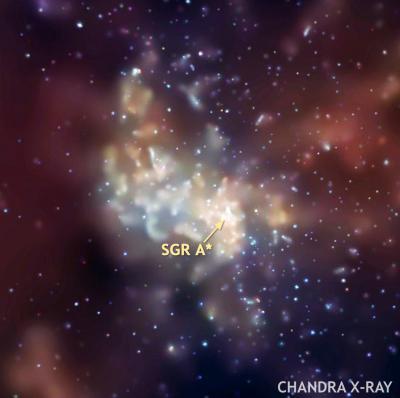
Using NASA, Japanese, and European X-ray satellites, a team of Japanese astronomers has discovered that our galaxy’s central black hole let loose a powerful flare three centuries ago.

The finding helps resolve a long-standing mystery: why is the Milky Way’s black hole so quiescent? The black hole, known as Sagittarius A* (pronounced "A-star"), is a certified monster, containing about 4 million times the mass of our Sun. Yet the energy radiated from its surroundings is billions of times weaker than the radiation emitted from central black holes in other galaxies.

"We have wondered why the Milky Way’s black hole appears to be a slumbering giant," says team leader Tatsuya Inui of Kyoto University in Japan. "But now we realize that the black hole was far more active in the past. Perhaps it’s just resting after a major outburst."

Matter and anti-matter are believed to have been created in equal amounts when the universe came in to existence during the Big Bang, yet in the universe today there is only matter.

The quest to understand more about the mysterious neutrino particle which is thought to be responsible for this phenomenon has taken a major step forward. The Muon Ionisation Cooling Experiment (MICE) project, an accelerator research experiment for a major component of a future Neutrino Factory, has achieved an important milestone with the successful transport of a beam of muon particles along the MICE muon beam.

Observations of atmospheric and solar neutrinos have shown that they change state (oscillate), between three forms - electron, tau and muon - during their journey across the Earth or from the Sun to the Earth. This discovery is extremely significant since oscillations can only occur if neutrinos have mass and yet the Standard Model of particle physics, on which our current understanding of how our universe was created and is held together rests, assumes that neutrinos have no mass.

Public scandals, such as Enron, Societe Generale and Global Crossing, the sub-prime mortgage problem, and the ensuing global credit crunch have led to dwindling confidence in the business world. A study published in the International Journal of Business Excellence suggests that relearning the ancient notion of virtue could create better harmony between business and society.

Businesses that excel in the services and products they offer their customers are usually the ones that succeed and post a healthy profit for their shareholders, but Alistair Anderson of the Aberdeen Business School at The Robert Gordon University, Aberdeen, and Carter Crockett of the Department of Economics & Business at Westmont College in Santa Barbara suggest that conventional models of excellence are too narrow and too functional for today's global economy.

A new approach based on the ancient principle of virtue, dating back to Aristotle, could, they say, allow underachieving businesses to excel without moral compromise.

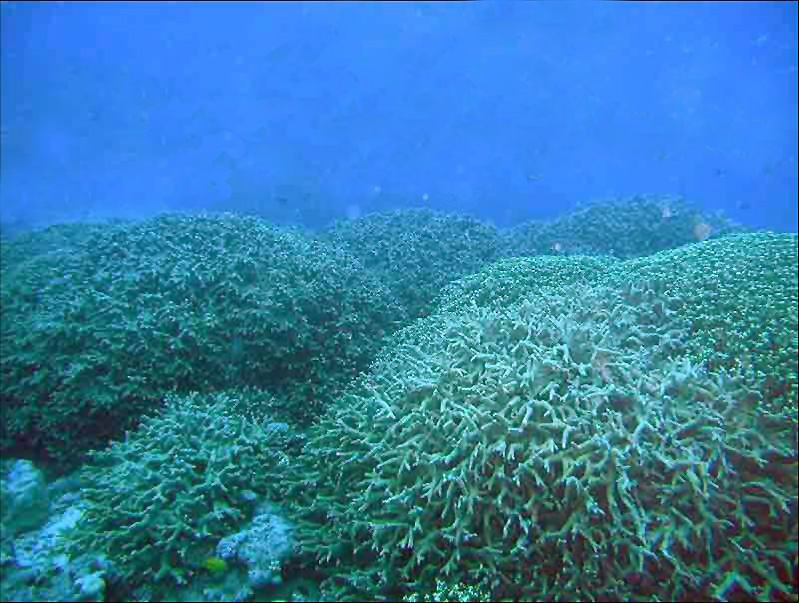
Half a century after the last earth-shattering atomic blast shook the Pacific atoll of Bikini, the corals are flourishing again. Some coral species, however, appear to be locally extinct.

These are the findings of a remarkable investigation by an international team of scientists from Australia, Germany, Italy, Hawaii and the Marshall Islands. The expedition examined the diversity and abundance of marine life in the atoll.

One of the most interesting aspects is that the team dived into the vast Bravo Crater left in 1954 by the most powerful American atom bomb ever exploded (15 megatonnes - a thousand times more powerful than the Hiroshima bomb). The Bravo bomb vapourised three islands, raised water temperatures to 55,000 degrees, shook islands 200 kilometers away and left a crater 2km wide and 73m deep.

By studying in great detail the 'ringing' of a planet-harbouring star, a team of astronomers using ESO's 3.6-m telescope have shown that it must have drifted away from the metal-rich Hyades cluster. This discovery has implications for theories of star and planet formation, and for the dynamics of our Milky Way.

The yellow-orange star Iota Horologii, located 56 light-years away towards the southern Horologium ("The Clock") constellation, belongs to the so-called "Hyades stream", a large number of stars that move in the same direction.

Previously, astronomers using an ESO telescope had shown that the star harbours a planet, more than 2 times as large as Jupiter and orbiting in 320 days (ESO 12/99).

