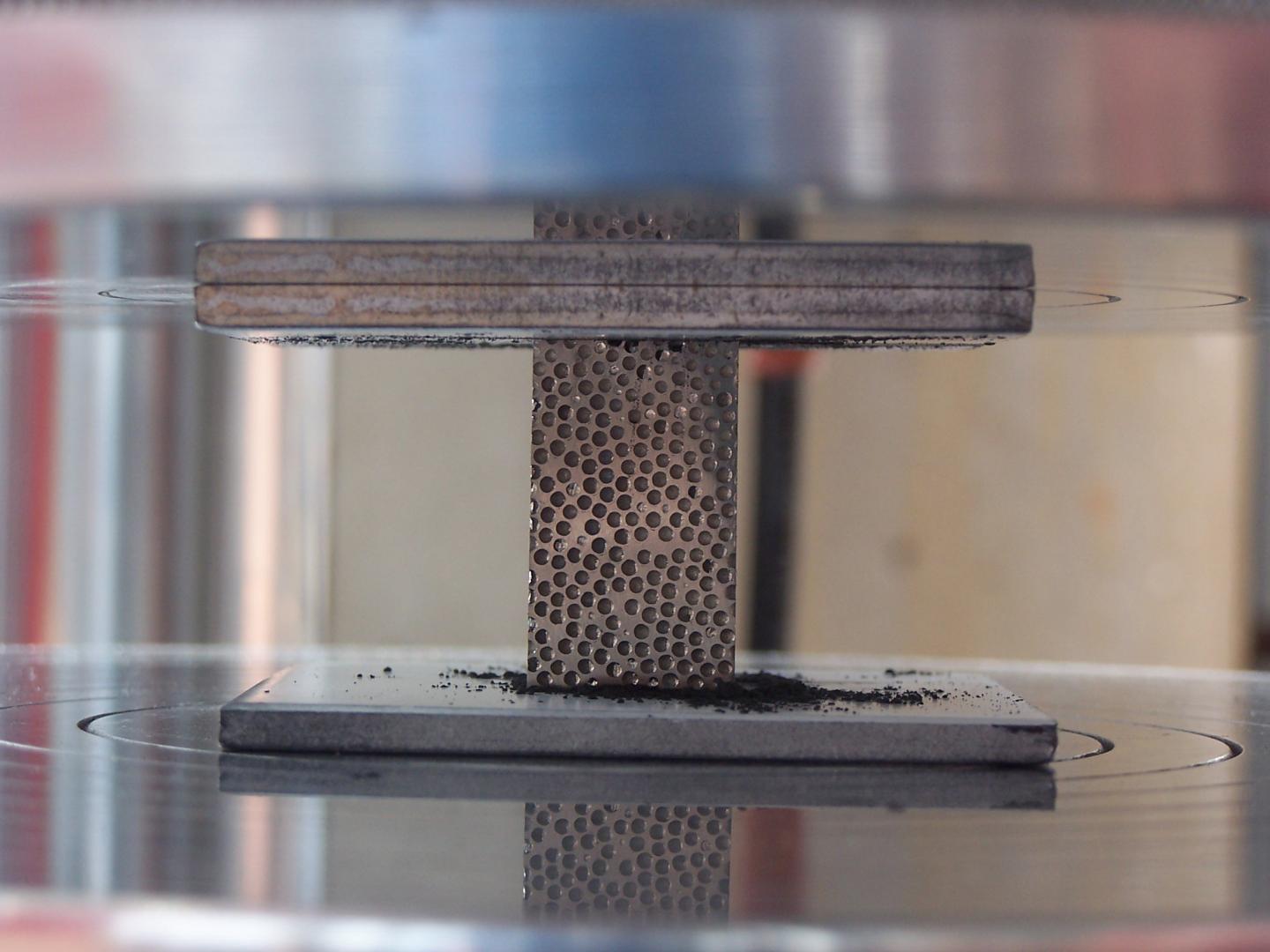

Titanium and gold are usually not magnetic and cannot be magnets – unless you combine them just so. Scientists at Rice University did so and discovered what is a first of its kind: an itinerant antiferromagnetic metal -- TiAu -- made from nonmagnetic constituent elements.

The research by the lab of Rice physicist Emilia Morosan has already been cited as a textbook example of how magnetism arises in metals. While the uses for this particular magnet have yet to be determined, the Rice discovery could enhance the scientific understanding of magnetism. This is not the kind of magnet one would stick to a refrigerator. Magnetic order only appears in TiAu when the metal is cooled to 36 kelvins, about minus 395 degrees Fahrenheit.

PHidiots

PHidiots

Jul 23 2015 | comment(s)

And I thought *these* were bad products:

Challenging the idea that addiction is hardwired in the brain, a new study suggests that even a short time spent in a stimulating learning environment can rewire the brain’s reward system and buffer it against drug dependence.

Scientists tracked cocaine cravings in more than 70 adult male mice and found that those rodents whose daily drill included exploration, learning and finding hidden tasty morsels were less likely than their enrichment-deprived counterparts to seek solace in a chamber where they had been given cocaine.

A new paper says that Chinese grandparents tend to indulge, overfeed and protect grandchildren in their care from physical chores, thus increasing their risk of obesity. The underlying motive for the action of grandparents may be affection for their treasured grandchild and stems from their personal experiences, misunderstanding and poor recognition of the adverse health effects of childhood obesity.

A newly discovered family of chemical structures known as zeolites could increase the value of biogas and natural gas that contains carbon dioxide.

The zeolites -- crystalline aluminosilicates with frameworks that contain windows and cavities the size of small molecules -- can separate out carbon dioxide more effectively from fuel gases than those previously known.

Existing zeolites have widespread use in industrial processes that involve gas separation and catalytic conversion, for example to remove nitrogen and carbon dioxide from compressed air to generate oxygen in hospitals and airplanes. There is an ongoing search for new zeolites to add to those known, to augment the small number of different types used commercially.

Someone forgot to tell James Beck that Oceanographers are supposed to work near an ocean. 

A new study suggests that a single set of genes affects a person's perception of sweet taste, regardless of whether the sweetener is a natural sugar or a non-caloric sugar substitute.

Johanna Olson, MD, and her colleagues at Children’s Hospital Los Angeles, provide care for the largest number of transgendered youth in the U.S. and have enrolled 101 patients in a prospective observational study to determine the safety and efficacy of treatment that helps patients bring their bodies into closer alignment with their chosen gender. 

Baseline characteristics of these individuals were published on July 21 in the Journal of Adolescent Health and include a significant finding: transgendered individuals have sex hormone levels consistent with the gender they were born with.

“We’ve now put to rest the residual belief that transgender experience is a result of a hormone imbalance,” says Olson. “It’s not.”

Weyl points, the 3D analogues of the structures that make graphene exceptional, were theoretically predicted in 1929. Today, an international team of Physicists from MIT and Zhejiang University, found them in photonic crystals, opening a new dimension in photonics.

Researchers have identified a genetic mutation associated with the appearance of premature aging and severe loss of body fat in children.

Researchers at the Translational Genomics Research Institute (TGen) Center for Rare Childhood Disorders found that the appearance of premature aging, a neonatal form of Progeroid syndrome, in a 3-year-old girl was caused by a mutation in the gene CAV1, according to a study published in PLOS ONE.