Banner
Here's Where Your Backyard Was 300 Million Years Ago

We may use terms like "grounded" and terra firma to mean stability and consistency but geology...

Convergent Evolution Cheat Sheet Now 120 Million Years Old

One tenet of natural selection is a random walk of genes but nature may be more predictable than...

Synchrotron Could Shed Light On Exotic Dark Photons

There are many hypothetical particles proposed to explain dark matter and one idea to explore how...

The Pain Scale Is Broken But This May Fix It

Chronic pain is reported by over 20 percent of the global population but there is no scientific...

User picture.
News StaffRSS Feed of this column.

News Releases From All Over The World, Right To You... Read More »

Blogroll

Whether you're baking bread or building an organism, the key to success is consistently adding ingredients in the correct order and in the right amounts, according to a new genetic study by University of Michigan researchers.

Using the baker's yeast Saccharomyces cerevisiae, Patricia Wittkopp and her colleagues developed a novel way to disentangle the effects of random genetic mutations and natural selection on the evolution of gene expression. Their findings are scheduled for online publication in the journal Nature on March 16.

When patients develop acute liver failure, severe complications arise rapidly after the first signs of liver disease, and patients' health can deteriorate rapidly. New research published in the American Journal of Transplantation indicates that emergency evaluations of living liver donors can be conducted safely to allow acute liver failure patients to undergo transplantation before their condition worsens.

Tumors acquiring resistance is one of the major barriers to successful cancer therapy. Feng Fu, Sebastian Bonhoeffer (ETH Zurich) and their collaborator Martin Nowak (Harvard) use mathematical models to characterize how important aspects of tumor microenvironment can impair the efficacy of targeted cancer therapies.

Failure of cancer therapy is commonly attributed to pre-existing resistant mutants already present prior to treatment. However, the research publishing this week in PLOS Computational Biology highlights the important role of tumor sanctuaries in the rapid acquisition of resistance.

Scientists at Albert Einstein College of Medicine of Yeshiva University and their international collaborators have developed a novel fluorescence microscopy technique that for the first time shows where and when proteins are produced. The technique allows researchers to directly observe individual messenger RNA molecules (mRNAs) as they are translated into proteins in living cells.

The technique, carried out in living human cells and fruit flies, should help reveal how irregularities in protein synthesis contribute to developmental abnormalities and human disease processes including those involved in Alzheimer's disease and other memory-related disorders.

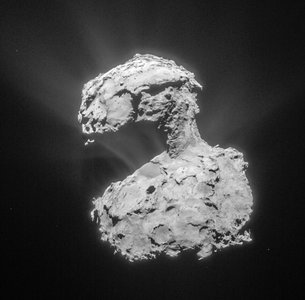
ESA’s Rosetta spacecraft has made the first measurement of molecular nitrogen at a comet,  Comet 67P/Churyumov–Gerasimenko,  providing clues about the temperature environment in which it formed. 

A means by which the removal of carbon dioxide (CO2) from coal-fired power plants might one day be done far more efficiently and at far lower costs than today has been discovered by a team of researchers with the U.S. Department of Energy (DOE)'s Lawrence Berkeley National Laboratory (Berkeley Lab). By appending a diamine molecule to the sponge-like solid materials known as metal-organic-frameworks (MOFs), the researchers were able to more than triple the CO2-scrubbing capacity of the MOFs, while significantly reducing parasitic energy.