Banner
Here's Where Your Backyard Was 300 Million Years Ago

We may use terms like "grounded" and terra firma to mean stability and consistency but geology...

Convergent Evolution Cheat Sheet Now 120 Million Years Old

One tenet of natural selection is a random walk of genes but nature may be more predictable than...

Synchrotron Could Shed Light On Exotic Dark Photons

There are many hypothetical particles proposed to explain dark matter and one idea to explore how...

The Pain Scale Is Broken But This May Fix It

Chronic pain is reported by over 20 percent of the global population but there is no scientific...

User picture.
News StaffRSS Feed of this column.

News Releases From All Over The World, Right To You... Read More »

Blogroll

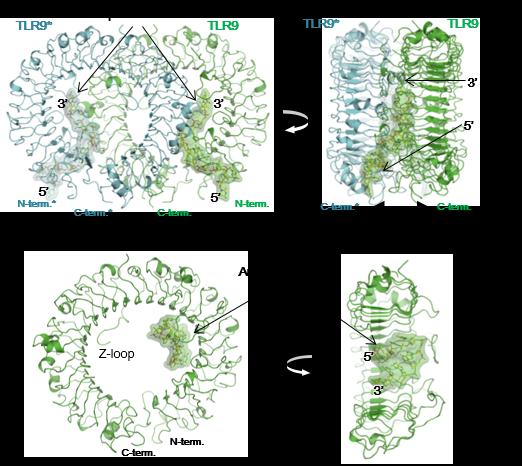
Researchers have discovered how Toll-like receptor 9 (TLR9) binds to pathogen DNA, activating the innate immune system. This discovery is vital for the design of new antiviral, antibacterial, allergy and other drugs targeting TLR9.

Invading pathogens such as bacteria or viruses leave traces in the form of DNA fragments, proteins and other biomolecules. TLR9 is a membrane-bound protein that detects these traces by recognizing a DNA sequence called Cytosine-phosphate-Guanine dinucleotide (CpG), a motif that is specific to bacteria and viruses. This brings about the release of interferon and induces inflammation, but until recently, the structure of TLR9 and how it functions remained unknown.

UK supermarket price promotions are more likely to lead to an increase in sales of less healthy foods than healthier choices in supermarkets, according to a study published today. However, the study of almost 27,000 UK households found that supermarkets were no more likely to promote less healthy over healthier foods.

Price promotions are commonly used in stores to boost sales through price reductions and stimulate impulsive purchases by increasing items' prominence through tags and positioning. However, there is growing concern that such promotional activities by the food industry may contribute to poor dietary choices and might lure consumers away from healthier, higher priced options.

Sophisticated germ fighters found in alligator blood may help future soldiers in the field fend off infection, according to new research by George Mason University.

The study, published Feb. 11 in the scientific journal PLOS One, is the result of a fundamental research project supported by the Defense Threat Reduction Agency (DTRA) to find bacterial infection-defeating compounds in the blood of the crocodilian family of reptiles, which includes American alligators.

The project is about to start its fourth year and has received $6 million in funding to date from DTRA. If fully funded over five years, the project will be worth $7.57 million.

Alligators live in bacteria-filled environments and dine on carrion. Yet this ancient reptile rarely falls ill.

Influenza has a long history of being one of the most deadly diseases to afflict humanity, but what exactly makes it so dangerous?

Certainly one reason is that influenza viruses have a history of jumping from other animals to humans, which, when the trans-species virus is new to the human population, generally means that human immune systems have no natural resistance. Another reason is that influenza viruses, with their rapidly mutating single-strand RNA genomes, are highly variable over time.

Surgeons and transplant centers nationwide increasingly have rejected hearts donated for transplantation despite a growing need for them, according to a new study which also found that the rejection of "marginal" donor hearts - those with undesirable qualities, such as being small or coming from an older donor - varied significantly across geographical regions.

In other words, some hearts rejected in one region would be accepted in another.

A psychedelic drug, (R)-DOI, prevents the development of allergic asthma in a mouse model. The effects are potent and effective at a concentration 50-100 times less than would influence behavior.