Banner
Here's Where Your Backyard Was 300 Million Years Ago

We may use terms like "grounded" and terra firma to mean stability and consistency but geology...

Convergent Evolution Cheat Sheet Now 120 Million Years Old

One tenet of natural selection is a random walk of genes but nature may be more predictable than...

Synchrotron Could Shed Light On Exotic Dark Photons

There are many hypothetical particles proposed to explain dark matter and one idea to explore how...

The Pain Scale Is Broken But This May Fix It

Chronic pain is reported by over 20 percent of the global population but there is no scientific...

User picture.
News StaffRSS Feed of this column.

News Releases From All Over The World, Right To You... Read More »

Blogroll

Finding out whether you have been infected with dengue may soon be as easy as spitting into a rapid test kit. The Institute of Bioengineering and Nanotechnology (IBN) of A*STAR has developed a paper-based disposable device that will allow dengue-specific antibodies to be detected easily from saliva within 20 minutes. This device is currently undergoing further development for commercialization.

89 percent of young people in one region of Spain own their first mobile phone before they reach the age of 13 and a recent study has analyzed the use of information and communication technologies by using a sample of 5,538 students from the Vallès Occidental region of Catalonia.

The study, based on surveys taken in the 2010/2011 academic year, finds links between school failure and an elevated use of computers at home. It also correlates an intensive use of video devices with the consumption of toxic substances. 
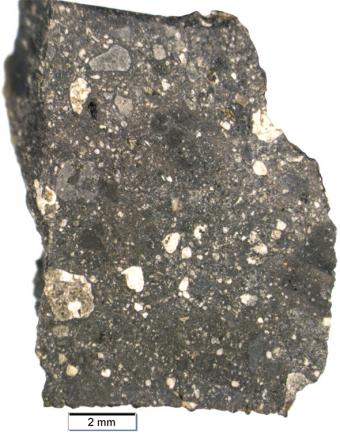
NWA 7034 - Black Beauty - is a meteorite found a few years ago in the Moroccan desert. Now it has been shown to be a 4.4 billion-year-old chunk of the Martian crust, and according to a new analysis, rocks just like it may cover vast swaths of Mars.

In a new paper, scientists report that spectroscopic measurements of the meteorite are a spot-on match with orbital measurements of the Martian dark plains, areas where the planet's coating of red dust is thin and the rocks beneath are exposed. The findings suggest that the meteorite, nicknamed Black Beauty, is representative of the "bulk background" of rocks on the Martian surface, says Kevin Cannon, a Brown University graduate student and lead author of the new paper.

Mitochondria produce ATP, the energy currency of the body. The driver for this process is an electrochemical membrane potential, which is created by a series of proton pumps. These complex, macromolecular machines are collectively known as the respiratory chain. The structure of the largest protein complex in the respiratory chain, that of mitochondrial complex I, has been elucidated by scientists from the Frankfurt "Macromolecular Complexes" cluster of excellence, working together with the University of Freiburg, by X-ray diffraction analysis.

The process of converting the sun's energy into liquid fuels requires a sophisticated, interrelated series of choices but a solar refinery is especially tricky to map out because the designs involve newly developed or experimental technologies. This makes it difficult to develop realistic plans that are economically viable and energy efficient.

In a paper recently published in the journal Energy & Environmental Science, a team led by University of Wisconsin-Madison chemical and biological engineering Professors Christos Maravelias and George Huber outlined a tool to help engineers better gauge the overall yield, efficiency and costs associated with scaling solar-fuel production processes up into large-scale refineries.

Five genetic variants that influence the size of structures within the human brain have been discovered by an international team that included a Georgia State University researcher.

In the study led by Drs. Sarah Medland, Margie Wright, Nick Martin and Paul Thompson of the QIMR Berghofer Medical Research Institute in Australia, nearly 300 researchers analyzed genetic data and magnetic resonance imaging (MRI) scans from 30,717 individuals from around the world. They evaluated genetic data from seven subcortical brain regions (nucleus accumbens, caudate, putamen, pallidum, amygdala, hippocampus and thalamus) and intracranial volume from MRI scans.