Banner
Here's Where Your Backyard Was 300 Million Years Ago

We may use terms like "grounded" and terra firma to mean stability and consistency but geology...

Convergent Evolution Cheat Sheet Now 120 Million Years Old

One tenet of natural selection is a random walk of genes but nature may be more predictable than...

Synchrotron Could Shed Light On Exotic Dark Photons

There are many hypothetical particles proposed to explain dark matter and one idea to explore how...

The Pain Scale Is Broken But This May Fix It

Chronic pain is reported by over 20 percent of the global population but there is no scientific...

User picture.
News StaffRSS Feed of this column.

News Releases From All Over The World, Right To You... Read More »

Blogroll

The way neurons are interconnected in the brain is very complicated. This holds especially true for the cells of the hippocampus. It is one of the oldest brain regions and its form resembles a see horse (hippocampus in Latin).

The hippocampus enables us to navigate space securely and to form personal memories. So far, the anatomic knowledge of the networks inside the hippocampus and its connection to the rest of the brain has left scientists guessing which information arrived where and when.

Signals spread through the brain

The director of the National Institutes of Health, Dr. Francis Collins, is worried about the lack of reproducibility and 'secret sauce' in a large number of studies funded by their $30 billion government agency. 

Fraud happens everywhere, as does cherry-picking of results, but the more scientific the field, the less it happens. It's hard to get 2,000 people to be fraudulent about an experimental physics result while a lone psychologist writing about surveys of college students is difficult to catch.

Carnegie-Mellon and Stanford scholars say they have a solution for Dr. Collins, at least - use 

Sexting may be a new "normal" part of adolescent sexual development and not strictly limited to at-risk teens, according to a paper in Pediatrics, which the authors say is the first survey to address the relationship between teenage sexting, or sending sexually explicit images to another electronically, and future sexual activity. 

The  results indicate that sexting may precede sexual intercourse in some cases and further cements the idea that sexting behavior is a credible sign of teenage sexual activity. Further, the researchers did not find a link between sexting and risky sexual behavior over time, which may suggest that sexting is becoming a part of growing up. 

A snaking, extended filament of solar material currently lies on the front of the sun-- some 1 million miles across from end to end. Filaments are clouds of solar material suspended above the sun by powerful magnetic forces. Though notoriously unstable, filaments can last for days or even weeks.

NASA's Solar Dynamics Observatory, or SDO, which watches the sun 24 hours a day, has observed this gigantic filament for several days as it rotated around with the sun. If straightened out, the filament would reach almost across the whole sun, about 1 million miles or 100 times the size of Earth.

A team of engineers have built a new system that protects Internet users' privacy while increasing the flexibility for web developers to build web applications that combine data from different web sites, dramatically improving the safety of surfing the web.

The system, Confinement with Origin Web Labels, or COWL, works with Mozilla's Firefox and Google's Chrome web browsers and prevents malicious code in a web site from leaking sensitive information to unauthorized parties, while allowing code in a web site to display content drawn from multiple web sites – an essential function for modern, feature-rich web applications.

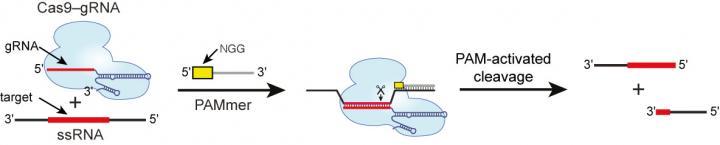
A tool for editing the DNA instructions in a genome can now also be applied to RNA, the molecule that translates DNA's genetic instructions into the production of proteins, according to a team of researchers who demonstrated a means by which the CRISPR/Cas9 protein complex can be programmed to recognize and cleave RNA at sequence-specific target sites. 

A team led by biochemist Jennifer Doudna or Lawrence Berkeley National Lab showed how the Cas9 enzyme can work with short DNA sequences known as "PAM," for protospacer adjacent motif, to identify and bind with specific site of single-stranded RNA (ssRNA). They are designating this RNA-targeting CRISPR/Cas9 complex as RCas9.