Banner
Here's Where Your Backyard Was 300 Million Years Ago

We may use terms like "grounded" and terra firma to mean stability and consistency but geology...

Convergent Evolution Cheat Sheet Now 120 Million Years Old

One tenet of natural selection is a random walk of genes but nature may be more predictable than...

Synchrotron Could Shed Light On Exotic Dark Photons

There are many hypothetical particles proposed to explain dark matter and one idea to explore how...

The Pain Scale Is Broken But This May Fix It

Chronic pain is reported by over 20 percent of the global population but there is no scientific...

User picture.
News StaffRSS Feed of this column.

News Releases From All Over The World, Right To You... Read More »

Blogroll

There's evidence that a child's future health is influenced by more than just their parents' genetic material and can be impacted by environmental factors, but what is being done with that is something of a concern.

Astronomers have produced new maps of the material located between the stars in the Milky Way, which could move science closer to cracking a stardust puzzle nearly a century old.

 The researchers say their work demonstrates a new way of uncovering the location and eventually the composition of the interstellar medium—the material found in the vast expanse between star systems within a galaxy. 

This material includes dust and gas composed of atoms and molecules that are left behind when a star dies. The material also supplies the building blocks for new stars and planets.

Laser physicists have found a way to make atomic-force microscope probes 20 times more sensitive, using laser beams to cool a nanowire probe to minus 265 degrees Celsius. 

Atomic force microscopes achieve extraordinarily sensitivity measurements of microscopic features by scanning a wire probe over a surface.
The technique makes it capable of detecting forces as small as the weight of an individual virus.

The development could be used to improve the resolution of atomic-force microscopes, which are the state-of-the-art tool for measuring nanoscopic structures and the tiny forces between molecules.

Transport accounts for an up to 30% of CO2 emissions in the EU, with estimates claiming that emissions from that sector rose 36% between 1990 and 2007. 

A new analysis conducted by Lund University and the University of Surrey takes on the widely-held view that new technologies, such as biofuel and improved aircraft design, will result in carbon reduction targets being met. 

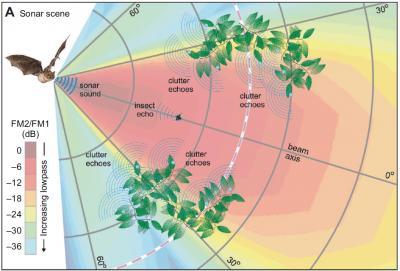
How people and animals focus on distinct objects within cluttered scenes is a long-standing neuroscience debate and a great deal of research has looked to the way bats "see" with their ears for answers.

There has been discussion among cosmologists about galileons, a hypothetical class of effective scalar fields which are extremely universal and arise generically in describing the short distance behavior of the new degrees of freedom introduced during the process of modifying gravity, and in describing the dynamics of extra dimensional brane worlds.  They might be able to explain dark matter - no cosmological constant needed.

Despite prolific use of the term 'theory', they are math that hopes to become physics.