Banner
Here's Where Your Backyard Was 300 Million Years Ago

We may use terms like "grounded" and terra firma to mean stability and consistency but geology...

Convergent Evolution Cheat Sheet Now 120 Million Years Old

One tenet of natural selection is a random walk of genes but nature may be more predictable than...

Synchrotron Could Shed Light On Exotic Dark Photons

There are many hypothetical particles proposed to explain dark matter and one idea to explore how...

The Pain Scale Is Broken But This May Fix It

Chronic pain is reported by over 20 percent of the global population but there is no scientific...

User picture.
News StaffRSS Feed of this column.

News Releases From All Over The World, Right To You... Read More »

Blogroll

Scientists have altered key biological events in red blood cells, causing the cells to produce a form of hemoglobin normally absent after the newborn period.

Because this hemoglobin is not affected by the inherited gene mutation that causes sickle cell disease, the cell culture findings may give rise to a new therapy for the debilitating blood disorder. Their approach uses protein-engineering techniques to force chromatin fiber, the substance of chromosomes, into looped structures that contact DNA at specific sites to preferentially activate genes that regulate hemoglobin. 

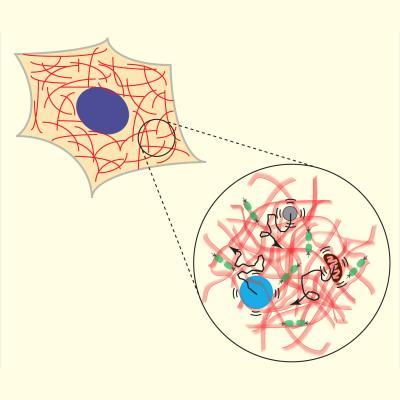
The cytoplasm of mammalian cells is a viscous fluid, with organelles and proteins jiggling against one another and drifting at random.

Yet a new biophysical study finds that those drifting objects are subject to a very different type of environment than what we have thought.

The cytoplasm is actually an elastic gel, it turns out, so it puts up some resistance to simple diffusion. But energetic processes elsewhere in the cell—in the cytoskeleton, especially—create random but powerful waves in the cytoplasm, pushing on proteins and organelles alike. Like flotsam and jetsam buffeted by the wakes of passing ships, suspended particles scatter much more quickly and widely than they would in a calm sea.

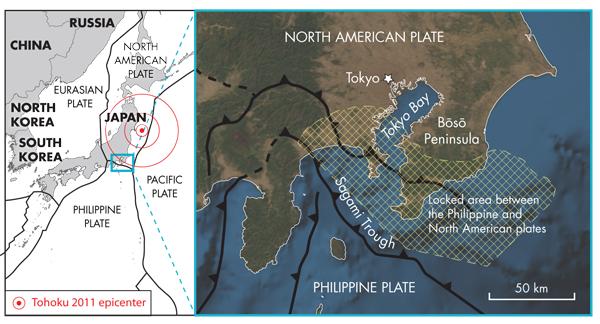
Tokyo is a city of more than 13 million people and they are no strangers to earthquakes. The city, like much of Japan, has been devastated by earthquakes in the past and likely will be again - but when?

Ongoing slow-slip earthquakes can't usually be felt at the surface but they play a role in relieving or building up geological stress and recent research examining plate movements under Tokyo has found that, since the massive magnitude-9 Tohoku earthquake and tsunami in March 2011, recurrence intervals for non-damaging slow-slip quakes beneath Japan's capital have shortened. 

This has led some seismologists to wonder if this aseismic creep could be signaling a countdown to Tokyo's next "big one."

Hematopoietic stem cells (HSCs) are adult stem cells isolated from blood or bone marrow that can renew themselves and differentiate into a variety of specialized cells. They give rise to all other blood cell types but their development has long remained a mystery.

In a new paper, researchers elaborate upon a crucial signaling pathway and the role of key proteins, which may help clear the way to generate HSCs from human pluripotent precursors, similar to advances with other kinds of tissue stem cells.  

Not popular on Twitter? You may think it's because you're too honest. Unless you are a celebrity, popularity instead seems to come from conforming to social norms and expectations, so science journalists will complain about Republicans a lot, entertainment journalists will pretend to care about the Kardashians and New York Times journalists will pretend they like having spontaneous social media participation in their job descriptions.

Given the perceived importance of social media, it's no surprise Aalto University found that users admitted faking parts of their online image in order to conform to social norms and expectations. But in looking at Facebook and Last.fm, they instead came to the conclusion that being real is much more acceptable according to social norms.

There are positive aspects of work but some people are unable to detach from it – they work excessively and compulsively. They are workaholics; not like the kind of people who use the term because they work a lot and self-diagnose with psychological fads on an annual basis, but truly compulsive