Banner
Here's Where Your Backyard Was 300 Million Years Ago

We may use terms like "grounded" and terra firma to mean stability and consistency but geology...

Convergent Evolution Cheat Sheet Now 120 Million Years Old

One tenet of natural selection is a random walk of genes but nature may be more predictable than...

Synchrotron Could Shed Light On Exotic Dark Photons

There are many hypothetical particles proposed to explain dark matter and one idea to explore how...

The Pain Scale Is Broken But This May Fix It

Chronic pain is reported by over 20 percent of the global population but there is no scientific...

User picture.
News StaffRSS Feed of this column.

News Releases From All Over The World, Right To You... Read More »

Blogroll

A new paper has found that two broad-spectrum systemic insecticides, fipornil and imidacloprid, may be impacting honeybees.

Fipronil, part of the phenylpyrazole chemical family, is a highly effective insecticide which can be applied at very low doses for everything from crop to veterinary pests. Imidacloprid is in the class of chemicals called neonicotinoids - it mimics nicotine, which can be toxic to sucking insects like fleas and termites but has no effect on mammals.
 

Tuber melanosporum - black or Périgord truffles - are fungi that grow in symbiosis with the roots of oak and hazelnut trees. In the world of haute cuisine, they are expensive and highly prized.

Epigenetics is the study of changes in gene expression caused by mechanisms other than changes in the DNA sequence.
In the world of epigenetics, black truffles are of major interest because of their unique pattern of DNA methylation, a biochemical process that chemically modifies nucleic acids without changing their sequence. 

A newly published reports on the truffle's unique genetic makeup.

Mercury is a naturally occurring element and a part of human enterprises like burning coal and making cement and compact fluorescent light bulbs.

Knowing how much of both natural and unnatural mercury is bioavailable - uptaken by animals and humans— is important in international agreements to protect humans and the environment from mercury emissions and establishing public policies behind warnings about seafood consumption. Yet little is known about how much mercury in the environment is the result of human activity, or even how much bioavailable mercury exists in the global ocean.

Wikipedia is a free, online, user-generated database of articles on topics and people. Because of its popularity, it has become the default first link in Google search, which means it is frequently read and cited, making it even more authoritative in Google search.

There are numerous problems with the veracity of content, deliberate vandalism and incomplete entries - the Science 2.0 entry, for example, has been repeatedly hijacked and reverted by one user and the first reference is from a Wired article written in 2012 even though Science 2.0 came into existence in 2006. There are no links to Science 2.0 and that user even refuses to allow mention that it is a registered trademark and in the US and the European Union.

Miles of linked habitat sounds like a good thing - until the ants show up.

Environmentalists who promote the notion of unintended consequences regarding genetic modification never considered that wildlife corridors might have risks also - but they do, as a recent study showed. Julian Resasco and colleagues at the University of Florida found that one type of fire ant used wildlife corridors to dominate recently created landscapes.

"Although habitat corridors are usually beneficial, they occasionally have negative effects," Resasco said."Sometimes they can help invasive species spread in exactly the same way they help native species."

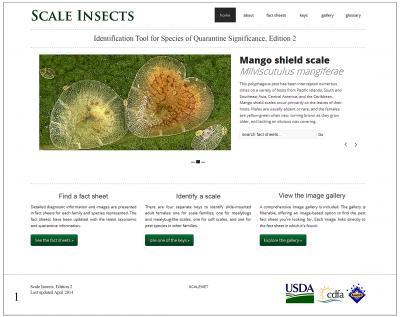
In order to keep outwanted immigrants, the United States Department of Agriculture and California Department of Food and Agriculture joined efforts and built an online tool for identification - of alien and potentially invasive species from all over the world.

Scales are small insects that feed by sucking plant juices. They can attack nearly any plant and cause serious damage to many agricultural and ornamental plants. While native scales have natural enemies that generally keep their populations in check, invasive species often do not, and for this reason many commercially important scale pests in the United States are species that were accidentally introduced.