Banner
Here's Where Your Backyard Was 300 Million Years Ago

We may use terms like "grounded" and terra firma to mean stability and consistency but geology...

Convergent Evolution Cheat Sheet Now 120 Million Years Old

One tenet of natural selection is a random walk of genes but nature may be more predictable than...

Synchrotron Could Shed Light On Exotic Dark Photons

There are many hypothetical particles proposed to explain dark matter and one idea to explore how...

The Pain Scale Is Broken But This May Fix It

Chronic pain is reported by over 20 percent of the global population but there is no scientific...

User picture.
News StaffRSS Feed of this column.

News Releases From All Over The World, Right To You... Read More »

Blogroll

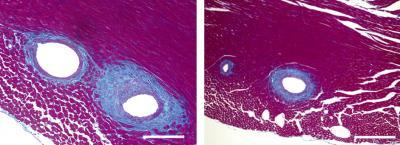
Too much dietary fat is bad for the heart, everyone knows that by now, but not all fats are equal. The right kind of fat keeps the heart healthy, and a paper in The Journal of Experimental Medicine shows how it works.

Unlike saturated fats discussed in popular media, unsaturated dietary fatty acids, such as eicosapentaenoic acid (EPA), are known to protect against cardiovascular diseases. However, the mechanism and the specific fat metabolites responsible for this protection were unknown. 

A team of researchers made a seminal breakthrough in understanding the molecular basis of fibroadenoma, one of the most common breast tumors diagnosed in women. Led by Professors Teh Bin Tean, Patrick Tan, Tan Puay Hoon and Steve Rozen, the team used advanced DNA sequencing technologies to identify a critical gene called MED12 that was repeatedly disrupted in nearly 60% of fibroadenoma cases. 

A new single-cell technique can help investigate how the environment affects our development and the traits we inherit from our parents. It can be used to map all of the 'epigenetic marks' on the DNA within a single cell,which will boost understanding of embryonic development, enhance clinical applications like cancer therapy and even reduce the number of mice used in research.

"She'll grow out of it," used to be a common phrase about raising kids, meaning it wasn't anything that was wrong physically or in upbringing, it is just the diversity of human existence. Some kids develop later. But in today's hyper-diagnosis culture, researchers have wanted to figure out if that old saying was true, or just wishful thinking.

A  study of 473 sets of twins followed since birth has found that, compared to single-born children, 47 percent of 24-month-old identical twins had language delay compared to 31 percent of non-identical twins. Overall, twins had twice the rate of late language emergence of single-born children. None of the children had disabilities affecting language acquisition. 

Teaching remains more art than science and a popular conjecture that has caught the attention of the education business has been that fourth grade is when students stop learning to read and start reading to learn.  People love to swap terms around that way. But is it accurate?

A new paper in Developmental Science says there is nothing special about fourth grade at all, there is no change in automatic word processing, a crucial component of that reading shift conjecture. Instead, some types of word processing become automatic before fourth grade, while others don't switch until after fifth.

Woodrats lost their ability to eat toxic creosote bushes after antibiotics killed their gut microbes. Woodrats that never ate the plants were able to do so after receiving fecal transplants with microbes from creosote-eaters, University of Utah biologists found.

The new study confirms what biologists long have suspected: bacteria in the gut – and not just liver enzymes – are "crucial in allowing herbivores to feed on toxic plants," says biologist Kevin Kohl, a postdoctoral researcher and first author of a new paper in Ecology Letters.