Banner
Here's Where Your Backyard Was 300 Million Years Ago

We may use terms like "grounded" and terra firma to mean stability and consistency but geology...

Convergent Evolution Cheat Sheet Now 120 Million Years Old

One tenet of natural selection is a random walk of genes but nature may be more predictable than...

Synchrotron Could Shed Light On Exotic Dark Photons

There are many hypothetical particles proposed to explain dark matter and one idea to explore how...

The Pain Scale Is Broken But This May Fix It

Chronic pain is reported by over 20 percent of the global population but there is no scientific...

User picture.
News StaffRSS Feed of this column.

News Releases From All Over The World, Right To You... Read More »

Blogroll

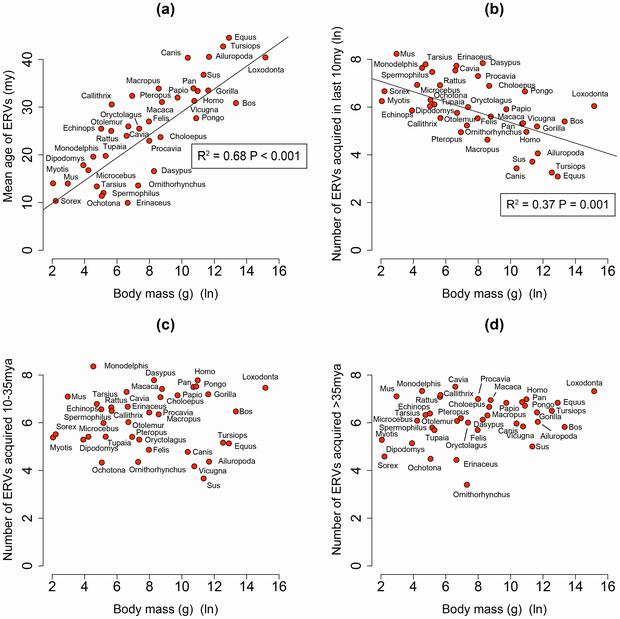
The relics of ancient viruses preserved in the genomes of 38 mammal species have provided insight into cancer’s ‘footprint’ on our evolution.

Viral relics are evidence of the ancient battles our genes have fought against infection. Occasionally the retroviruses that infect an animal get incorporated into that animal’s genome and sometimes these relics get passed down from generation to generation – termed ‘endogenous retroviruses’ (ERVs). Because ERVs may be copied to other parts of the genome they contribute to the risk of cancer-causing mutations.

Despite decades of concern about a looming population bomb and mass starvation, American agriculture has instead 'dematerialized' in a material world: using science, farmers are now feeding more people on less land than ever thought possible.

If science were similarly accepted in Europe and developing nations. we could easily feed 3 billion more people and still decrease agriculture's environmental footprint, according to a paper in Science.

A new small-scale sociology survey finds that the more a woman self-identifies with her profession, the more paid hours she works and the less time she spends with her children, though childcare balance is more equal between a couple. 

Yet the more a woman identifies herself with motherhood, the less time the father spends with the children. And while the more a man self-identifies as a parent the more time he spends with children, this had no impact on the amount of time the woman spends on childcare – regardless of her self-identity.  

A new study has found a way to prevent some of the most serious foodborne illnesses caused by pathogenic bacteria, like
Escherichia coli (E. coli): cinnamon.

A new paper in Food Control suggests Cinnamomum cassia oil can work effectively as a natural antibacterial agent in the food industry - that's welcome news for organic food, which has higher risks of spreading bacteria like E. coli

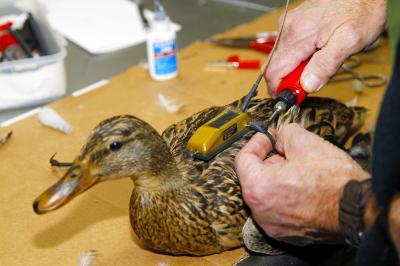
During the 2011 and 2012 migration seasons, University of Missouri researchers monitored mallard ducks using satellite tracking, the first time ducks have been tracked closely during the entirety of their migration from Canada to the American Midwest and back.

They found that as mallards travel hundreds of miles across the continent, they use public and private wetland conservation areas extensively, which  illustrates the importance of maintaining protected wetland areas.

Evidence from human famines and animal studies suggests that starvation can affect the health of descendants of famished individuals, but how such an acquired trait might be transmitted from one generation to the next?

A new study involving roundworms finds that starvation induces specific changes in small RNAs and that these changes are inherited through at least three consecutive generations, apparently without any DNA involvement. The paper in Cell offers new evidence that the biology of inheritance is more complicated than previously thought.