Banner
Here's Where Your Backyard Was 300 Million Years Ago

We may use terms like "grounded" and terra firma to mean stability and consistency but geology...

Convergent Evolution Cheat Sheet Now 120 Million Years Old

One tenet of natural selection is a random walk of genes but nature may be more predictable than...

Synchrotron Could Shed Light On Exotic Dark Photons

There are many hypothetical particles proposed to explain dark matter and one idea to explore how...

The Pain Scale Is Broken But This May Fix It

Chronic pain is reported by over 20 percent of the global population but there is no scientific...

User picture.
News StaffRSS Feed of this column.

News Releases From All Over The World, Right To You... Read More »

Blogroll

Optogenetics is a technology that allows scientists to control brain activity by shining light on light-sensitive proteins that can suppress or stimulate electrical signals within cells.  In the last 15 years,  optogenetics has become a common laboratory tool for shutting off or stimulating specific types of neurons in the brain, allowing neuroscientists to learn much more about their functions. 

Chlorinated chemicals perform a host of societally useful functions, but they're not perfect. Once their use life has ended, they can become environmental contaminants and even resistant to bioremediation.

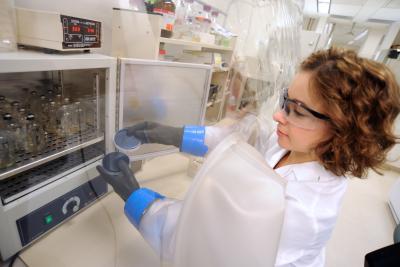
In a series of new studies, Anca Delgado, a researcher at Arizona State University's Biodesign Institute, examines unique groups of microorganisms, capable of converting hazardous chlorinated chemicals like trichloroetheene (TCE) into ethene, a benign end product of microbial biodegradation. The new studies explore the metabolic activities of a group of microbes known as Dehalococcoides, and propose strategies to improve their effectiveness for environmental cleanup projects involving chlorinated chemicals.

Girls and boys learn to use language differently, according to a new study which found that girls were more likely to remember words while boys were more likely to create words and sentences in ‘real-time’.

Language scholars believe language uses both a mental dictionary and a mental grammar. The mental ‘dictionary’ stores sounds, words and common phrases, while mental ‘grammar’ involves the real-time composition of longer words and sentences. For example, making a longer word ‘walked’ from a smaller one ‘walk’. Most research into understanding how these processes work has been carried out with adults.
A new study in mice shows that even short-term consumption of a Western diet rich in saturated fats and fructose is more damaging for healthy liver development than following a high fat diet alone, which provides new insight into the effects of adding fructose to a Western diet high in fat. 

Dr. Susanna Iossa, who led the study at the University of Naples, Italy, said, “This result points to the harmful effect of adding fructose to the usual western, high-fat diet and, together with other related findings, should stimulate the discussion on the use of fructose and fructose-containing sweeteners in beverages and packaged foods.

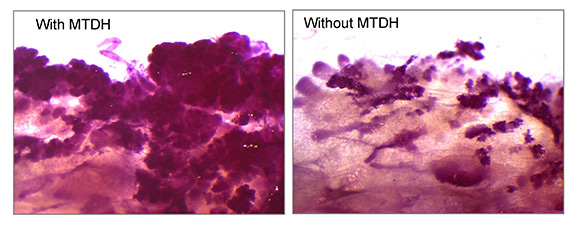
The gene Metadherin - MTDH - which is implicated in promoting the spread of breast cancer tumors, only stimulates tumor growth when the protein made by the gene interacts with a second protein known as SND1, according to a paper in Cancer Cell.

Invasive breast cancer strikes 1 in 8 women and causes roughly 40,000 deaths each year in the United States. About 20 percent of women with breast cancer go on to develop tumors that spread throughout body, are resistant to chemotherapy, and are often fatal.

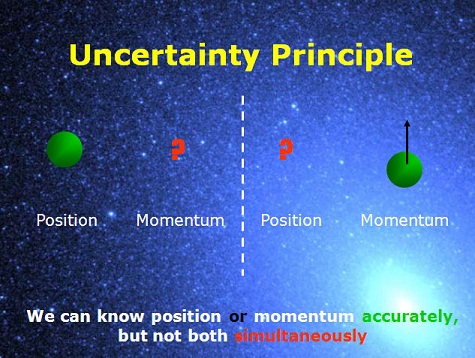
In quantum physics, you can't precisely measure momentum and position simultaneously. They are an example of conjugate variables, connected by Heisenberg's Uncertainty Principle. There are workarounds, such as "weak measurement," to measure both at the same time but a new study says that a technique called compressive sensing also offers a way to measure both variables at the same time, without violating the Uncertainty Principle.