Banner
Here's Where Your Backyard Was 300 Million Years Ago

We may use terms like "grounded" and terra firma to mean stability and consistency but geology...

Convergent Evolution Cheat Sheet Now 120 Million Years Old

One tenet of natural selection is a random walk of genes but nature may be more predictable than...

Synchrotron Could Shed Light On Exotic Dark Photons

There are many hypothetical particles proposed to explain dark matter and one idea to explore how...

The Pain Scale Is Broken But This May Fix It

Chronic pain is reported by over 20 percent of the global population but there is no scientific...

User picture.
News StaffRSS Feed of this column.

News Releases From All Over The World, Right To You... Read More »

Blogroll

You wouldn't think that mechanical force, like kicking a ball in the World Cup or embossing letters on a credit card, could process nanoparticles more subtly than the most advanced chemistry but a current paper in Nature Communications describes a now patented method to use simple pressure — a kind of high-tech embossing — to produce finer and cleaner results in forming silver nanostructures than do chemical methods.

All without harmful byproducts to dispose of.

How bad is western music? Chimps in a study published by the Journal of Experimental Psychology: Animal Learning and Cognition preferred silence - yet they liked music from Africa.

And music from India. What is the reason for that?

Music in the east is structured differently, notation is everything from Swara Kalana to Chôngganbo, but African music is not all that different. Why would chimps like it more? It may be tempo. The current findings say this may be the first to show that they display a preference for particular rhythmic patterns. If the authors aren't sure, none of the rest of the world can be.

You can't coddle kids or their brains too much. Without a little bit of frustration and stress, they would never learn how to talk or read or do science. Without some physical stress, we would all be crawling from place to place.

Stress helps us learn, adapt and cope. But too much stress, such as from neglect or abuse, can be toxic. A team of University of Wisconsin-Madison researchers writing in Biological Psychiatry recently showed these kinds of stressors, experienced in early life, might be changing the parts of developing children's brains responsible for learning, memory and the processing of stress and emotion.

Scientists working to make gene therapy a reality say they have figured out how to bypass a blood stem cell's natural defenses and efficiently insert disease-fighting genes into the cell's genome.

The drug rapamycin, which is commonly used to slow cancer growth and prevent organ rejection, enables delivery of a therapeutic dose of genes to blood stem cells while preserving stem cell function. The findings in Blood could lead to more effective and affordable long-term treatments for blood cell disorders in which mutations in the DNA cause abnormal cell functions, such as in leukemia and sickle cell anemia.

Methane is a simple molecule, it consists of a carbon atom bound to four hydrogen atoms. 

But it is the key component in the natural gas that has led to lower CO2 emissions in America and due to that it is getting some attention in global warming that was denied it when the cultural focus regarded carbon dioxide as a magic bullet to control the climate. 

Rather than simplistic tales of it being a runaway problem, like in some claims, its status is more positive. It hasn't really gone up even with the boom in natural gas and it has a far shorter life than CO2. It is also a kind of metabolic currency in many ecosystems.

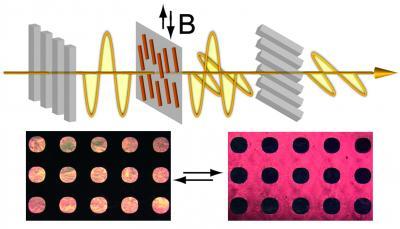
Chemists have constructed liquid crystals with optical properties that can be instantly and reversibly controlled by an external magnetic field and that paves the way for display applications using instantaneous and contactless nature of magnetic manipulation - like a poster that customizes based on the people around it.

Commercially available liquid crystals in electronic displays are composed of rod-like or plate-like molecules. When an electric field is applied, the molecules rotate and align themselves along the field direction, resulting in a rapid tuning of transmitted light.