Banner
Here's Where Your Backyard Was 300 Million Years Ago

We may use terms like "grounded" and terra firma to mean stability and consistency but geology...

Convergent Evolution Cheat Sheet Now 120 Million Years Old

One tenet of natural selection is a random walk of genes but nature may be more predictable than...

Synchrotron Could Shed Light On Exotic Dark Photons

There are many hypothetical particles proposed to explain dark matter and one idea to explore how...

The Pain Scale Is Broken But This May Fix It

Chronic pain is reported by over 20 percent of the global population but there is no scientific...

User picture.
News StaffRSS Feed of this column.

News Releases From All Over The World, Right To You... Read More »

Blogroll

The term "tween" is a marketing colloquialism for a child who is between the ages of 8 and 12 -not quite a little kid but not yet a teenager. A pre-adolescent.

This demographic watches more television than any other age group and is thus considered a lucrative market for advertisers. Tween television programming often consists of the following: "teen scene" and "action-adventure" , which a pair of academics say is shaping stereotypes in tweens rather than reflecting what kids want to watch.

77% of Americans prefer summer over winter and while we know what temperatures actually were this past winter, what people think they were in a recent Harris Poll is something else.

When it came to the temperature, 88 percent of Midwesterners and 84 percent of Easterners say it was colder than normal. 71 percent believe it was while only 18 percent felt it was colder than normal. 45% in the West believe it was warmer than normal.

When it came to precipitation, 77 percent of those in the Midwest, 73 percent in the East and 49 percent say there was more rain or snow in their area. In the West, 62% say they had less rain or snow this winter.

Was the snow due to climate change?
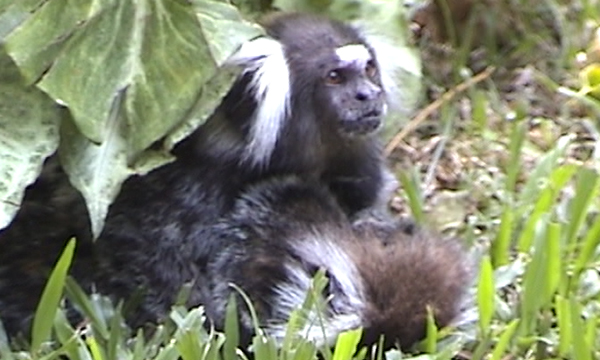
Dr. Bruna Bezerra from the University of Bristol and colleagues have captured video of a wild male marmoset embracing and caring for his dying partner after she accidentally fell from a tree in the Atlantic Forest in the Northeast of Brazil, the first time that compassionate care-taking behavior towards a dying adult group member has been observed in monkeys.

Previously, such behavior was believed to be unique to humans and chimpanzees.

Manure from dairy cows, which is commonly used as a farm soil fertilizer, contains a surprising number of newly identified antibiotic resistance genes from the cows' gut bacteria. The findings, reported in mBio® the online open-access journal of the American Society for Microbiology, hints that cow manure is a potential source of new types of antibiotic resistance genes that transfer to bacteria in the soils where food is grown.

Thousands of antibiotic resistance (AR) genes have already been identified, but the vast majority of them don't pose a problem when found in harmless bacteria. The real worry is when these genes appear in the types of pathogenic bacteria that cause food-borne illnesses or hospital infections.

2,234 adults surveyed online between March 12 and 17, 2014 by The Harris Poll reveal that people are concerned about the environment - but may not be doing much about it.

And over 80 percent avoid labels like “green”, “conservationist” and “environmentalist”, which shows that environmental corporations have lost a lot of credibility among the public. 

However, parents with younger kids are more concerned than childless people, though they are only slightly more likely to tell others to be more environmentally responsible. Women are more likely to indicate encouraging others to be more environmentally-friendly. 25% more women than men claim they are making more effort to be environmentally-conscious than they did a year ago.
We are all familiar with the Mafia. In China, it is the Triads, in Italy it is La Cosa Nostra. You pay for protection or disaster is sure to befall you.

It happens in the bird world too, according to a new report. A bird will lay an egg in your home and you will raise the hatchling or pay the price. Throw the little parasite out and an accident will befall your nest.

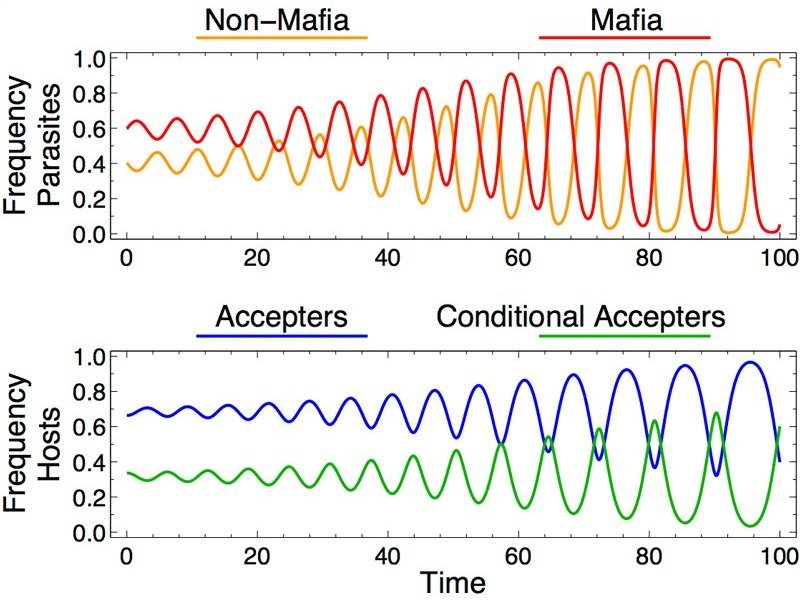
It is a child-rearing strategy, but is it an effective one? Evolutionary biologist Amotz Zahavi postulated the mafia hypothesis back in 1979 and it has been contentious ever since. Critics argue that the retaliation gives the parasites no advantage, carrying high costs instead.

Evolutionary biologists created a mathematical model to find out.