Banner
Here's Where Your Backyard Was 300 Million Years Ago

We may use terms like "grounded" and terra firma to mean stability and consistency but geology...

Convergent Evolution Cheat Sheet Now 120 Million Years Old

One tenet of natural selection is a random walk of genes but nature may be more predictable than...

Synchrotron Could Shed Light On Exotic Dark Photons

There are many hypothetical particles proposed to explain dark matter and one idea to explore how...

The Pain Scale Is Broken But This May Fix It

Chronic pain is reported by over 20 percent of the global population but there is no scientific...

User picture.
News StaffRSS Feed of this column.

News Releases From All Over The World, Right To You... Read More »

Blogroll

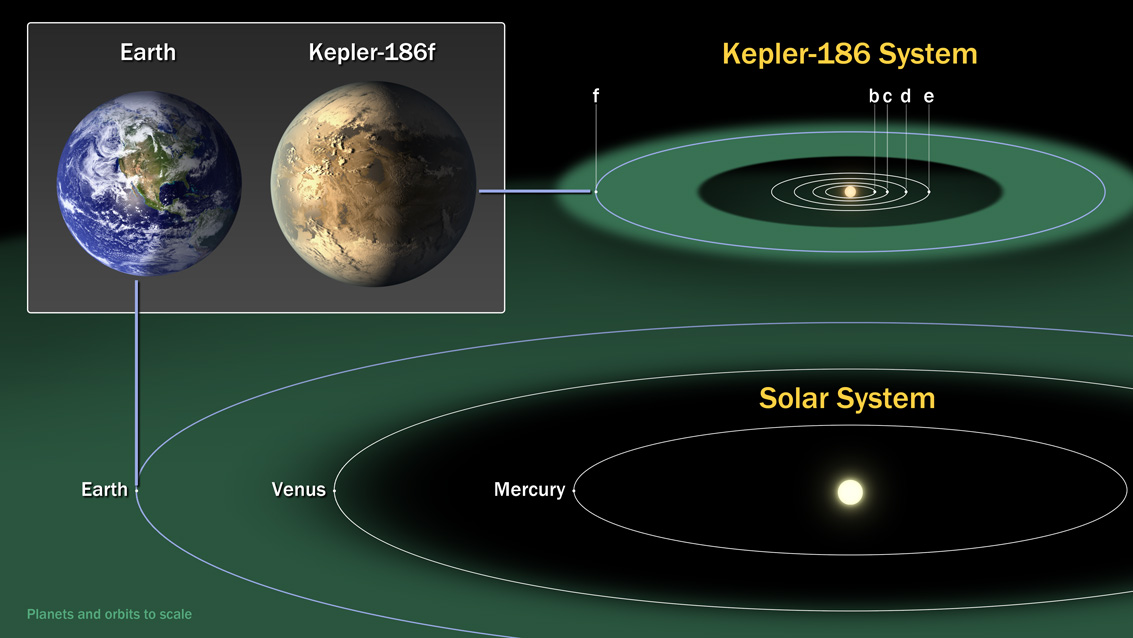
Astronomers using NASA's Kepler Space Telescope report discovery of the first Earth-size planet orbiting a star in the "habitable zone" -- the range of distance from a star where liquid water might pool on the surface of an orbiting planet.

The discovery of Kepler-186f confirms that planets the size of Earth exist in the habitable zone of stars other than our sun. While planets have previously been found in the habitable zone, they are all at least 40 percent larger in size than Earth and understanding their makeup is challenging. Kepler-186f is more reminiscent of Earth.

NEW YORK, NY (April 16, 2014) — The cause of neuronal death in Parkinson's disease is still unknown, but a new study proposes that neurons may be mistaken for foreign invaders and killed by the person's own immune system, similar to the way autoimmune diseases like type I diabetes, celiac disease, and multiple sclerosis attack the body's cells. The study was published April 16, 2014, in Nature Communications.

An international research team has identified a new superbug that caused a bloodstream infection in a Brazilian patient.

The new superbug is part of a class of highly-resistant bacteria known as methicillin-resistant Staphylococcus aureus or MRSA, which is a major cause of hospital and community-associated infections. The superbug has also acquired high levels of resistance to vancomycin, the most common and least expensive antibiotic used to treat severe MRSA infections worldwide.

The world could be less than 40 years away from a food shortage that will have serious implications for people and governments, according to a senior science advisor at the U.S. Agency for International Development. It's not Paul Ehrlich/John Holdren Doomsday Prophet levels of gloom, but it's a sign we need to keep science advancing.

Children with Tourette syndrome may unconsciously train their brain to more effectively control their tics.

How so? A recent study found that teenagers diagnosed with  Tourette syndrome   were slower than typical peers when asked to perform a task that involved them simply moving their eyes to look at targets but buterr when the task was more demanding and required them to choose between looking at or away from targets. They were as fast as their peers but made fewer eye movements in the wrong direction.

Researchers have reported a big improvement in the distance of wireless power.   Their "Dipole Coil Resonant System (DCRS) boosts the extended range of inductive power transfer up to 5 meters between transmitter and receiver coils. 

It's not quite the rumors about Nikola Tesla but if you think that's not a lot, ponder that Bluetooth is only slightly greater after 15 years in progress.