Banner
Here's Where Your Backyard Was 300 Million Years Ago

We may use terms like "grounded" and terra firma to mean stability and consistency but geology...

Convergent Evolution Cheat Sheet Now 120 Million Years Old

One tenet of natural selection is a random walk of genes but nature may be more predictable than...

Synchrotron Could Shed Light On Exotic Dark Photons

There are many hypothetical particles proposed to explain dark matter and one idea to explore how...

The Pain Scale Is Broken But This May Fix It

Chronic pain is reported by over 20 percent of the global population but there is no scientific...

User picture.
News StaffRSS Feed of this column.

News Releases From All Over The World, Right To You... Read More »

Blogroll

If you were a blonde girl or boy captured in a raid a few hundred years ago, you were an exotic luxury item so valuable it was worthwhile to transport you to far-away markets in Asia.

Slave-trading was so common the routes stretched from Finland, the Russian Karelia and the Baltic Countries all the way to the Caspian Sea and central Asia.

Finland to Asia? Rarely, of course. Only the largest merchants, with a buyer already in place, would hire gangs from the Volga to capture people and then hazard that journey. Writing
in Russian History, University of Eastern Finland
Professor Jukka Korpela

There's a disturbing, though funny to outsiders, trend sweeping green conscious corporations on the coasts of the United States - flurries of emails between indignant employees talking about how long their cars have been plugged in.

Though subsidies and public relations campaigns for electric cars are everywhere to be found, improvements in batteries have been absent for decades. Unless we want acid rain to come roaring back, there needs to be an improvement. Electric car companies are not going to spearhead the research, they are enjoying their 1950s-style "planned obsolescence" and have no reason to cause people to buy cars less often.

A larger waist circumference is associated with higher risk of postmenopausal breast cancer, according to a paper by American Cancer Society researchers in Cancer Causes, and Control which disputes previous findings that body shape itself is an independent risk factor for breast cancer. 

A significant body of research has linked abdominal obesity to a number of conditions, including heart disease, type II diabetes, and breast and other cancers. Those studies have led to the belief that having an "apple shaped" body, with weight concentrated in the chest and torso, is riskier than having a "pear-shaped" body, with fat concentrated in the hips, thighs and buttocks. 

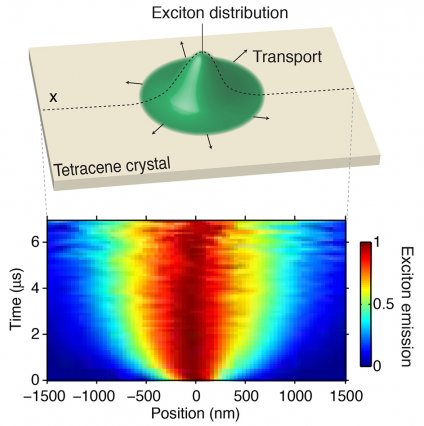
A quasiparticle called the exciton is responsible for the transfer of energy within devices, such as solar cells, LEDs, and semiconductor circuits, and has been understood for decades, but exciton movement within materials has never been directly observed.

Last winter's curvy jet stream pattern brought mild temperatures to western North America and harsh cold to the East and it may have seemed exceptional in the era of 24-hour news, but it's been happening that way for about 4,000 years, according to a new study. 

Since the discovery of the Antarctic ozone hole, scientists, policymakers, and the public have wondered whether we might someday see a similarly extreme depletion of ozone over the Arctic.

A new MIT study finds it isn't a big worry. In the 30 years of international efforts to limit ozone-depleting chemicals, ozone levels in the Arctic haven't yet sunk to Antarctica levels. Picking one solution and declaring it the savior may not be valid; in Canada, ozone-depleting chemicals dropped but ozone still went up, forcing policymakers to scramble and claim it must be coming from Asia.