Banner
Here's Where Your Backyard Was 300 Million Years Ago

We may use terms like "grounded" and terra firma to mean stability and consistency but geology...

Convergent Evolution Cheat Sheet Now 120 Million Years Old

One tenet of natural selection is a random walk of genes but nature may be more predictable than...

Synchrotron Could Shed Light On Exotic Dark Photons

There are many hypothetical particles proposed to explain dark matter and one idea to explore how...

The Pain Scale Is Broken But This May Fix It

Chronic pain is reported by over 20 percent of the global population but there is no scientific...

User picture.
News StaffRSS Feed of this column.

News Releases From All Over The World, Right To You... Read More »

Blogroll

This news release is available in French.

Montreal, March 5, 2014 — There are clear benefits to raising a bilingual child. But could there be some things learning a second language doesn't produce, such as a more open-minded youngster?

New research from Concordia University shows that, like monolingual children, bilingual children prefer to interact with those who speak their mother tongue with a native accent rather than with peers with a foreign accent.

Imagine driving on a dark road. In the distance you see a single light. As the light approaches it splits into two headlights. That's a car, not a motorcycle, your brain tells you.

A new study found that neural circuits in the brain rapidly multitask between detecting and discriminating sensory input, such as headlights in the distance. That's different from how electronic circuits work, where one circuit performs a very specific task. The brain, the study found, is wired in way that allows a single pathway to perform multiple tasks.

Inspired by this embryonic induction mechanism, Ingber and Basma Hashmi, a Ph.D. candidate at SEAS who is the lead author of the current paper, set out to develop a way to engineer artificial teeth by creating a tissue-friendly material that accomplishes the same goal. Specifically, they wanted a porous sponge-like gel that could be impregnated with mesenchymal cells, then, when implanted into the body, induced to shrink in 3D to physically compact the cells inside it.

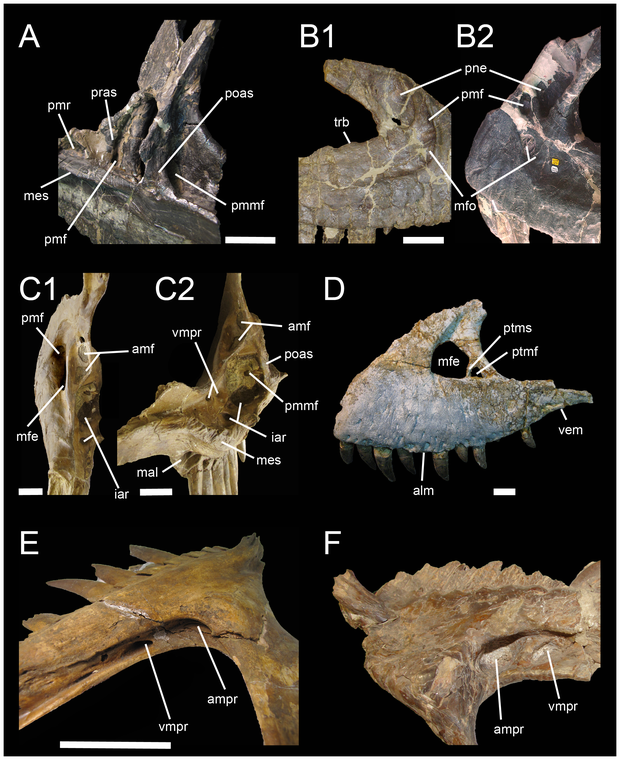
A new dinosaur species found in Portugal is one of the largest carnivorous dinosaurs from the Jurassic period - and may be the largest land predator discovered in Europe - 30 feet long and weighing up to 5 tons.

Scientists discovered bones belonging to this dinosaur north of Lisbon. They were originally believed to be Torvosaurus tanneri, a dinosaur species from North America. Closer comparison of the shin bone, upper jawbone, teeth, and partial tail vertebrae suggest to the authors that it may warrant a new species name, Torvosaurus gurneyi.

Research in The New England Journal of Medicine and Human and Molecular Genetics journals finds that mutation in the STAG3 gene is the major cause of human fertility disorders, as it provokes a loss of function of the protein it encodes. 

STAG3 encodes a meiosis-specific subunit of the cohesin ring, the biological process through which, from a diploid somatic cell, a haploid cell or gamete is produced.

Cohesins are protein complexes that bind two straps of DNA and are implicated in its repair, replication and recombination, as well as in its chromosomal stability, transcription regulation, stem-cell pluripotency, and cell differentiation.


Genetic study in a family

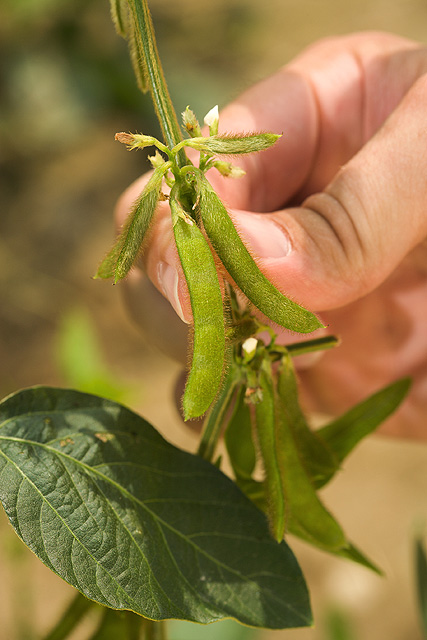
Soybeans are a tremendously successful crop and a new study that traced the genetic changes in varieties over the last 80 years of soybean breeding found that increases in yield gains and an increased rate of gains over the years are largely due to the continual release of greater-yielding cultivars.  

Some are concerned that converging on optimal crops for each region might be a bad thing but plentiful food tells a different story.