Banner
Pilot Study: Fibromyalgia Fatigue Improved By TENS Therapy

Fibromyalgia is the term for a poorly-understood condition where people experience pain and fatigue...

High Meat Consumption Linked To Lower Dementia Risk

Older people who eat large amounts of meat have a lower risk of dementia and cognitive decline...

Long Before The Inca Colonized Peru, Natives Had A Thriving Trade Network

A new DNA analysis reveals that long before the Incan Empire took over Peru, animals were...

Mesolithic People Had Meals With More Tradition Than You Thought

The common imagery of prehistoric people is either rooting through dirt for grubs and picking berries...

User picture.
News StaffRSS Feed of this column.

News Releases From All Over The World, Right To You... Read More »

Blogroll

The evolution of the complex, weight-bearing hips of walking animals from the basic hips of fish was a much simpler process than previously thought, according to a new paper.

Tetrapods, four-legged animals, first came to land about 395 million years ago - a significant step, literally and figuratively, and it was made possible by strong hipbones and a connection through the spine via an ilium, features that were not present in the fish ancestors of tetrapods. 

The drug candidate J147 was able to reverse memory deficits and improve several aspects of brain function in mice with advanced symptoms of Alzheimer's disease, according to a new study.  

Unique cellular and molecular mechanisms behind tooth renewal in American alligators may help science learn how to stimulate tooth regeneration in people, according to a new study.

We regenerate teeth now. We grow baby teeth and then we replace those with adult teeth.  Yet most vertebrates can replace teeth throughout their lives and we cannot, despite the lingering presence of dental lamina, a band of epithelial tissue crucial to tooth development. Because alligators have well-organized teeth with similar form and structure as mammalian teeth and are capable of lifelong tooth renewal, the authors reasoned that they might serve as models for mammalian tooth replacement. 

Detecting alien worlds is a significant challenge since they are small, faint, and close to their stars. The two most prolific techniques for finding exoplanets are radial velocity (looking for wobbling stars) and transits (looking for dimming stars). 

A team at Tel Aviv University and the Harvard-Smithsonian Center for Astrophysics (CfA) has just discovered an exoplanet and the planet they found, Kepler-76b, was identified by the BEER algorithm; an acronym for relativistic BEaming, Ellipsoidal, and Reflection/emission modulations. BEER was developed by Professor Tsevi Mazeh and his student, Simchon Faigler, at Tel Aviv University in Israel and is a new method that relies on Einstein's special theory of relativity.

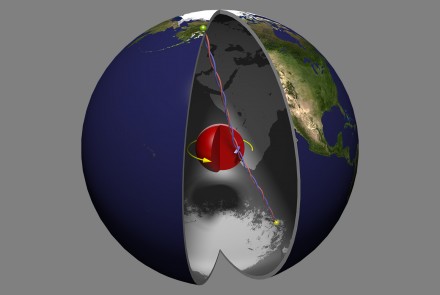
We all know that the Earth is in constant motion, rotating beneath our feet, but new research in Nature Geoscience reveals that the center of the Earth is out of sync with the rest of the planet and is frequently speeding up and slowing down.

Associate Professor Hrvoje Tkalcic from the ANU College of Physical and Mathematical Sciences and his team used earthquake doublets to measure the rotation speed of Earth’s inner core over the last 50 years and discovered that not only did the inner core rotate at a different rate to the mantle – the layer between the core and the crust that makes up most of the planet’s interior – but its rotation speed was variable.
Rather than Draconian measures to cut emissions, which will impact people in various regions and economic spheres unfairly, a better solution may be to simply keep places cooler on hot days, which will reduce fuel needed for air conditioning.

And outer space can help, Stanford researchers say. They designed an entirely new form of cooling structure that cools even when the sun is shining - by reflecting sunlight back into the chilly vacuum of space.