Banner
Pilot Study: Fibromyalgia Fatigue Improved By TENS Therapy

Fibromyalgia is the term for a poorly-understood condition where people experience pain and fatigue...

High Meat Consumption Linked To Lower Dementia Risk

Older people who eat large amounts of meat have a lower risk of dementia and cognitive decline...

Long Before The Inca Colonized Peru, Natives Had A Thriving Trade Network

A new DNA analysis reveals that long before the Incan Empire took over Peru, animals were...

Mesolithic People Had Meals With More Tradition Than You Thought

The common imagery of prehistoric people is either rooting through dirt for grubs and picking berries...

User picture.
News StaffRSS Feed of this column.

News Releases From All Over The World, Right To You... Read More »

Blogroll
People communicate in bursts. In communication, our behavior does not happen in a homogenous way over time, but rather there is universal behavior in which there is no communication, followed by short intervals, says a new study.

A new study analyzed around 9,000 million calls throughout a nearly one year period and identified  features of the communication process and attempted to quantify their impact in the diffusion of information.  
Everyone agrees what the LHC needs is more art.

Okay, no one actually thinks that.  What the LHC needs is to find a Higgs boson or a whole bunch of Europeans outside physics are going to be annoyed they spent $10 billion to find the "God particle" and will now be told 'we advanced science by not finding it'.   Most people don't think in terms of negatives, they think in terms of positives, so in a bad economy the political questions will be 'why did we spend billions of Euros to confirm the non-existence of something a lot of physicists didn't think existed anyway?'
The Encyclopedia of Life (EOL), a free, online collaborative tool, is expanded in its second edition released today, offering information on more than one-third of all known species on Earth.

EOLv2  has 20 times as many pages as when the EOL.org first launched in 2008 - 700,000 today. The global partnership of 170 content providers behind EOL.org wants to build a site with 1.9 million pages, one for every species known to science. 

Breast-feeding mothers are far more likely to demonstrate a 'mama bear' effect', aggressively protecting their infants and themselves , than women who bottle-feed their babies or who are non-mothers, says a new study in Psychological Science.

To help mama bear out, breast-feeding mothers register lower blood pressure than other women when behaving aggressively - the researchers say suggests breast-feeding helps dampen the body’s stress response to fear; breast-feeding mothers are more likely to be courageous.
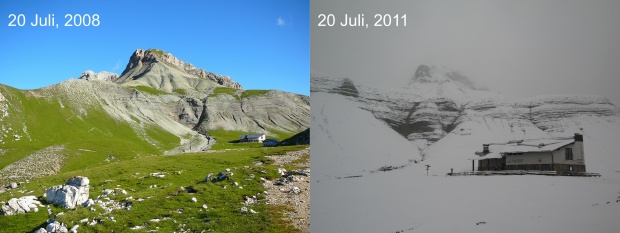
Mountains sure aren´t what they used to be. Take  the Dolomites in the Veneto Region of Italy and Austria; 140 to 90 million years ago, they were part of the sea floor rather than mountains. 

Over millions of years, deposits were then formed from calcareous shells of marine life from the Mesozoic era. Tectonic forces later caused these sediments to rise upward to the mountaintops of today´s well-known and popular Southern Alps. The mountain range contains one of the most complete and most accessible geological records - also being one of the richest in fossils - from the Cretaceous period in Europe. This record was scientifically analyzed in-depth for the first time within the framework of a project supported by the Austrian Science Fund FWF.

Bias in science academia is a big topic, but it's selective.  If there are fewer women, it is regarded as a hostile environment but if there are no Republicans that is their choice.  

Penn State researchers have added something new into the mix - hormones.  If you are a woman who wanted to be a physicist, you may have been fighting your own sex hormones to do it, they say.  They did it by looking at people's interest in occupations that exhibit sex differences in the general population and are relevant to science, technology, engineering and mathematics (STEM) careers.