Banner
Pilot Study: Fibromyalgia Fatigue Improved By TENS Therapy

Fibromyalgia is the term for a poorly-understood condition where people experience pain and fatigue...

High Meat Consumption Linked To Lower Dementia Risk

Older people who eat large amounts of meat have a lower risk of dementia and cognitive decline...

Long Before The Inca Colonized Peru, Natives Had A Thriving Trade Network

A new DNA analysis reveals that long before the Incan Empire took over Peru, animals were...

Mesolithic People Had Meals With More Tradition Than You Thought

The common imagery of prehistoric people is either rooting through dirt for grubs and picking berries...

User picture.
News StaffRSS Feed of this column.

News Releases From All Over The World, Right To You... Read More »

Blogroll
If you are worried about big changes in Arctic sea ice, you are not alone - but it is hard to know how much is worth worrying about.  If you are worried, there is some slightly good news - even if we lose half, it will not be a 'point of no return' according to a new study.

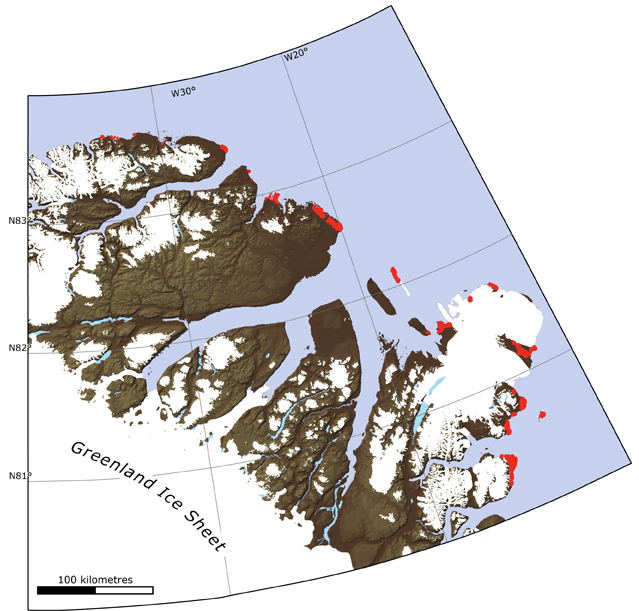
Sea ice comes and goes without leaving a record so our knowledge about variations and extent was limited before we had satellite surveillance and observations from airplanes and ships.  Not any more.  Researchers at The Centre for Geogenetics at the Natural History Museum of Denmark, University of Copenhagen say have developed a method by which it is possible to measure the variations in the ice several millennia back in time.
Psychology does not usually lend itself to live experimentation but the The American Psychological Association intends to change that perception.    They are featuring three public demonstrations of psychological science applications at their annual convention this week.

The goal: to show practical uses of psychological research and how it can be of great service to individuals and society as a whole.
A new non-deformed energy storage phase change material (PCM) can retain and release heat according to specific temperature requirements - a breakthrough that might make a significant difference to the cost of heating and cooling buildings.

If, for example, the required optimum temperature in a room is 22°C, the material can be fixed so that it starts absorbing any excess heat above that temperature.  The heat-regulating material looks like a circular tablet with the circumference of a large coin in the laboratory and can be manufactured so small that it can be sprayed as an unobtrusive microscopic film on surfaces and could be applied anywhere, from walls and roofs to wallpaper.

The future of networking may mean streaming high-definition movies at blazing fast speeds and the routers are the lights in the room.

Scientists at the Fraunhofer Institute for Telecommunications, Heinrich Hertz Institute HHI in Berlin, Germany, have developed a new transfer technology for video data and were able to transfer data at a rate of 100 megabits per second (Mbit/s), without any losses, using LEDs in the ceiling that light up more than ten square meters (90 square feet). 

"This means that we transferred four videos in HD quality to four different laptops at the same time," says Dr. Anagnostis Paraskevopoulos from the HHI.

The hormone oxytocin may be the "cuddle chemical" but recent research has found that oxytocin can promote negative emotions too.

Salespeople love oxytocin - they think if they spray it on customers will trust them more.  Mothers bond with babies due to oxytocin.  It's positive effects are well known but studies have also found that oxytocin can increase gloating and envy.

Molecules of oxygen have been found in the nearby Orion star-forming complex, the first undisputed detection of oxygen molecules in space.   Previous missions looking for the molecular variety, two atoms of oxygen bonded together, had been fruitless.

Yet as interesting as the discovery is, it leads to a bigger question; the observed amount of atomic oxygen is far less than expected.  Where is all the oxygen hiding in the cold clouds?

Dark oxygen, anyone?