Banner
Pilot Study: Fibromyalgia Fatigue Improved By TENS Therapy

Fibromyalgia is the term for a poorly-understood condition where people experience pain and fatigue...

High Meat Consumption Linked To Lower Dementia Risk

Older people who eat large amounts of meat have a lower risk of dementia and cognitive decline...

Long Before The Inca Colonized Peru, Natives Had A Thriving Trade Network

A new DNA analysis reveals that long before the Incan Empire took over Peru, animals were...

Mesolithic People Had Meals With More Tradition Than You Thought

The common imagery of prehistoric people is either rooting through dirt for grubs and picking berries...

User picture.
News StaffRSS Feed of this column.

News Releases From All Over The World, Right To You... Read More »

Blogroll
The social impairment of people with Autism Spectrum Disorders (ASD) can have a profound impact on quality of life. 

As part of their research, Eastern Virginia Medical School scientists say they have verified that a specific mouse strain, known as the BALB/c mouse, is a valid animal model of the limited sociability seen in persons with Autism.   In the presence of another mouse, BALB/c mice move as far away as possible and do not interact as normal mice do,  they say in much the same way people with autism often avoid making social contact with other people.
As if neurotic people weren't already neurotic enough, they now have to be neurotic knowing their relationships and marriages have a lot more difficulty.

But a new study says if neurotic newlyweds have more sex, their marital satisfaction is as high as less neurotic counterparts.  That's a science result we can all get behind!

Neuroticism to eroticism


Neuroticism is the tendency to experience negative emotion and people who are high in it get upset easily, change their mood often and worry frequently. People who score high in neuroticism are also less satisfied in romance and relationships, and when they get married they are more likely to divorce.
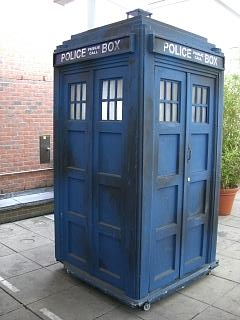
Doctor Who is always getting into some pickle or another.  Luckily he has advanced technology (and a time traveling police box/telephone booth) to help solve problems.

If defeating Daleks and keeping a temperamental TARDIS functional is in your future, we have good news;  Doctor Who's trusty sonic screwdriver gadget could become a reality for DIY types, according to Bristol University engineers who are out to show how a real life version of the fictional screwdriver, which uses sonic technology to open locks and undo screws, could be created.

In the midst of all the lamentations that their isn't enough spending on science outreach (read: grants to do it rather than simply doing it, like we do here) or enough spending on turning people who want to be veterinarians (insert any alternative career choice here) into scientists, young people who want to excel in science are still doing it, just like they always have.

Guerin Catholic High School senior Mark Babbey is co-author of a paper in Physical Review A on the properties of quantum particles that hop from site to site on a chain in which one site can absorb them and another can emit them, known as a PT-symmetric chain. 
Why does religion still exist?  It is something we have pondered many times because its demise has been predicted for centuries.    It turns out that religious people are happier, studies show, and that makes sense; answers to otherwise unsolvable puzzles are comforting and if you've ever been to an 'skeptic' conference, the only times they are happy are when they are making fun of religion so, technically, religion even makes atheists happier.
The RMS Titanic, which hit an iceberg and sank in 1912 and then was found by searchers in 1977, still has a few mysteries left.   

A brand-new bacterial species dubbed Halomonas titanicae by scientists from Dalhousie University in Halifax and the University of Sevilla, was found aboard the Titanic and is contributing to its deterioration. 

The researchers isolated the
Halomonas titanicae micro-organisms from a 'rusticle' collected from the Titanic, 3.8 km below the ocean surface.