Future technology such as quantum cryptography and computation, or perhaps even larger scale teleportation, requires a deeper understanding of the phenomenon known as "entanglement", the quantum non-local connection, an aspect of quantum theory at the heart of the EPR paradox developed by Einstein, Podolsky and Rosen in 1935 which was experimentally verified in 1980 by Alain Aspect.
Two photons are entangled if the properties of one depend on those of the other, whatever the distance separating them. A new source of entangled photons twenty times brighter than all existing systems has been developed by a team from the Laboratoire de Photonique et de Nano-structures (LPN) of CNRS and they say the device is capable of considerably boosting the rate of quantum communications.
Women are waiting until their 30s and 40s to have children, but when they decide to do so, they are a lot more willing to engage in a variety of sexual activities to capitalize on their remaining childbearing years, according to new research by psychologists at The University of Texas at Austin.
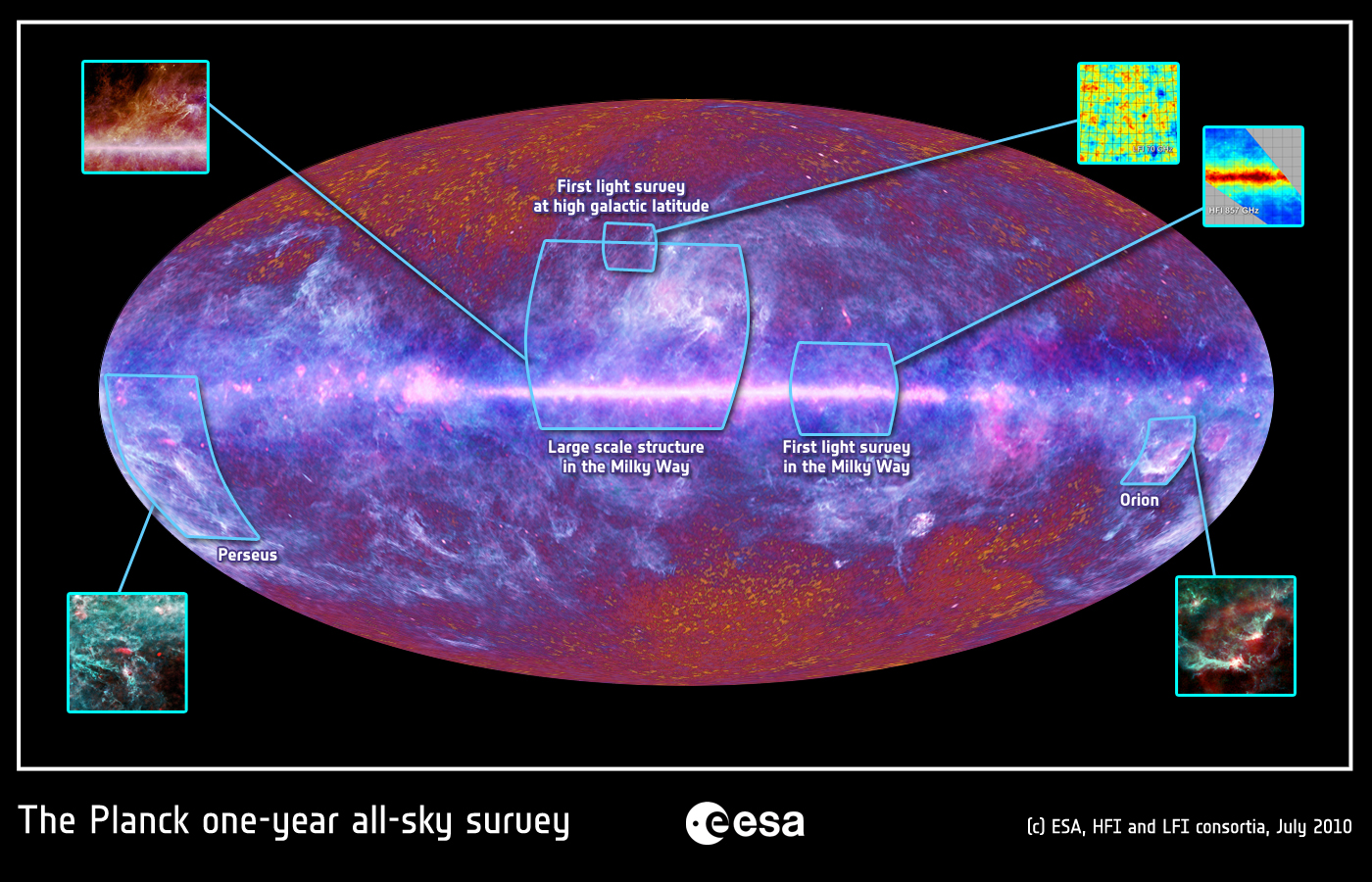
ESA’s Planck mission is a 'time machine' to study the relic radiation from the Big Bang, and it has delivered its first all-sky image, one of four all-sky scans it will complete by the end of its mission in 2012.
Planck is designed to map tiny irregularities in fossil radiation left over from the very first light in the Universe, emitted shortly after the Big Bang, and has enough sensitivity to reach the experimental limits of what can be observed, allowing researchers to peer into the early Universe and study its constituents, perhaps even the hypothetical dark matter and dark energy that continue to be a debate among the science community worldwide.
Brain stem cells remain dormant until needed to make more neurons but little is known about the molecular guards that keep them quiet - or 'wake' them up.
Scientists from the Salk Institute for Biological Studies say they have identified the signal that prevents stem cells from doing too much proliferating, a move that protects the brain against too much cell division and ensuring a pool of neural stem cells that lasts a lifetime.
Researchers have shown a new ability to control the behaviors of individual electrons within simple atoms and molecules by stripping them away, one by one, and in some cases creating 'hollow atoms'.
The results describe how the Linac Coherent Light Source's intense pulses of X-ray light change the very atoms and molecules they are designed to image. Controlling those changes will be critical to achieving the atomic-scale images of biological molecules and movies of chemical processes that the LCLS is designed to produce.
By optimizing magnets, hybrid and electric cars can be made economically competitive, according to a research project currently underway at St. Pölten University of Applied Sciences in Austria.
Their project is seeking to find the ideal composition and structure of high-performance permanent magnets intended for use in cars, a move which can help conserve raw materials and they say the ideal designs can be identified quickly and without major expense, thanks to numerical simulation methods.


 Pilot Study: Fibromyalgia Fatigue Improved By TENS Therapy
 High Meat Consumption Linked To Lower Dementia Risk
 Long Before The Inca Colonized Peru, Natives Had A Thriving Trade Network
 Mesolithic People Had Meals With More Tradition Than You Thought