Babies can grasp information about numbers, space and time before they can speak, and they do so in more complex ways than previously realized, according to new research.
In 1890 William James wrote in "The Principles of Psychology" that the baby's impression of the world as "one great blooming, buzzing confusion." But modern evidence indicates otherwise.
Babies understand quantity quite well, say Emory University psychologist Stella Lourenco and University College London neuroscientist Matthew Longo, and so much earlier than thought.
There are two aspects to food research; an industry one, where food additives that can make food taste more or less sweet without calories have benefits, and a therapeutic one, like treating patients who over eat.
Lutetia is a large, primitive asteroid left on the shelf for billions of years, presumably because no planet consumed it as the Solar System formed. Most measurements affirm this, making the asteroid out to be a 'C-type', which contains primitive compounds of carbon, but some others suggest that Lutetia is an 'M-type', which could mean there are metals in its surface.
If the second is true, it could be a real find in space science because although metallic asteroids do exist, they are thought to be fragments of the metallic core of larger asteroids that have since been shattered into pieces. If Lutetia is made of metal or even contains large amounts of metal, the traditional asteroid classification scheme may need rethinking.
In vitro fertilization (IVF) resulted in the first 'test tube baby' in 1978 and now an estimated 1% of all American babies born each year has happened thanks to in vitro fertilization - wonderful for parents with reproductive issues but IVF and other assisted fertility treatments may be creating one problem by solving another, according to new research from Tel Aviv University.
Polar science will continue to have a global impact, whether you believe in man-made climate change or not, says an expert.
Global warming was always an unfortunate use of 'framing' by policy-oriented scientists who were out of their league and political groups looking to mobilize their base. Climate change was always the issue and change can mean warming ... which leads to cooling.
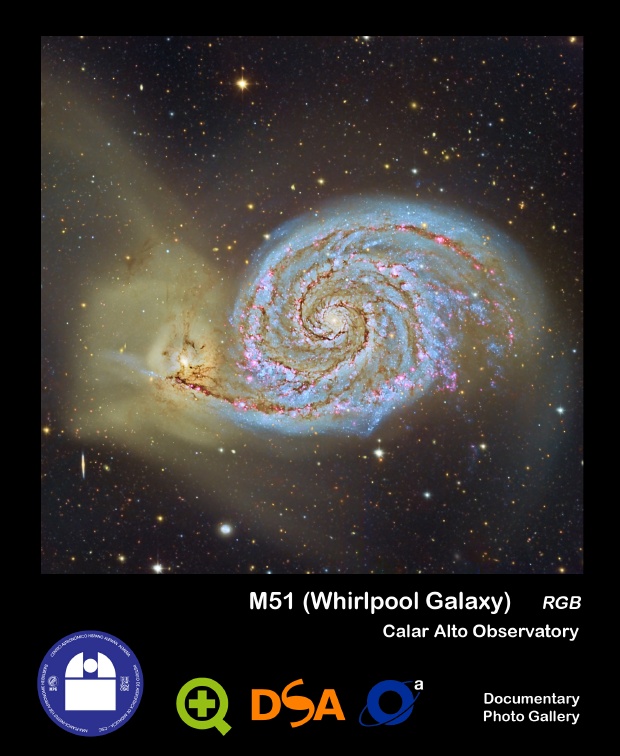
Galaxy M51, now called the Whirlpool Galaxy, was discovered by Charles Messier in 1773 but its spiral structure was first found by William Parsons in 1845, using his huge (and wonderfully named) reflecting telescope called the Leviathan of Parsonstown. Today even small amateur telescopes can see that this galaxy is not isolated, but has a small companion, a dwarf irregular galaxy NGC 5195.
These two stellar systems are colliding and the spiral shape of M51 is due to the tidal forces unleashed during this process. At a distance of 23 millions of light-years, the apparent dimensions of M51 mean that that galaxy has to be quite similar to our own, yet somewhat smaller.


 Pilot Study: Fibromyalgia Fatigue Improved By TENS Therapy
 High Meat Consumption Linked To Lower Dementia Risk
 Long Before The Inca Colonized Peru, Natives Had A Thriving Trade Network
 Mesolithic People Had Meals With More Tradition Than You Thought