Banner
Pilot Study: Fibromyalgia Fatigue Improved By TENS Therapy

Fibromyalgia is the term for a poorly-understood condition where people experience pain and fatigue...

High Meat Consumption Linked To Lower Dementia Risk

Older people who eat large amounts of meat have a lower risk of dementia and cognitive decline...

Long Before The Inca Colonized Peru, Natives Had A Thriving Trade Network

A new DNA analysis reveals that long before the Incan Empire took over Peru, animals were...

Mesolithic People Had Meals With More Tradition Than You Thought

The common imagery of prehistoric people is either rooting through dirt for grubs and picking berries...

User picture.
News StaffRSS Feed of this column.

News Releases From All Over The World, Right To You... Read More »

Blogroll

Each day the humans are confronted with a variety of pathogens. Most of them are fended off by our immune system. 

For a successful infection, bacteria must deliver so-called virulence factors through a transport channel located in the bacterial membrane.  Scientists from the Max Planck Society and the Federal Institute for Materials Research and Testing have shown how in some bacteria this transport channel is formed like a syringe, enabling them to inject virulence factors directly into the host cell - an important starting point for the development of new drugs that might interfere considerably earlier than antibiotics in the course of infection. 


A new strain of bacteria  can produce non-toxic, comparatively inexpensive rhamnolipids and effectively help degrade polycyclic aromatic hydrocarbons, or PAHs – the environmental pollutants that are one of the most harmful aspects of oil spills.

The findings on this new bacterial strain, NY3, of a common bacteria that has been known of for decades, called Pseudomonas aeruginosa, that degrades the PAHs in oil and other hydrocarbons were just published in Biotechnology Advances by researchers from Oregon State University and two collaborating universities in China.   Because of some unique characteristics, this new bacterial strain could be of considerable value in the long-term cleanup of the massive Gulf Coast oil spill caused by BP.

The 2010 World Cup will be watched online by nearly a third of British football fans, according to a survey released today by PC World. They questioned over 3,000 Brits in the run up to the World Cup following a surge in sales of its wireless networking and video streaming gadgets.

What did they find?

 30% of fans, which equates to over 14 million of those expected to watch the World Cup live, are planning on doing so over the Internet.

Nearly a quarter (23%) revealed they would be using laptops or desktop PCs.

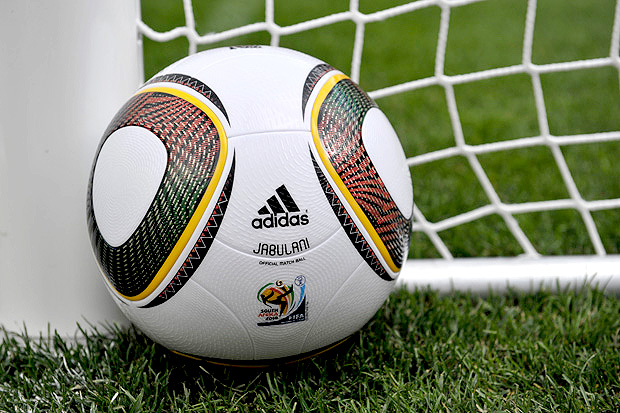
Players, most loudly in Brazil, are not happy with the Jabulani ball in use for World Cup 2010 and have made no secret about it recently - despite it being in use for months.    There hasn't been this much controversy over a World Cup ball since ... well ... the last World Cup, when the ball was called too smooth.

So will things get even weirder since the 2010 ball has new ridges and grooves?    They sure will, say physics experts at the University of Adelaide who believe the new Jabulani ball will play "harder and faster", bending even more unpredictably than its predecessor.

But why, and what will it mean for the World Cup?
No one says, "I am in favor of pollution" but how would anyone know who really cares?   Body language, claims a new book.

Professor Geoff Beattie, from The University of Manchester, says mismatches between gestures and speech will allow us to identify ‘green fakers’, regardless of what they actually say.

His research for the Sustainable Consumption Institute used video recordings to examine the gestures and speech of people with differing views on the environment while they talked about carbon labeling, global warming and their lifestyles.  By examining their gestures, each speaker showed a connection between what they were saying and what they actually believed, Beattie says.
How geeky do you have to be to attend a mathematical meeting every 4 years - and think India in August is a cool place to do it?   Pretty geeky.   The ultimate geeks.

If that is you, we know where you will be August 2010, when the largest gathering of geeks ever will happen in Hyderabad.   It's the International Congress of Mathematicians, the biggest and most prestigious international mathematical meeting, which takes place once every four years. No meeting in any scientific discipline has the kind of wide sweep that ICMs have: every branch of mathematics is covered and emphasis is on the essential unity of all mathematics.