Banner
Pilot Study: Fibromyalgia Fatigue Improved By TENS Therapy

Fibromyalgia is the term for a poorly-understood condition where people experience pain and fatigue...

High Meat Consumption Linked To Lower Dementia Risk

Older people who eat large amounts of meat have a lower risk of dementia and cognitive decline...

Long Before The Inca Colonized Peru, Natives Had A Thriving Trade Network

A new DNA analysis reveals that long before the Incan Empire took over Peru, animals were...

Mesolithic People Had Meals With More Tradition Than You Thought

The common imagery of prehistoric people is either rooting through dirt for grubs and picking berries...

User picture.
News StaffRSS Feed of this column.

News Releases From All Over The World, Right To You... Read More »

Blogroll
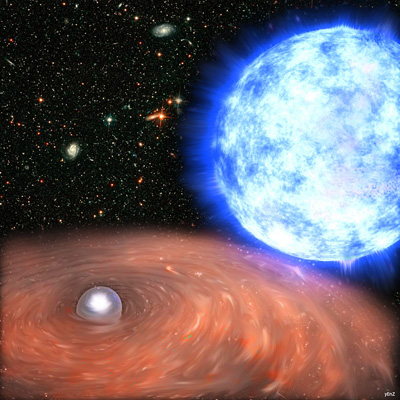
ESA's XMM-Newton orbiting X-ray telescope has uncovered the first close-up of a white dwarf star, circling a companion star, that could explode into a particular kind of supernova.

Well, in a few million years.

Astronomers use these supernovae as beacons to measure cosmic distances and could one day help us understand the expansion of the Universe.   They've been on the trail of this particular mystery object since 1997 when they discovered that something was giving off X-rays near the bright star HD49798. Now the mysterious object has been tracked along its orbit and observation has shown it to be a white dwarf, the dead heart of a star, shining X-rays into space.  
 
Stanford scientists say they will reinvent digital photography with the introduction of an 'open-source' digital camera.

If the technology catches on, camera performance will be no longer be limited by the software that comes pre-installed by the manufacturer because virtually all of the features of the Stanford camera – focus, exposure, shutter speed, flash, etc – are at the command of software that can be created by inspired programmers anywhere. "The premise of the project is to build a camera that is open source," said computer science professor Marc Levoy.
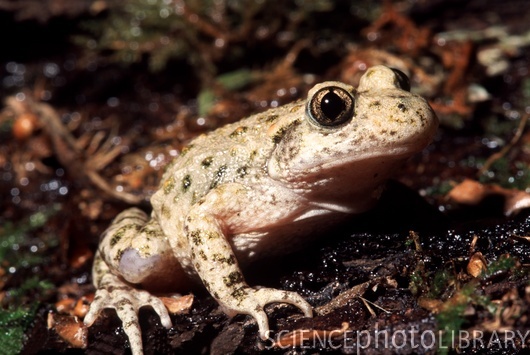
Should early 20th century researcher Paul Kammerer be credited as the founder of epigenetics?   It would certainly be a dramatic change from current perceptions of his work.

Kammerer, a leading proponent of the Lamarckian theory of evolution, achieved global prominence in the 1920's by arguing that acquired traits could be passed down through generations and, in his most controversial experiment,  forced land dweller midwife toads to live in water. Their offspring preferred to live and mate in water and by the third generation he noted that they began to develop black nuptial pads on their forelimbs, a feature common to water dwelling species.
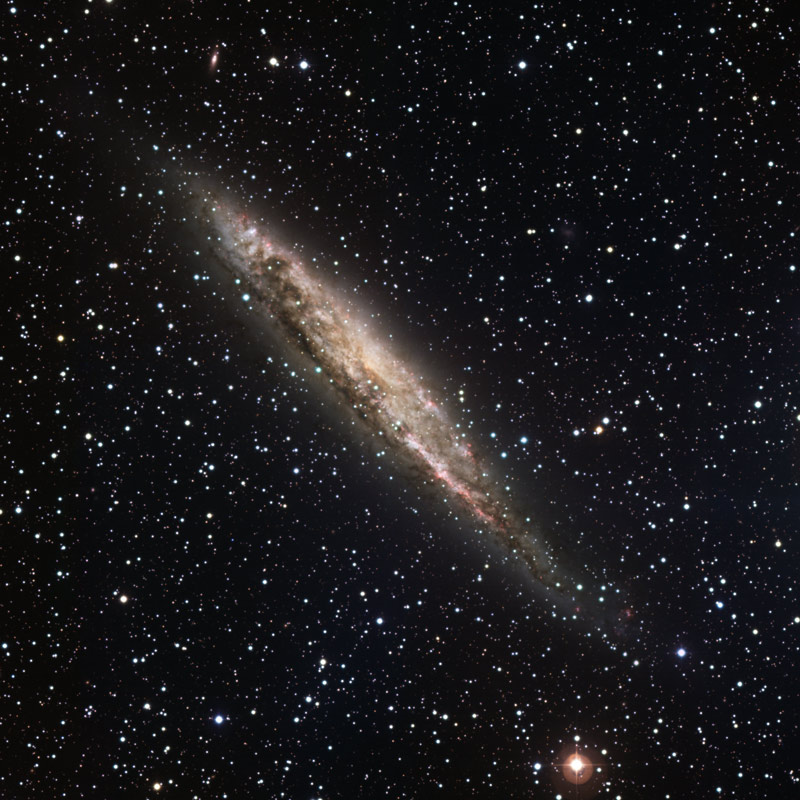
A new image of nearby galaxy NGC 4945 shows that it looks a lot like our own Milky Way.

NGC 4945 seems to be a spiral galaxy with swirling, luminous arms and a bar-shaped central region, though NGC 4945 has a brighter center that likely harbors a supermassive black hole which is devouring reams of matter and blasting energy out into space.
One component of interstellar clouds emitting unusual infrared light known as the Unidentified Infrared Bands (UIRs) is a gaseous version of naphthalene, the chief component of mothballs back on Earth, according to research led by Michael Duncan, Regents Professor of Chemistry at the University of Georgia, along with doctoral student Allen Ricks and Gary Douberly, now an assistant professor in the department of chemistry at UGA.

The UIRs have been seen by astronomers for more than 30 years, but no one has ever identified what specific molecules cause these patterns. 
The Eastern Seaboard had higher than normal sea levels in June and July and a new NOAA technical report blames persistent winds and a weakened current in the Mid-Atlantic . 

After observing water levels six inches to two feet higher than originally predicted, NOAA scientists began analyzing data from select tide stations and buoys from Maine to Florida and found that a weakening of the Florida Current Transport—an oceanic current that feeds into the Gulf Stream—in addition to steady and persistent Northeast winds, contributed to this anomaly.